Shandong Qilu lndustrial Co.,Ltd.

Your Guide to the Forging Manufacturing Process
Welcome to My Blog!
Before we dive into the content, I’d love for you to join me on my social media platforms where I share more insights, engage with the community, and post updates. Here’s how you can connect with me:
Facebook:https://www.facebook.com/profile.php?id=100090903441806
Now, let’s get started on our journey together. I hope you find the content here insightful, engaging, and valuable.
Table of Contents
Introduction
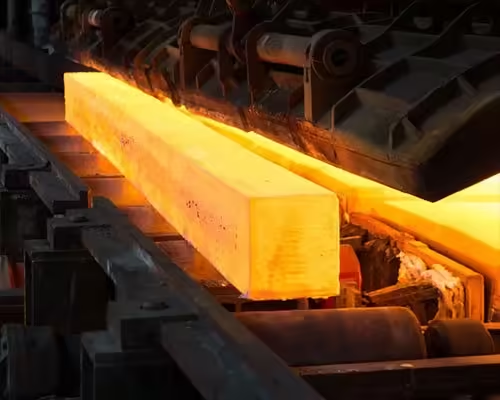
The forging manufacturing process is an essential technique in modern industrial production. By applying compressive forces to metal workpieces, manufacturers can improve strength, structural integrity, and material consistency. Used in aerospace, automotive, construction, and heavy machinery, the forging manufacturing process ensures durability where it matters most.
This comprehensive guide explores every facet of the forging manufacturing process—from core techniques to industry applications—while helping businesses understand why forging remains one of the most dependable fabrication methods.
Understanding the Basics of the Forging Manufacturing Process
Forging involves shaping metal using localized compressive forces. Unlike casting, where molten metal is poured into molds, the forging manufacturing process manipulates solid metal to achieve desired forms and properties.
Forging can be performed at various temperatures—cold, warm, or hot—depending on the material and intended application. Each method offers distinct mechanical benefits and cost implications.
Qilu specializes in delivering high-quality forgings such as shafts, rings, and discs, using state-of-the-art facilities and rigorous quality control measures.
Common Types of Forging Methods
Open-Die Forging
In open-die forging, metal is deformed between flat or simply shaped dies. This process is ideal for large parts and allows for continuous manipulation and refinement of the metal structure.
Closed-Die Forging
Also known as impression-die forging, this method uses dies that enclose the workpiece entirely, resulting in highly accurate and repeatable components. It’s widely used in automotive and aerospace manufacturing.
Seamless Rolled Ring Forging
This process produces strong, circular components by piercing and rolling a punched metal disk. It’s frequently used in gear manufacturing, bearings, and aerospace applications.
Cold Forging
Performed at or near room temperature, cold forging is economical for small parts, such as bolts and fasteners, due to less energy consumption and reduced material waste.
Table: Comparing Forging Methods and Their Applications
| Forging Method | Operating Temperature | Key Applications | Advantages |
|---|---|---|---|
| Open-Die Forging | Hot | Shafts, cylinders | High strength, large components |
| Closed-Die Forging | Hot or Warm | Automotive parts, aerospace parts | Precision, repeatability |
| Seamless Ring Forging | Hot | Bearings, flanges, gear rings | Toughness, dimensional consistency |
| Cold Forging | Room Temperature | Fasteners, pins | Less material waste, better finish |
Selecting the appropriate method ensures that the forging manufacturing process aligns with your product’s mechanical and commercial requirements.
Equipment Used in the Forging Manufacturing Process
A successful forging operation requires highly specialized machinery and inspection tools. At Qilu, we’ve invested in a full range of forging equipment, ranging from 200 to 4000 tons, allowing for production runs from 1 piece to over 100,000 units.
Common equipment includes:
- Hydraulic presses
- Mechanical presses
- Hammers
- Ring rollers
- Heat treatment furnaces
- CNC machining and inspection systems
Advanced monitoring and quality assurance systems ensure every forged part meets rigorous performance standards.
Quality Control in the Forging Manufacturing Process
Maintaining consistent quality is essential in the forging manufacturing process. Rigorous inspections, non-destructive testing, and metallurgical analysis are all key steps.
At Qilu, we conduct:
- Ultrasonic Testing (UT)
- Magnetic Particle Testing (MPT)
- Hardness and tensile strength tests
- Dimensional inspection using coordinate measuring machines (CMM)
These processes guarantee mechanical reliability and dimensional precision, no matter the scale of production.
Benefits of the Forging Manufacturing Process for Industrial Use
Forging provides a wide range of advantages over casting and machining, especially when strength, fatigue resistance, and grain structure alignment are vital.
- Superior mechanical properties: Increased tensile and fatigue strength
- Improved material efficiency: Less waste and higher yield
- Better surface finish: Especially in cold forging
- Reduced porosity: Enhances structural integrity
- Consistency: Ideal for large production runs
These benefits make forging the ideal choice for high-performance industries such as aerospace, oil & gas, and transportation.
Industry Applications of Forged Metal Components
Forged components are used across diverse industries due to their reliability and performance.
- Aerospace: Turbine rings, engine shafts
- Automotive: Crankshafts, connecting rods
- Construction: Steel columns, lifting gear
- Energy: Wind turbine hubs, pipeline components
- Railway: Axles, wheels, couplings
Qilu’s forged products are built to meet stringent global standards and are shipped worldwide with rapid delivery.
Environmental and Economic Considerations
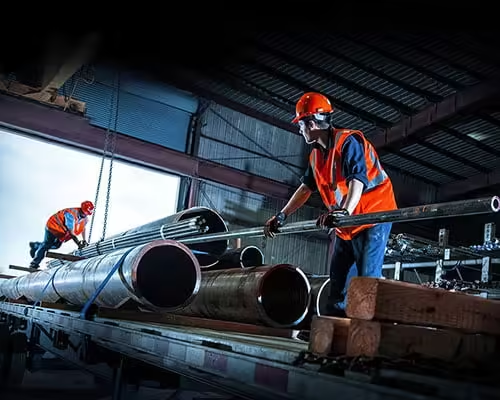
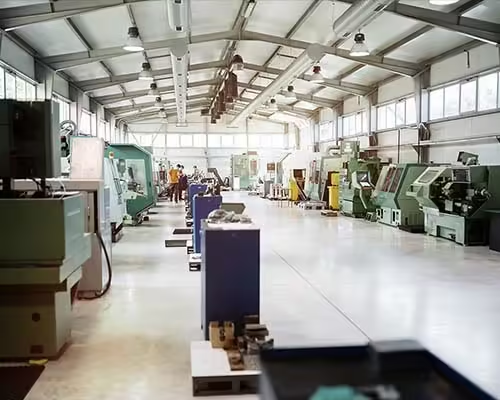
The forging manufacturing process is both energy-efficient and environmentally responsible. Modern forging techniques minimize material waste, require less machining, and reduce emissions compared to casting processes.
Economic advantages include:
- Lower production costs over large volumes
- Enhanced durability reducing maintenance costs
- Scalable output for varying project sizes
By choosing forged solutions, companies benefit from long-term sustainability and cost efficiency.
Conclusion
Understanding the forging manufacturing process empowers businesses to make informed decisions on component selection, production methods, and cost-efficiency. From superior mechanical strength to environmental sustainability, forging is a proven solution for high-performance demands.
At Qilu, we produce high-quality shafts, rings, and disc forgings using cutting-edge technology and a rigorous quality control system. Whether you need a single prototype or mass production, we have the capabilities to deliver.
Looking to enhance your supply chain with precision-forged parts? Contact us today to learn how our forging manufacturing process can meet your project’s exact needs.
FAQ
What is the difference between forging and casting?
Forging shapes solid metal using compressive forces, resulting in better mechanical properties. Casting involves pouring molten metal into molds, which may include porosity and inconsistent grain structures.
How long does the forging manufacturing process take?
The timeline depends on part complexity and volume. With Qilu’s advanced facilities, production can range from days to a few weeks, including quality checks and heat treatment.
Can you forge stainless steel or other specialty alloys?
Yes, the forging manufacturing process is suitable for a wide range of metals, including stainless steel, carbon steel, alloy steel, and more. Each metal type requires specific temperature and handling considerations.
What is the typical lifespan of forged parts?
Forged components often last longer than cast or machined parts due to improved strength and wear resistance. Lifespan depends on usage and maintenance but can exceed several decades in industrial settings.
Is it possible to customize forged parts?
Absolutely. Qilu provides OEM and custom forging services tailored to unique dimensions, specifications, and mechanical performance targets. Customization includes material selection, heat treatment, and finishing.