Shandong Qilu lndustrial Co.,Ltd.

4140 Forging vs. Rolled Steel: Enhancing Fatigue Strength via Microstructure
In high-stress engineering environments, the choice between a 4140 Forging and a rolled counterpart is often the deciding factor between long-term component reliability and catastrophic fatigue failure. While AISI 4140 is a versatile chromium-molybdenum alloy renowned for its toughness, the mechanical performance of the final part is dictated more by the thermo-mechanical processing (TMP) method than by chemical composition alone.
To understand why engineers choose 4140 Forging for critical parts, we must look beyond the surface and analyze how the forging process reshapes the material’s “DNA”—its microstructure.
Table of Contents
Eliminating Internal Porosity: The Compressive Advantage
The primary metallurgical advantage of 4140 Forging lies in its ability to heal internal discontinuities. During the primary ingot casting or continuous casting stage, steel naturally develops microscopic voids, gas pockets, and “centerline porosity” due to solidification shrinkage.
The Forging “Healing” Mechanism
Unlike rolling, which primarily stretches the material longitudinally, 4140 Forging subjects the workpiece to localized, multidirectional compressive forces. These forces effectively collapse internal voids and weld the surfaces of microscopic pores together.
In a technical comparison of forging vs rolling steel, the high reduction ratios in forging ensure that the internal structure is 100% dense. For parts subjected to high-pressure hydraulic cycles or heavy torque, this density is non-negotiable. A 4140 Forging ensures that there are no “hidden” crack initiation points within the core of the component.
Grain Structure of Forged 4140 Steel: Directional Integrity
The most significant differentiator in the forging vs rolling steel debate is the orientation of the grain flow. When steel is rolled, the grains are elongated in a single, unidirectional path. While this is efficient for producing long bars, it creates a “wood-grain” effect that is weak when subjected to transverse loads.
Contour-Following Grain Flow
The grain structure of forged 4140 steel is unique because the forging process reorients the grains to follow the actual geometry of the part. This is known as “directional grain flow.”
When a 4140 forged bar is machined into a gear or a crankshaft, the grain lines curve around the fillets and radii. This mechanical “weaving” provides superior resistance to impact and shear. By aligning the grain structure of forged 4140 steel with the direction of the expected service loads, engineers can significantly reduce the risk of structural cleavage.
Microstructural Refinement and Fatigue Strength
Fatigue failure is the silent killer of industrial machinery, usually starting at the grain boundaries. 4140 Forging excels here through a process called dynamic recrystallization.
Refining the Grain Size
The intense heat and mechanical work involved in 4140 Forging break down large, coarse grains into much finer, equiaxed grains. A finer grain size increases the total surface area of grain boundaries, which acts as a barrier to dislocation movement and crack propagation.
This refinement is exactly why choose forged 4140 for critical parts like landing gear components or oilfield drill collars. The fatigue limit of a 4140 Forging is typically 20-30% higher than that of rolled steel, as the refined microstructure absorbs energy more efficiently during cyclic loading.
Authority Reference: The ASM International Handbook (Volume 14: Forming and Forging) provides extensive data on how forge-induced grain refinement enhances the toughness-to-weight ratio of alloy steels. Source: ASM International – Materials Information
Comparing Mechanical Properties: Forging vs Rolling Steel
While a 4140 forged bar and a rolled bar may share the same datasheet for tensile strength, their “Anisotropy” tells a different story. Rolled steel is highly anisotropic—meaning its properties are significantly lower in the transverse direction than in the longitudinal direction.
Transverse Ductility and Impact Resistance
In 4140 Forging, the multidirectional working reduces this anisotropy. This means the ductility and impact resistance (Charpy V-Notch values) remain consistently high regardless of the loading direction.
If you are designing a part that experiences complex stress states—such as a steering knuckle or a high-pressure valve—relying on a 4140 Forging provides a safety buffer that rolled steel simply cannot match. The structural uniformity of a 4140 forged bar ensures predictable performance under extreme thermal and mechanical stress.
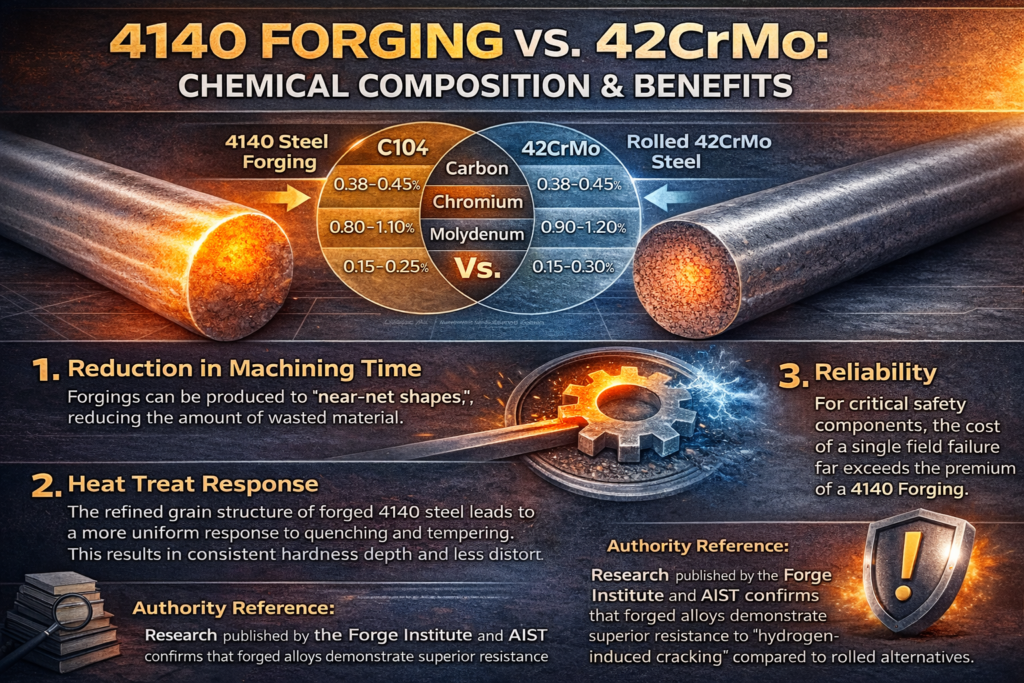
Chemical Composition Difference: 4140 vs. 42CrMo
Beyond the microstructural benefits, the economic reality of 4140 Forging often outweighs the initial material cost of rolling.
1.Reduction in Machining Time: Forgings can be produced to “near-net shapes,” reducing the amount of wasted material.
2.Heat Treat Response: The refined grain structure of forged 4140 steel leads to a more uniform response to quenching and tempering. This results in consistent hardness depth and less distortion.
3.Reliability: For critical safety components, the cost of a single field failure far exceeds the premium of a 4140 Forging.
Authority Reference: Research published by the Forge Institute and AIST confirms that forged alloys demonstrate superior resistance to “hydrogen-induced cracking” compared to rolled alternatives. Source: Association for Iron & Steel Technology
FAQ
Does 4140 Forging eliminate the need for heat treatment?
No. While 4140 Forging improves the grain structure, the material still requires quenching and tempering to achieve specific Rockwell hardness (HRC) levels and tensile properties.
Why is a 4140 forged bar better for high-torque applications?
High torque creates intense shear stress. The continuous, contour-following grain structure of forged 4140 steel provides higher shear strength than the linear, “broken” grain lines of rolled steel.
Is there a significant cost difference between forging vs rolling steel?
Forging has higher tooling costs initially, but for 4140 Forging, the reduction in scrap metal and the increase in part lifespan often lead to a lower “Total Cost of Ownership.”