Shandong Qilu lndustrial Co.,Ltd.

The Engineering Guide to Forged Steel Rectangle: Performance, Process, and Procurement
In the high-stakes environment of heavy industrial manufacturing, material integrity is the dividing line between operational success and catastrophic structural failure. Among the various geometries used in modern engineering, the Forged Steel Rectangle stands out as a critical component for those requiring maximum load-bearing capacity and fatigue resistance.
Unlike standard rolled plates, a Forged Steel Rectangle undergoes a transformative thermo-mechanical process that refines its internal chemistry and physical structure. For engineers sourcing components for aerospace, oil and gas, or heavy machinery, understanding the “why” behind the forging process is the first step in optimizing the lifecycle of their equipment.
Table of Contents
The Physics of the Forging Process
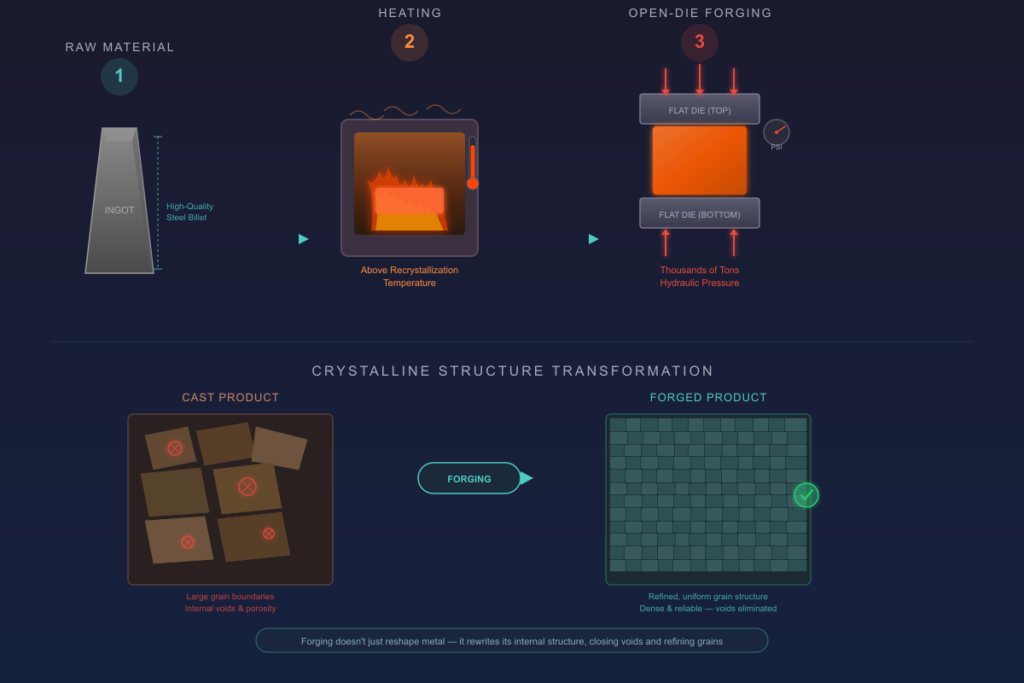
The journey of a Forged Steel Rectangle begins with a high-quality ingot or billet. In the open-die forging process, the metal is heated above its recrystallization temperature and placed between two flat dies. Under massive hydraulic pressure—often reaching thousands of tons—the metal is compressed and shaped.
This process is fundamentally different from rolling or casting. When a facility provides metal forging services, they are not just changing the shape of the metal; they are manipulating its crystalline structure. This “working” of the metal closes internal voids and porosity that are common in cast products, resulting in a significantly denser and more reliable material.
Unmatched Metallurgical Advantages: Grain Flow
The most significant advantage of choosing a Forged Steel Rectangle is the development of directional grain flow. In a casting, the grains are oriented randomly. In a rolled plate, the grains are elongated but can be brittle in the “Z” (thickness) direction.
However, in industrial steel forgings, the grain flow is deliberately oriented to follow the principal geometry of the part. This alignment creates high-tensile forged steel rectangles for industrial machinery that exhibit superior toughness and ductility. This structural “memory” within the steel allows the rectangle to absorb higher impact loads without fracturing along the grain boundaries.
Comparing Materials: A Technical Perspective
While the process remains consistent, the choice of chemistry is vital. A Forged Steel Rectangle can be produced in various grades to meet specific environmental stressors. Whether you require the weldability of carbon steel or the extreme corrosion resistance of stainless alloys, the forging process enhances the base properties of the chosen metal.
Technical Specification Matrix: Forged Material Performance
| Material Category | Common Grades | Core Advantage | Typical Industrial Application |
| Carbon Steel | 1045, A105 | Excellent Machinability | Crankshafts, Gear blanks |
| Alloy Steel | 4140, 4340 | High Fatigue Strength | Oil & Gas valves, Drive shafts |
| Tool Steel | H13, D2, P20 | Thermal Stability | Plastic injection molds, Die sets |
| Stainless Steel | 304, 316, 17-4PH | Corrosion Resistance | Marine hardware, Chemical pumps |
Engineering for the Extremes: Industrial Applications
The adoption of high-tensile forged steel rectangles for industrial machinery is most prevalent in sectors where downtime is not an option. In the mining industry, for instance, the sheer force exerted on shaker screens and crushing equipment requires a material that can withstand billions of cycles of vibration.
Furthermore, in the tooling industry, a Forged Steel Rectangle serves as the foundation for complex die sets. Because the forging process eliminates internal gas pockets, the material can be polished to a mirror finish without the risk of “pinholes” appearing during the final machining stages. This level of purity is essential for high-precision plastic injection molding.
Quality Assurance and Standards Compliance
When procuring industrial steel forgings, compliance with international standards is the primary metric for quality. A reputable provider of metal forging services will always accompany their products with a Mill Test Certificate (MTC).
Key standards that govern the production of a Forged Steel Rectangle include ASTM A694 for carbon and alloy forgings and EN 10222 for pressure purposes. Furthermore, Ultrasonic Testing (UT) is often mandated to ensure that the “heart” of the forged block is free from any internal discontinuities. According to ASTM International, Non-Destructive Testing (NDT) is the only way to guarantee the structural integrity of large-section forgings before they enter service.
Procurement Strategy: Forged vs. Rolled
For procurement managers, the decision often comes down to the initial cost versus the total cost of ownership. While a rolled plate may be cheaper upfront, a Forged Steel Rectangle offers a much higher yield strength-to-weight ratio.
This means that for the same load requirement, a thinner forged section can often replace a thicker rolled section, reducing the overall weight of the machinery. Additionally, the improved machinability of forged structures leads to reduced tool wear and faster cycle times in the CNC shop, further offsetting the initial material premium.
Customization and Near-Net Shapes
One of the most overlooked aspects of metal forging services is the ability to produce “near-net shapes.” A Forged Steel Rectangle can be forged to dimensions very close to the final part requirements.
This reduction in “black skin” or “scale” means that less material needs to be turned into chips during machining. In an era of rising material costs and sustainability mandates, minimizing scrap through precision forging is both an economic and environmental advantage.
Conclusion
As we have explored, the Forged Steel Rectangle is more than just a block of metal; it is a highly engineered product designed for the most demanding environments on earth. By leveraging professional metal forging services, manufacturers can ensure that their equipment is built on a foundation of metallurgical excellence.
Whether you are designing the next generation of subsea valves or upgrading your facility’s heavy-duty presses, the structural consistency of industrial steel forgings provides the peace of mind that only comes from superior manufacturing.
FAQ
Is there a maximum thickness for a forged rectangle?
Most open-die forges can produce rectangles up to 1000mm in thickness, though the maximum depends on the total weight capacity of the forging press.
How does forging affect the hardness of the steel?
Forging itself does not significantly change hardness, but the dense structure allows for much more uniform results during subsequent Quench and Temper heat treatments.
Can I get a forged rectangle in a pre-machined state?
Yes. Many suppliers provide “Rough Machining” services, which square up the Forged Steel Rectangle to within a few millimeters of your final dimensions.
What is the lead time for custom industrial steel forgings?
Depending on the material grade, lead times typically range from 3 to 6 weeks, which includes forging, heat treatment, and testing.
Does forging improve the weldability of the steel?
Because forging removes internal impurities and gas pockets, the resulting weld zones tend to be much cleaner and less prone to “hydrogen cracking” than cast alternatives.