Shandong Qilu lndustrial Co.,Ltd.

Why Temperature for Forging Steel Matters Most
Welcome to My Blog!
Before we dive into the content, I’d love for you to join me on my social media platforms where I share more insights, engage with the community, and post updates. Here’s how you can connect with me:
Facebook:https://www.facebook.com/profile.php?id=100090903441806
Now, let’s get started on our journey together. I hope you find the content here insightful, engaging, and valuable.
Table of Contents
Introduction
For steel forgings, forging temperature is not just a technical detail, it is a decisive factor in forging quality, product performance and long-term reliability. Whether you are producing shaft, ring or disk forgings, precisely controlling the right temperature is critical to ensuring durability, strength and dimensional accuracy.
If you’ve ever wondered why some forgings last for decades while others fail prematurely, the answer is often hidden in proper temperature control during the forging process. In this blog, we’ll take a closer look at why forging temperature is so important, how forging temperature affects product quality, what the ideal temperature range is, and what happens when this critical factor is ignored or mismanaged.
The Science Behind Temperature for Forging Steel
Why Is Temperature Control Critical in Steel Forging?
The forging process depends entirely on temperature. Steel must be heated to a temperature that allows it to become ductile enough to deform under pressure without cracking — but not so hot that it burns, scales excessively, or loses important material properties.
Here’s why the temperature for forging steel is a critical factor:
- Material Structure Transformation: At certain temperatures, the crystalline structure of steel changes, allowing it to deform plastically rather than fracturing.
- Reduced Internal Stress: Proper temperatures prevent internal stresses and grain boundary cracks.
- Dimensional Accuracy: Controlling heat ensures that the steel flows correctly into die cavities, reducing dimensional errors.
- Consistent Mechanical Properties: Incorrect temperatures can result in uneven hardness, brittleness, or loss of tensile strength.
Hot Forging vs. Cold Forging: The Role of Temperature
- Hot Forging (above recrystallization temperature, typically 950°C – 1250°C for steel):
- Suitable for shafts, rings, disks where grain flow alignment is critical.
- Offers better formability and reduced energy requirement for deformation.
- Cold Forging (below recrystallization temperature):
- Used for smaller, high-precision parts.
- Requires much higher forming forces.
- Risks work hardening and cracking without temperature adjustment.
Clearly, temperature for forging steel is the dividing line between these processes — and knowing which side you’re on makes all the difference.
Optimal Temperature Ranges for Different Steel Grades
Not all steel is forged the same way. The temperature for forging steel varies based on the chemical composition, carbon content, and intended application.
Here’s a detailed table outlining typical forging temperatures for common steel types:
| Steel Grade | Typical Forging Temperature (°C) | Recrystallization Temperature (°C) | Remarks |
|---|---|---|---|
| Low Carbon Steel | 1150 – 1250 | 700 – 750 | High ductility, used for shafts, bolts |
| Medium Carbon Steel | 1100 – 1200 | 750 – 800 | Balanced strength & toughness |
| High Carbon Steel | 1050 – 1150 | 800 – 850 | Requires precise control to avoid cracking |
| Alloy Steel (e.g. Cr-Mo) | 1000 – 1150 | 800 – 850 | Enhanced strength, wear-resistant |
| Stainless Steel (304/316) | 1100 – 1250 | 900 – 950 | Corrosion-resistant, needs uniform heating |
| Tool Steel (H13, D2) | 950 – 1150 | 850 – 900 | Precision-critical, avoid overheating |
Note: Always consult specific material data sheets for precise forging guidance to ensure the quality and reliability of your steel forgings.
How Improper Temperature for Forging Steel Affects Quality and Reliability
It may be tempting to speed up production or cut corners by heating steel faster or pressing it cold — but here’s what happens when temperature for forging steel is not properly controlled:
1. Microstructure Defects
Overheating can cause grain growth, weakening the material. Underheating causes cracking and poor metal flow.
2. Mechanical Failures
If steel is forged outside its optimal temperature range, the final product can have unexpected brittleness or softness, leading to failures during operation — a disaster for critical components like shafts and bearings.
3. Poor Dimensional Control
Wrong temperatures lead to uneven flow and spring-back, producing forgings that fail to meet tolerance or shape requirements — especially problematic in complex rings or disk forgings.
4. Increased Rework and Scrap Rates
Each incorrect forging temperature increases the risk of rejections, waste, and production costs — directly impacting delivery times and customer satisfaction.
Controlling the Temperature for Forging Steel in Real Production
Modern Methods to Guarantee Perfect Temperature Control
- Induction Heating Systems: Allows precise, uniform heating — especially crucial for high-alloy or stainless steels.
- Infrared Thermography: Non-contact measurement ensures real-time feedback.
- Furnace Atmosphere Control: Reduces scaling and oxidation at high temperatures.
- Automated Thermocouples: Embedded temperature sensors provide instant alerts if the forging temperature moves out of specification.
All these methods play vital roles in maintaining forging quality — a key to long-term reliability and safety in the final forged components.
Practical Tips for Operators and Engineers
- Always preheat dies to avoid chilling the workpiece.
- Never exceed upper forging limits to prevent decarburization.
- Cool down forged pieces gradually to reduce internal stress.
Why Proper Temperature for Forging Steel Ensures Durability and Performance

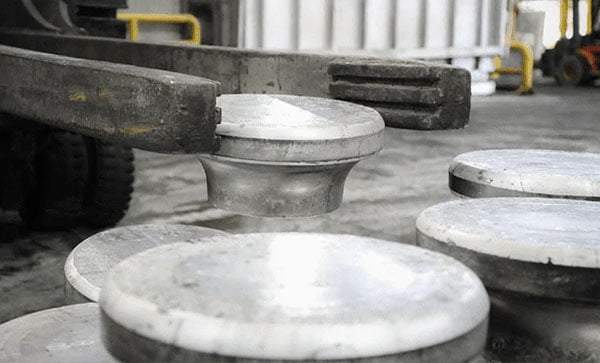
High-quality steel forgings such as shafts, rings, and disks depend heavily on correct forging temperatures to deliver long-lasting performance in their end-use environments. When the temperature for forging steel is right:
- Shaft Forgings resist torsional fatigue and shear stress.
- Ring Forgings withstand centrifugal forces and thermal expansion.
- Disk Forgings maintain shape under pressure and mechanical loads.
In industries like energy, transportation, and heavy machinery, reliability means safety — and temperature control during forging is non-negotiable for these outcomes.
Conclusion
To summarize: temperature for forging steel is the cornerstone of the entire forging process. Without the right temperature:
- Strength is compromised.
- Reliability is questioned.
- Costs rise due to scrap and failures.
Whether you’re producing shafts, rings, or disks, quality starts at the furnace. Every forged component carries the legacy of the temperature it was shaped under.
Forging temperature is not just a number; it is the guarantee of performance, safety, and value — both for the manufacturer and the end user. Always make it your top priority.
FAQ
What is the ideal temperature for forging low carbon steel?
The optimal range is typically 1150°C – 1250°C. Staying within this range ensures good ductility and prevents cracking or tearing during deformation.
Can forging temperature vary depending on the steel grade?
Absolutely. Each steel grade (carbon, alloy, tool, or stainless) has its unique temperature for forging steel range to achieve the best grain structure and mechanical properties.
What happens if steel is forged below its recommended temperature?
Under-forging causes cracks, poor flow, and incomplete filling of the die — leading to dimensional inaccuracies and reduced mechanical strength.
Is it possible to overheat steel during forging?
Yes. Overheating results in grain growth, scale formation, decarburization, and a weaker final product. Temperature control is critical to prevent these defects.