Shandong Qilu lndustrial Co.,Ltd.

trength and Weight Savings: 7 Benefits of Forge Titanium
Welcome to My Blog!
Before we dive into the content, I’d love for you to join me on my social media platforms where I share more insights, engage with the community, and post updates. Here’s how you can connect with me:
Facebook:https://www.facebook.com/profile.php?id=100090903441806
Now, let’s get started on our journey together. I hope you find the content here insightful, engaging, and valuable.
Table of Contents
Introduction

Titanium has gained prominence in various industries due to its exceptional properties. Among the most significant forms of titanium processing is forging, which enhances the metal’s characteristics, making it suitable for a range of applications. This blog post will delve into seven key benefits of forge titanium, particularly emphasizing its strength and weight savings. As industries continue to seek materials that offer both performance and efficiency, understanding the advantages of titanium forging becomes essential.
Exceptional Strength-to-Weight Ratio
One of the most remarkable benefits of forge titanium is its exceptional strength-to-weight ratio. Compared to traditional metals like steel and aluminum, forged titanium provides superior strength while being significantly lighter. This characteristic is crucial in applications where reducing weight is essential, such as in aerospace and automotive industries.
Comparison of Strength-to-Weight Ratios
| Material | Strength (MPa) | Weight (g/cm³) | Strength-to-Weight Ratio (MPa/g/cm³) |
|---|---|---|---|
| Forge Titanium | 900 | 4.51 | 199.56 |
| Steel | 500 | 7.85 | 63.69 |
| Aluminum | 350 | 2.70 | 129.63 |
As shown in the table, forge titanium’s strength-to-weight ratio outperforms both steel and aluminum, making it an ideal choice for applications that demand lightweight materials without compromising strength.
Superior Corrosion Resistance
Another significant advantage of utilizing forged titanium is its remarkable ability to resist corrosion. Unlike many conventional metals, which can succumb to rust and degradation when subjected to harsh environmental conditions, this advanced material exhibits exceptional resilience against corrosive agents. This intrinsic property makes it an ideal choice for a variety of applications across diverse fields, including marine, chemical, and medical sectors.
Benefits of Corrosion Resistance
- Longevity: Components crafted from this type of titanium can significantly outlast their counterparts made from other metals in corrosive environments. The durability of these parts ensures they maintain their structural integrity and functionality over extended periods, reducing the frequency of replacements.
- Reduced Maintenance: The inherent resistance to corrosion minimizes the necessity for regular maintenance and replacement. As a result, organizations can experience substantial cost savings over time, allowing them to allocate resources more efficiently while ensuring continuous operation without disruptions.
- Enhanced Safety: In critical applications, such as those involving medical implants, the ability to resist corrosion is crucial for maintaining patient safety. Components that do not degrade or react negatively with bodily fluids provide peace of mind to both healthcare providers and patients, ensuring that medical devices remain reliable and effective throughout their intended lifespan.
Excellent Fatigue Resistance
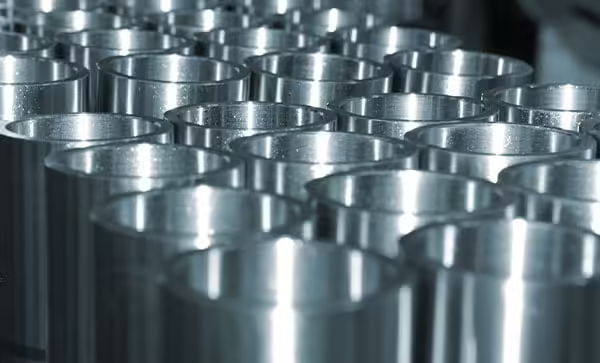
Forge titanium also boasts excellent fatigue resistance, making it suitable for applications subjected to cyclic loading and high-stress conditions. This characteristic is particularly important in the aerospace industry, where components experience repeated stress during flight.
Fatigue Performance Comparison
| Material | Fatigue Limit (MPa) |
|---|---|
| Forge Titanium | 300 |
| Steel | 200 |
| Aluminum | 150 |
The table illustrates that forge titanium maintains a higher fatigue limit compared to other common materials, allowing for longer service life and reliability in demanding applications.
Enhanced Design Flexibility
The forging process enhances titanium’s malleability, allowing for greater design flexibility. Manufacturers can create complex shapes and sizes tailored to specific applications without compromising material integrity. This flexibility is particularly beneficial in industries that require customized solutions.
Advantages of Design Flexibility
- Customization: Components can be tailored to fit unique specifications.
- Reduced Material Waste: Forging minimizes waste compared to traditional machining methods.
- Increased Performance: Optimized designs can lead to better overall performance in end-use applications.
Biocompatibility for Medical Applications
The advanced material is highly esteemed for its biocompatibility, making it an exceptional choice for medical implants and devices. Its compatibility with the human body significantly reduces the risk of adverse reactions, ensuring the safety and well-being of patients who rely on these critical technologies.
Key Biocompatibility Benefits
- Minimal Rejection Rates: Components made from this versatile titanium are less likely to be rejected by the body compared to other metals, which can sometimes provoke an immune response. This characteristic is vital for ensuring that medical implants remain stable and effective within the physiological environment.
- Integration with Bone: One of the standout features of titanium is its remarkable ability to integrate with bone tissue. This property, known as osseointegration, enhances the overall success rate of implants, allowing them to bond effectively with the surrounding bone. Such integration is essential for providing stability and support to prosthetic devices.
- Durability: Medical devices crafted from this material are exceptionally durable, designed to withstand the unique challenges posed by the physiological environment. Their resilience ensures that they can endure daily wear and tear, contributing to their longevity and reliability in critical applications.
Cost-Effectiveness Over Time
While the initial cost of forge titanium may be higher than other materials, its long-term benefits often outweigh the investment. The durability, corrosion resistance, and reduced maintenance needs contribute to cost savings over the product’s lifespan.
Long-Term Cost Analysis
| Factor | Forge Titanium | Steel | Aluminum |
|---|---|---|---|
| Initial Cost | High | Medium | Low |
| Maintenance Cost | Low | High | Medium |
| Replacement Frequency | Low | High | Medium |
The table highlights that while forge titanium has a higher initial cost, its lower maintenance and replacement frequency result in significant savings over time.
Environmental Sustainability
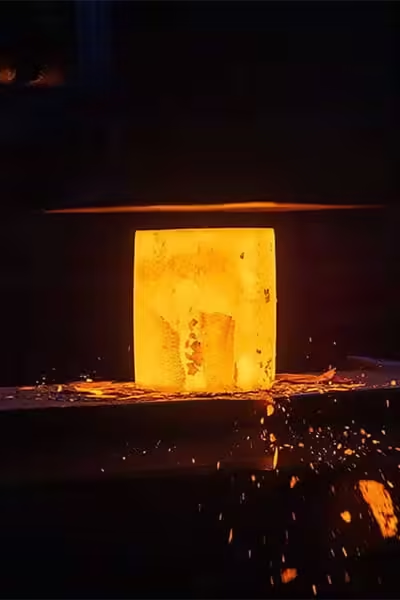
As industries increasingly prioritize sustainability, forge titanium emerges as an environmentally friendly option. The long lifespan and recyclability of titanium contribute to reduced environmental impact compared to materials that require frequent replacement.
Environmental Benefits
- Recyclability: Titanium can be recycled without losing its properties, contributing to a circular economy.
- Energy Efficiency: The lightweight nature of titanium reduces fuel consumption in transportation applications.
- Reduced Waste: Its durability leads to less waste generated from discarded materials.
Conclusion
Forge titanium offers numerous benefits, including exceptional strength-to-weight ratio, superior corrosion resistance, excellent fatigue resistance, design flexibility, biocompatibility, cost-effectiveness, and environmental sustainability. As industries continue to seek high-performance materials that meet demanding requirements, understanding the advantages of forge titanium becomes increasingly important. Whether in aerospace, medical, or automotive applications, forge titanium stands out as a reliable and effective choice for engineers and manufacturers alike.
FAQ
What is forge titanium?
Forge titanium refers to titanium that has undergone the forging process, enhancing its mechanical properties and making it suitable for various applications.
Why is forge titanium so strong?
The forging process aligns the grain structure of the titanium, resulting in improved strength and fatigue resistance.
Is forge titanium more expensive than other materials?
While the initial cost of forge titanium may be higher than materials like steel or aluminum, its long-term durability and reduced maintenance needs can lead to overall cost savings.
Where is forge titanium commonly used?
Forge titanium is commonly used in aerospace, medical implants, marine applications, and high-performance automotive parts.
Can forge titanium be recycled?
Yes, titanium is highly recyclable and can be repurposed without losing its mechanical properties, making it an environmentally friendly option.