Shandong Qilu lndustrial Co.,Ltd.

Top 5 Forging Procedures for Maximum Strength
Welcome to My Blog!
Before we dive into the content, I’d love for you to join me on my social media platforms where I share more insights, engage with the community, and post updates. Here’s how you can connect with me:
Facebook:https://www.facebook.com/profile.php?id=100090903441806
Now, let’s get started on our journey together. I hope you find the content here insightful, engaging, and valuable.
Table of Contents
Introduction
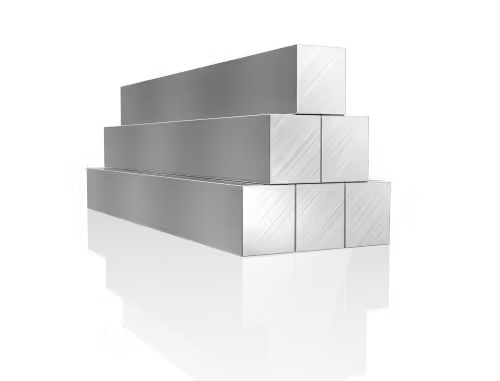
When it comes to manufacturing parts and components that need to endure harsh conditions and provide maximum performance, forging procedures are essential. Forging is one of the most effective processes for improving the strength, durability, and resilience of materials. By applying heat and pressure to metals, forging procedures reshape them into desired forms, increasing their strength and ability to withstand high-stress environments. In this blog, we’ll explore the top five forging procedures that ensure maximum strength and help you choose the best method for your needs.
Understanding Forging Procedures and Their Importance
Forging procedures are critical in various industries, including automotive, aerospace, and heavy machinery manufacturing, where components need to endure extreme conditions. The key to producing high-strength parts lies in the forging process used. Whether it’s a closed-die forging, open-die forging, or another technique, the method chosen will directly affect the final product’s strength and durability.
Each forging process has its own benefits, and selecting the right one depends on factors like material type, desired properties, and the specific application of the forged component. By optimizing the forging procedure, manufacturers can significantly improve the performance and longevity of their products.
Top 5 Forging Procedures to Maximize Strength
The following are five of the most effective forging procedures that ensure parts are forged with maximum strength and resistance to wear, stress, and impact.
Open-Die Forging: A Versatile Process for Strength Enhancement
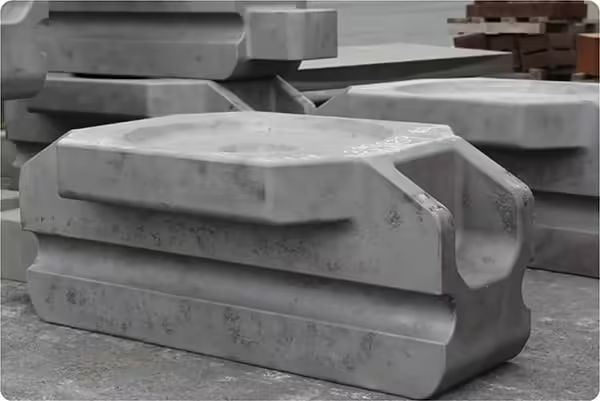
Open-die forging, also known as free forging, involves deforming metal between two flat dies, allowing it to flow freely. This process is highly versatile and is commonly used for large, heavy components like shafts and rods. One of the main advantages of open-die forging is its ability to create parts with excellent grain structure, which contributes to their overall strength.
The open-die forging process ensures that the grain structure of the material aligns with the shape of the part, enhancing its toughness and resistance to cracking. It’s ideal for producing large components that require strength and high durability under extreme conditions.
Closed-Die Forging: Precision and Strength in Complex Shapes
Closed-die forging involves placing the heated material inside a die cavity, which is then compressed under extreme pressure. This process allows for the creation of highly complex shapes and provides excellent dimensional accuracy. Closed-die forging is used in industries that require precise, high-strength parts, such as the automotive and aerospace industries.
The main advantage of closed-die forging is that it enhances the mechanical properties of the material, including strength, fatigue resistance, and impact resistance. The process also reduces material waste, as the die cavity controls the flow of the material.
Hammer Forging: High-Impact Process for Dense Materials
Hammer forging is one of the most widely used forging procedures, where the material is struck with a hammer or press to shape it. This process is particularly effective for creating small and medium-sized parts that require dense, strong properties. Hammer forging is ideal for materials such as steel, titanium, and aluminum, which benefit from the high-pressure impact that this method provides.
This procedure significantly improves the material’s strength by refining the grain structure and increasing its density, making it ideal for parts that require exceptional toughness and strength, such as connecting rods and crankshafts.
Roll Forging: Continuous Shaping for Strength and Uniformity
Roll forging involves passing a heated metal billet through a series of rollers to elongate and shape the material. This process creates parts that are both strong and uniform in size, with applications ranging from automotive components to industrial machinery. Roll forging is known for its ability to produce long, continuous parts with excellent dimensional accuracy and high strength.
The roll forging procedure not only enhances the mechanical properties of the material but also reduces the need for additional machining, as the process produces parts that are close to the desired final shape.
Isothermal Forging: Precision and Strength at Lower Temperatures
Isothermal forging involves maintaining a constant temperature during the forging process, ensuring the material is heated uniformly. This forging procedure is particularly useful for producing components that require high precision and uniformity. By controlling the temperature, isothermal forging helps improve material properties such as strength, toughness, and fatigue resistance, even at lower temperatures.
This method is commonly used for high-performance parts in industries like aerospace and defense, where strength and precision are critical.
| Forging Procedure | Description | Ideal Applications |
|---|---|---|
| Open-Die Forging | Deforming metal between two flat dies. | Large components (shafts, rods) |
| Closed-Die Forging | Metal compressed under extreme pressure in a die cavity. | Automotive, aerospace parts |
| Hammer Forging | Striking material with a hammer or press. | Small to medium components |
| Roll Forging | Passing material through rollers to elongate and shape. | Automotive, industrial parts |
| Isothermal Forging | Maintaining uniform temperature during forging. | Aerospace, defense components |
How Forging Procedures Affect the Strength of Materials
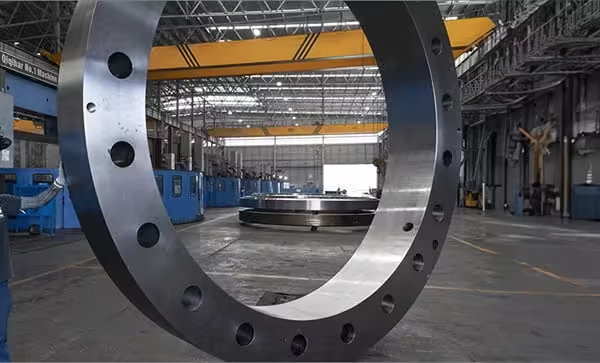
The strength of a forged component depends on the forging procedure used. By manipulating the temperature, pressure, and method of shaping, manufacturers can control the grain structure of the material, which directly impacts its strength. Each forging procedure improves specific properties of the material, such as toughness, fatigue resistance, and wear resistance.
For instance, closed-die forging and hammer forging both provide superior mechanical properties by refining the material’s grain structure, while roll forging ensures uniformity and reduces material waste. The choice of procedure depends on the material’s intended use and the level of strength required for the application.
Conclusion
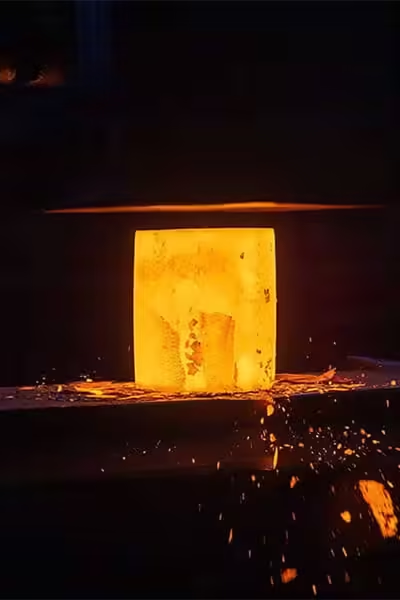
Choosing the right forging procedure is essential for ensuring that your components meet the required strength standards. Whether you need large, heavy components or highly precise, high-strength parts, understanding the benefits of each forging procedure can help you make the best decision for your manufacturing needs. Protect your investment by selecting the right process today.
Contact us to discuss how we can help you get the most out of your forging needs.
FAQ
What is the strongest forging procedure?
Closed-die forging is considered one of the strongest procedures due to its ability to refine the material’s grain structure and provide excellent mechanical properties.
Can forging procedures be used on all metals?
Most metals can be forged, but some metals, such as titanium and aluminum, may require specific procedures, such as hammer or isothermal forging, to achieve optimal strength.
What are the advantages of roll forging?
Roll forging provides excellent uniformity and strength in long components and can significantly reduce material waste compared to other methods.
How does isothermal forging improve material properties?
By maintaining a constant temperature throughout the process, isothermal forging enhances the strength, toughness, and fatigue resistance of the material, particularly in high-performance applications.
What industries benefit most from forging procedures?
Industries such as aerospace, automotive, industrial machinery, and defense benefit from forging procedures, as they require high-strength, durable components.