Shandong Qilu lndustrial Co.,Ltd.

Quality in Drop Forged Cold Steel Processes
Welcome to My Blog!
Before we dive into the content, I’d love for you to join me on my social media platforms where I share more insights, engage with the community, and post updates. Here’s how you can connect with me:
Facebook:https://www.facebook.com/profile.php?id=100090903441806
Now, let’s get started on our journey together. I hope you find the content here insightful, engaging, and valuable.
Table of Contents
Introduction
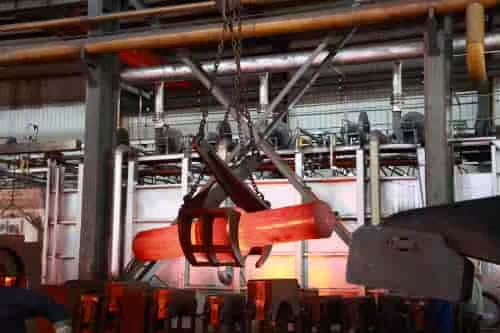
Drop forged cold steel is a cornerstone process in modern manufacturing, combining strength, durability, and precision. It is widely used in industries ranging from automotive and aerospace to construction and agriculture. In this article, we explore the essential qualities that define drop forged cold steel, from its production processes to its real-world applications. We also highlight how Qilu, a leading forged metal manufacturer in China, ensures unmatched quality and reliability in every product.
What Is Drop Forged Cold Steel?
Drop forged cold steel is produced by shaping metal at room temperature through high-pressure impact in a closed die. This process significantly enhances the mechanical properties of the metal, including strength, toughness, and wear resistance. Unlike hot forging, cold forging doesn’t involve heating the material, making it ideal for precision components that require minimal machining.
Advantages of Drop Forged Cold Steel
Enhanced Strength and Durability
Drop forging refines the grain structure of the steel, resulting in superior mechanical properties. Cold forging at room temperature ensures less deformation and tighter tolerances.
High Dimensional Accuracy
Because cold forging minimizes thermal expansion, it offers excellent control over part dimensions, reducing the need for secondary machining operations.
Cost Efficiency
The drop forged cold steel process is more material-efficient than traditional machining. It reduces waste and lowers production costs over large volumes.
Better Surface Finish
Cold forging results in a smoother surface finish compared to hot forging, which is beneficial for applications where aesthetics and friction reduction are important.
The Drop Forging Process Explained
- Material Selection – Choosing the appropriate steel grade based on mechanical requirements.
- Die Preparation – Precision dies are designed and tested to exact tolerances.
- Cold Forging – The steel is placed into the die and shaped using high-impact pressure.
- Trimming and Finishing – Excess material is removed, and parts are polished or treated.
- Inspection and Testing – Each part undergoes rigorous quality control checks to ensure compliance with specifications.
Why Qilu Leads in Drop Forged Cold Steel Manufacturing
Qilu has over three decades of experience in producing premium drop forged components. Our in-house team specializes in shaft forgings, ring forgings, and disk forgings using drop forged cold steel. With advanced testing labs and production lines, we guarantee consistent quality and mechanical performance.
Applications of Drop Forged Cold Steel
Automotive
In the automotive industry, drop forged cold steel is used for critical parts like transmission gears, crankshafts, and suspension components. These parts must endure high levels of stress and strain while maintaining safety and longevity. Drop forging ensures that each component has the required mechanical strength and fatigue resistance for long-term performance.
Aerospace
The aerospace sector demands components that can withstand extreme temperatures, pressures, and forces. Drop forged cold steel is ideal for manufacturing parts like aircraft landing gear and structural supports. Its excellent strength-to-weight ratio and consistency make it the go-to choice for safety-critical aerospace applications.
Agriculture
Agricultural tools such as plowshares, harrow disks, and mechanical linkages are frequently manufactured using drop forged cold steel. The superior hardness and durability of the material help these components withstand abrasive soil conditions and long hours of usage, minimizing replacement frequency.
Construction
In the construction field, drop forged cold steel is commonly used in scaffolding connectors, anchor bolts, structural supports, and safety components. These applications benefit from the steel’s robust mechanical strength and resistance to wear, corrosion, and environmental impact, ensuring long-term stability and security.
Table: Comparison of Forging Methods
| Feature | Drop Forged Cold Steel | Hot Forging | Machining |
|---|---|---|---|
| Dimensional Accuracy | High | Medium | Very High |
| Material Waste | Low | Medium | High |
| Mechanical Strength | Very High | High | Medium |
| Surface Finish | Excellent | Fair | Excellent |
| Production Efficiency | High | High | Low |
Quality Control in Drop Forged Cold Steel
Qilu utilizes state-of-the-art inspection tools, including ultrasonic testing, magnetic particle testing, and tensile strength analysis. Each component is tested for hardness, toughness, and microstructure integrity. This comprehensive approach ensures every part we deliver exceeds customer expectations.
Customization Options in Forging
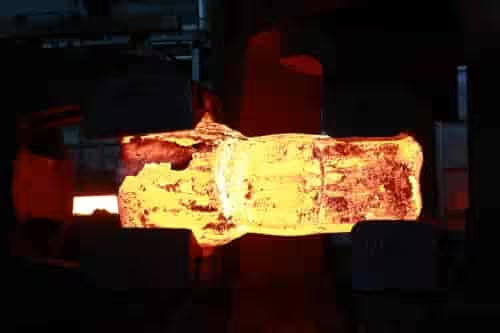
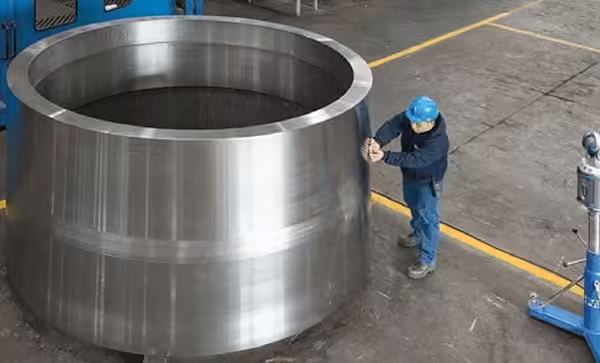
We offer tailored solutions for various industries. Whether you require specific tolerances, unique geometries, or post-processing services like heat treatment and machining, Qilu can meet your exact needs. Our engineers work closely with clients from design to delivery.
Conclusion
Drop forged cold steel remains a reliable and cost-effective manufacturing solution for high-performance applications. With over 30 years of forging expertise, Qilu continues to set industry benchmarks for quality and innovation. Looking for dependable forged components? Contact us today to discuss your requirements and receive a tailored solution.
FAQ
What is the difference between hot and cold forging?
Cold forging occurs at room temperature and offers higher precision and strength, while hot forging involves heating the metal and allows for more complex shapes.
What materials can be used for drop forged cold steel?
Common materials include carbon steel, alloy steel, and stainless steel, depending on the application’s requirements.
Can drop forged cold steel be customized?
Yes, Qilu provides comprehensive customization options, including material selection, design specifications, and surface treatment.
Is cold forging more expensive than hot forging?
Although tooling costs can be higher, cold forging is more efficient in large production volumes due to less material waste and reduced machining needs.