Shandong Qilu lndustrial Co.,Ltd.

Optimizing Efficiency With Ring of Forging Methods
Welcome to My Blog!
Before we dive into the content, I’d love for you to join me on my social media platforms where I share more insights, engage with the community, and post updates. Here’s how you can connect with me:
Facebook:https://www.facebook.com/profile.php?id=100090903441806
Now, let’s get started on our journey together. I hope you find the content here insightful, engaging, and valuable.
Table of Contents
Introduction
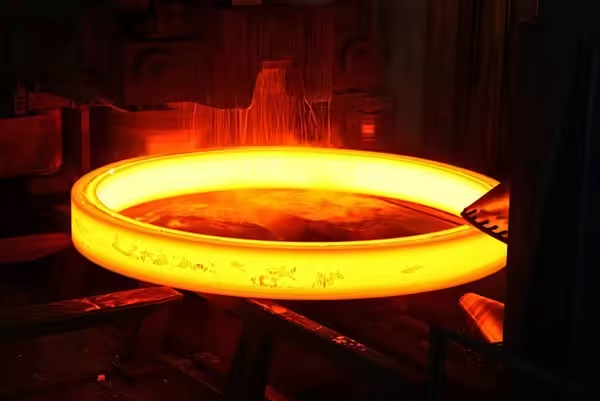
The ring of forging represents a specialized metalworking technique that combines traditional forging principles with modern efficiency enhancements. This process has become increasingly vital in industries requiring high-strength, precision metal components with optimized production workflows.
Unlike conventional forging methods, the ring of forging approach focuses on maximizing material utilization while minimizing energy consumption and production time. Manufacturers in aerospace, automotive, and heavy equipment sectors are adopting these methods to gain competitive advantages in both quality and cost-effectiveness.
This comprehensive guide explores how to optimize efficiency using ring of forging techniques, examining process improvements, technological advancements, and practical applications that deliver measurable results.
Understanding the Ring of Forging Process
The ring of forging method involves shaping metal into ring-like forms through controlled compression and rotational forces. This technique differs from standard forging in several key aspects:
- Circular Grain Flow: Metal fibers align concentrically, enhancing structural integrity
- Precision Thickness Control: Achieves uniform wall dimensions with minimal machining
- Material Savings: Typically uses 15-20% less raw material than block forging
Modern implementations combine hydraulic presses with computer-controlled mandrels to produce rings ranging from a few inches to over 30 feet in diameter. The process begins with a preformed donut-shaped blank that gets progressively shaped into its final dimensions.
Key Efficiency Advantages of Ring of Forging
Implementing optimized ring of forging methods provides multiple efficiency benefits:
Reduced Material Waste
The near-net-shape capability minimizes machining requirements, with typical material utilization rates exceeding 80% compared to 50-60% for conventional methods.
Faster Production Cycles
Rotational forging reduces the number of required heats, with some operations completing in half the time of traditional approaches.
Energy Savings
Precision force application decreases power consumption by up to 30% versus comparable forging techniques.
Improved Mechanical Properties
The controlled deformation creates superior fatigue resistance and impact strength in the final product.
Technological Innovations Enhancing Ring of Forging
Recent advancements have significantly improved ring forgings efficiency:
Automated Size Control Systems
Laser measurement devices continuously monitor dimensions during production, automatically adjusting pressure and rotation speed.
Predictive Maintenance Integration
Vibration analysis and thermal imaging predict equipment wear before failures occur, reducing unplanned downtime.
Advanced Simulation Software
Finite element analysis programs optimize die designs and predict material flow patterns with 95%+ accuracy.
Process Parameters for Optimal Ring of Forging
The table below outlines critical variables that affect efficiency in ring forgings operations:
| Parameter | Optimal Range | Impact on Efficiency |
|---|---|---|
| Temperature | 1050-1200°C | Maintains workability while minimizing scale formation |
| Reduction Rate | 15-25% per pass | Balances speed with material integrity |
| Rotational Speed | 30-60 RPM | Ensures uniform deformation without slippage |
| Axial Pressure | 50-150 MPa | Provides sufficient force without excessive energy use |
| Cooling Rate | 10-15°C/sec | Preserves microstructure properties |
Proper control of these factors can improve throughput by 20-35% while maintaining quality standards.
Industry Applications of Efficient Ring of Forging
Aerospace Components
Turbine engine cases and mounting rings benefit from the weight savings and fatigue resistance.
Energy Sector
Large-diameter flanges and pressure vessel rings withstand extreme operating conditions.
Heavy Machinery
Gear blanks and bearing races achieve superior wear characteristics.
Transportation
Wheel hubs and suspension components gain strength-to-weight advantages.
Cost Analysis of Ring of Forging Implementation
While initial setup costs for ring forgings systems exceed traditional forging, the long-term savings prove compelling:
- Material Costs: 18-22% reduction through improved yield
- Labor Requirements: 30-40% decrease due to automation
- Energy Consumption: 25-30% savings from optimized processes
- Quality Costs: 50-60% lower rejection rates
Most operations achieve ROI within 18-24 months through these cumulative efficiencies.
Common Challenges and Solutions
Die Wear Management
Problem: Frequent die replacement reduces uptime
Solution: Advanced coatings extend tool life by 3-5x
Dimensional Consistency
Problem: Variations in final dimensions
Solution: Real-time monitoring with automatic compensation
Material Handling
Problem: Heat loss during transfer
Solution: Robotic transfer systems minimize exposure
Future Trends in Ring of Forging Technology
AI-Driven Process Optimization
Machine learning algorithms will continuously adjust parameters for peak efficiency.
Hybrid Additive-Forging Systems
Combining 3D printed preforms with ring forging will enable complex geometries.
Sustainable Practices
Closed-loop cooling and waste heat recovery will further reduce environmental impact.
Conclusion
The ring of forging method represents the future of efficient metal component manufacturing, offering unmatched material savings, energy efficiency, and production speed. As industries face increasing pressure to reduce costs while improving quality, these advanced forging techniques provide a competitive edge.
For organizations ready to upgrade their forging capabilities, our team offers complete ring forgings solutions tailored to your specific requirements. Contact us today to discuss how we can help optimize your metalworking operations.
FAQ
What materials work best with ring of forging?
The process suits various alloys including carbon steels, stainless steels, titanium, and nickel-based superalloys.
How does ring forgings compare to rolled rings?
Ring forging provides better grain structure and mechanical properties than ring rolling alone.
What size range can ring forgings produce?
Modern systems handle diameters from 6 inches to 30 feet, with weights up to 50 tons.
Is special training required for operators?
Yes, technicians need specific training on the computerized control systems.