Shandong Qilu lndustrial Co.,Ltd.

Key Benefits of the Forging Metal Process in Manufacturing
Welcome to My Blog!
Before we dive into the content, I’d love for you to join me on my social media platforms where I share more insights, engage with the community, and post updates. Here’s how you can connect with me:
Facebook:https://www.facebook.com/profile.php?id=100090903441806
Now, let’s get started on our journey together. I hope you find the content here insightful, engaging, and valuable.
Table of Contents
Introduction
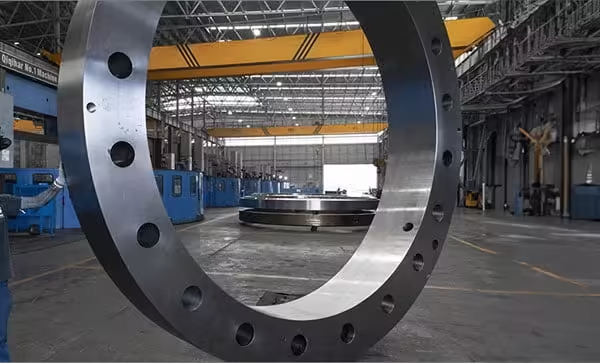
The forging metal process is a cornerstone of modern manufacturing, offering unmatched strength, durability, and precision in metal components. Unlike other metal-forming methods, forging involves shaping metal under high pressure, resulting in superior mechanical properties. Industries such as aerospace, automotive, and construction rely heavily on forged parts due to their reliability and performance.
In this blog, we will explore the key benefits of the forging metal process, its various techniques, and why it remains a preferred choice in manufacturing. Whether you’re an engineer, a procurement specialist, or simply curious about metalworking, this guide will provide valuable insights.
Superior Strength and Durability
The forging metal process significantly enhances the structural integrity of metal parts. Unlike casting or machining, forging aligns the grain structure of the metal, making it stronger and more resistant to fatigue and impact.
- Increased Tensile Strength: Forged metals can withstand higher stress loads.
- Better Fatigue Resistance: Components last longer under cyclic loading.
- Enhanced Toughness: Less prone to cracking under extreme conditions.
This makes forging ideal for critical applications like engine crankshafts, gears, and structural components.
Improved Metallurgical Properties
Forging refines the grain structure of metals, eliminating voids and porosity that weaken cast or machined parts.
- Grain Flow Optimization: The metal’s grain follows the part’s contours, improving strength.
- Reduced Defects: No internal cracks or inclusions, unlike casting.
- Consistent Quality: Uniform microstructure ensures reliable performance.
These properties make the forging metal process indispensable for high-stress environments.
Cost-Effectiveness in High-Volume Production
While initial tooling costs may be higher, forging becomes highly economical for large production runs.
- Lower Material Waste: Near-net-shape forging minimizes excess material.
- Reduced Machining Needs: Less post-processing required.
- Longer Tool Life: Dies withstand repeated use, lowering per-unit costs.
The forging metal process thus offers long-term savings, especially in automotive and industrial applications.
Enhanced Design Flexibility
Modern forging techniques allow for complex geometries and custom shapes.
- Precision Dies: Can produce intricate designs with tight tolerances.
- Custom Alloys: Works with a wide range of metals, including steel, aluminum, and titanium.
- Near-Net-Shape Capabilities: Reduces the need for extensive machining.
This flexibility makes forging suitable for specialized components in aerospace and defense.
Superior Performance Under Stress
Forged parts outperform cast or machined alternatives in high-pressure environments.
- Higher Load-Bearing Capacity: Ideal for heavy machinery and structural applications.
- Better Impact Resistance: Withstands sudden shocks without failure.
- Improved Wear Resistance: Longer lifespan in abrasive conditions.
Industries like oil & gas and construction rely on forged components for safety-critical applications.
Comparison of Forging vs. Alternative Processes
Below is a table comparing the forging metal process with other common manufacturing methods:
| Property | Forging | Casting | Machining |
|---|---|---|---|
| Strength | Very High | Moderate | High |
| Durability | Excellent | Good | Good |
| Material Waste | Low | Moderate | High |
| Production Speed | Fast (for bulk) | Fast (for bulk) | Slow (per part) |
| Cost Efficiency | High (volume) | Moderate | Low (high waste) |
As seen, forging offers the best balance of strength, efficiency, and cost for high-performance parts.
Environmental and Sustainability Benefits
The forging metal process is more sustainable than many alternatives.
- Energy Efficiency: Requires less energy than melting metals for casting.
- Recyclability: Forged metals can be reused without quality loss.
- Reduced Emissions: Lower carbon footprint compared to machining from billets.
Manufacturers increasingly prefer forging to meet eco-friendly production goals.
Common Applications of Forged Metal Parts
Forged components are found in nearly every heavy industry:
- Aerospace: Turbine blades, landing gear, and structural parts.
- Automotive: Crankshafts, connecting rods, and wheel spindles.
- Oil & Gas: Valves, flanges, and drill bits.
- Construction: Crane hooks, anchors, and heavy-duty fasteners.
The forging metal process ensures these parts perform reliably under extreme conditions.
Future Trends in Metal Forging Technology
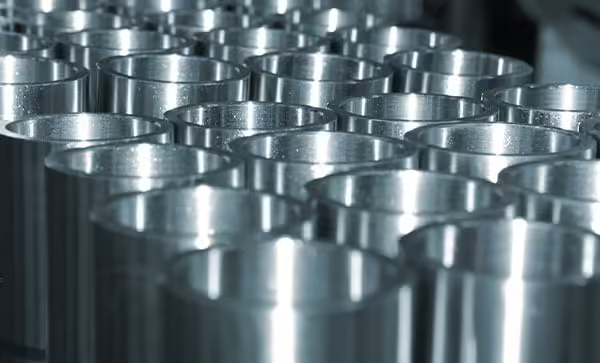
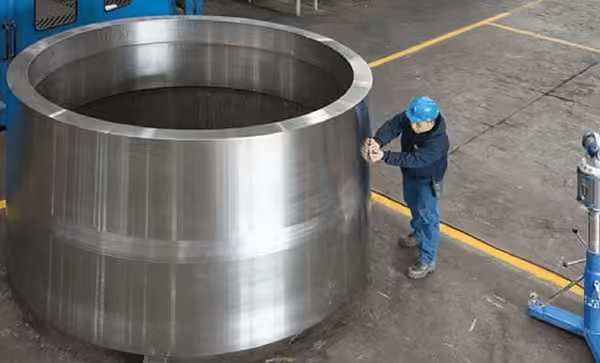
Advancements in forging continue to push industry standards:
- Automated Forging Presses: Faster, more precise production.
- Advanced Simulation Software: Optimizes die design and material flow.
- Hybrid Processes: Combining forging with additive manufacturing for complex parts.
These innovations ensure that the forging metal process remains at the forefront of manufacturing.
Conclusion
The forging metal process delivers unmatched strength, durability, and cost-efficiency, making it a preferred choice for high-performance metal components. From aerospace to automotive, forged parts ensure reliability under the most demanding conditions.
If you’re looking for high-quality forged metal parts for your industry, contact us today to discuss your requirements and benefit from our expertise in precision forging.
FAQ
What is the forging metal process?
The forging metal process involves shaping metal using compressive forces, typically with hammers or presses, to enhance strength and durability.
Why is forging better than casting?
Forging produces stronger, more reliable parts with fewer defects compared to casting, which can have porosity and weak grain structures.
Which metals are best for forging?
Common forged metals include steel, aluminum, titanium, and brass, chosen based on strength and application requirements.