Shandong Qilu lndustrial Co.,Ltd.

Is the Drop Forging Process Right for Your Project?
Welcome to My Blog!
Before we dive into the content, I’d love for you to join me on my social media platforms where I share more insights, engage with the community, and post updates. Here’s how you can connect with me:
Facebook:https://www.facebook.com/profile.php?id=100090903441806
Now, let’s get started on our journey together. I hope you find the content here insightful, engaging, and valuable.
Table of Contents
Introduction
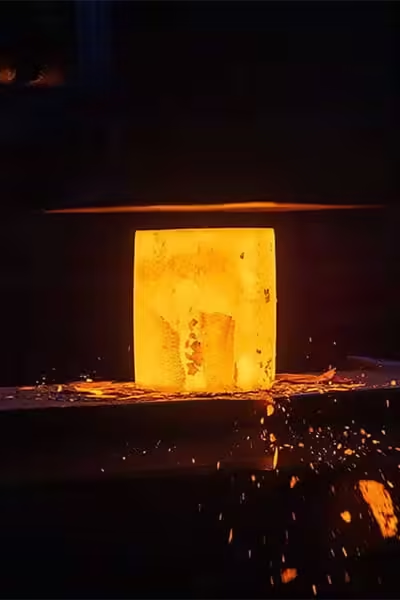
The drop forging process is a time-tested metalworking technique that delivers exceptional strength, durability, and precision for a wide range of industrial components. At Qilu, we specialize in producing high-quality forgings, such as shaft forgings, ring forgings, and disc forgings. Our significant investments in advanced production equipment and testing facilities ensure that our products meet the highest standards of quality and reliability.
With forging capabilities ranging from 200 to 4,000 tons, we can produce metal forgings in quantities from 1 to over 100,000 pieces. Supported by ample inventory and global distribution services, we guarantee swift delivery to meet your project timelines. This blog explores the intricacies of the drop forging process, its benefits, applications, and whether it’s the right choice for your manufacturing needs.
What Is the Drop Forging Process?
The drop forging process involves shaping heated metal by compressing it between two dies using a hammer or press. The metal, typically heated to a malleable state, is placed in a lower die, and an upper die is dropped or pressed onto it, forcing the material to conform to the die’s shape. This process can be performed using either open-die or closed-die forging methods, with closed-die forging being more common for high-precision components. The result is a forged part with superior mechanical properties, including enhanced strength and resistance to fatigue, making it ideal for demanding applications.
Types of Drop Forging Processes
There are two primary types of drop forging: open-die and closed-die forging. Open-die forging involves shaping metal between flat or simple dies, allowing for greater flexibility but less precision. Closed-die forging, on the other hand, uses precisely machined dies to create complex shapes with tight tolerances. At Qilu, our advanced closed-die forging equipment ensures that components like shaft forgings and ring forgings meet exact specifications, catering to industries such as automotive, aerospace, and energy.
Benefits of the Drop Forging Process
The drop forging process offers several advantages that make it a preferred choice for manufacturing high-performance components. These benefits include:
- Enhanced Strength: The forging process aligns the metal’s grain structure, resulting in parts that are stronger and more resistant to impact and fatigue than those produced by casting or machining.
- Improved Durability: Forged components exhibit excellent wear resistance, making them suitable for harsh operating conditions.
- Precision and Consistency: Closed-die forging ensures tight tolerances and repeatable results, critical for high-volume production.
- Material Efficiency: The drop forging process minimizes waste by shaping metal precisely, reducing the need for extensive machining.
- Versatility: It accommodates a wide range of metals, including steel, aluminum, and titanium, and supports the production of complex geometries.
These advantages make the drop forging process a reliable solution for projects requiring robust, high-quality components.
Applications of the Drop Forging Process
The versatility of the drop forging process enables its use across various industries. Common applications include:
- Automotive: Forged components such as crankshafts, connecting rods, and gears are essential for vehicle performance and safety.
- Aerospace: The process produces lightweight, high-strength parts like turbine blades and landing gear components that meet stringent safety standards.
- Oil and Gas: Forged valves, flanges, and fittings withstand extreme pressures and corrosive environments.
- Heavy Machinery: The drop forging process creates durable parts like shafts and couplings for construction and mining equipment.
- Energy: Components for wind turbines and power generation systems benefit from the process’s strength and reliability.
At Qilu, our ability to produce a wide range of forgings ensures that we can meet the diverse needs of these industries with precision and efficiency.
Key Considerations for Choosing the Drop Forging Process
Before selecting the drop forging process for your project, several factors should be evaluated to ensure it aligns with your requirements:
Material Selection
The choice of material significantly impacts the success of the drop forging process. Common materials include carbon steel, alloy steel, stainless steel, and non-ferrous metals like aluminum and titanium. Each material offers unique properties, such as corrosion resistance or high-temperature performance, that must match the application’s demands.
Component Complexity
The drop forging process excels at producing complex shapes with high precision, particularly in closed-die forging. However, extremely intricate designs may require additional machining, which could affect cost and lead time.
Production Volume
The process is well-suited for both low- and high-volume production. For small batches, the initial tooling cost may be a consideration, while high-volume runs benefit from economies of scale. Qilu’s capacity to produce 1 to 100,000+ pieces ensures flexibility for projects of any size.
Cost Implications
While the drop forging process may have higher upfront tooling costs compared to casting, its material efficiency and reduced need for secondary operations often result in long-term cost savings. Evaluating the total cost of ownership is essential for informed decision-making.
Drop Forging Process vs. Other Manufacturing Methods
To determine if the drop forging process is right for your project, it’s helpful to compare it with alternative manufacturing methods like casting, machining, and additive manufacturing. The table below outlines key differences:
| Aspect | Drop Forging Process | Casting | Machining | Additive Manufacturing |
|---|---|---|---|---|
| Strength | High, due to grain alignment | Moderate, prone to defects | High, but limited by raw material | Variable, depends on process |
| Precision | High with closed-die forging | Moderate, may require machining | Very high, but time-intensive | High, but surface finish may vary |
| Material Waste | Low, efficient use of material | Moderate, excess material in molds | High, significant material removal | Low, but material costs can be high |
| Production Speed | Fast for high volumes | Fast, but post-processing adds time | Slow for complex parts | Slow for large components |
| Tooling Cost | High initial cost, economical for large runs | Moderate, lower for sand casting | Low, but labor costs are high | Minimal, but equipment is expensive |
| Applications | Automotive, aerospace, heavy machinery | General-purpose parts, complex shapes | Precision components | Prototypes, complex geometries |
This comparison highlights the drop forging process’s strengths in producing durable, precise components with efficient material use, particularly for demanding applications.
Steps in the Drop Forging Process
Understanding the steps involved in the drop forging process provides insight into its precision and reliability:
- Material Preparation: Raw metal is cut into billets and heated to a forging temperature, typically between 1,000°C and 1,300°C for steel.
- Die Design and Setup: Custom dies are designed and installed in the forging press or hammer.
- Forging: The heated metal is placed in the lower die, and the upper die is dropped or pressed to shape the material.
- Trimming: Excess material (flash) is removed from the forged part.
- Heat Treatment: The part undergoes processes like quenching and tempering to enhance its mechanical properties.
- Inspection: Rigorous testing, including ultrasonic and dimensional checks, ensures quality. Qilu’s advanced testing facilities guarantee compliance with industry standards.
- Finishing: Surface treatments like shot blasting or coating may be applied to improve appearance and durability.
Each step is carefully controlled to produce components that meet exact specifications.
Challenges and Limitations of the Drop Forging Process

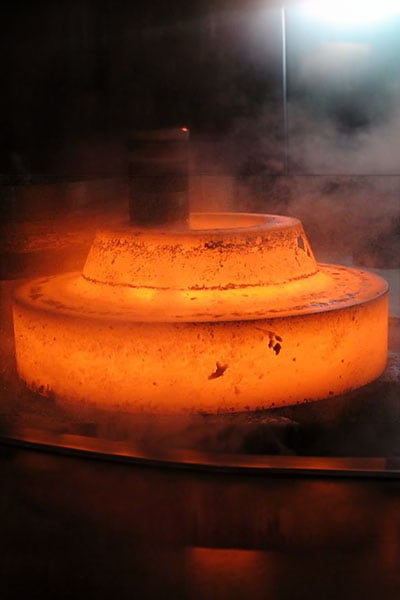
While the drop forging process offers numerous benefits, it also has some challenges:
- High Initial Tooling Costs: Designing and manufacturing custom dies can be expensive, particularly for low-volume production.
- Material Limitations: Not all metals are suitable for forging, and some may require specialized equipment or processes.
- Size Constraints: The process is best suited for small to medium-sized components, as larger parts may require alternative methods like open-die forging.
- Lead Time: Tooling development and setup can extend lead times, though Qilu’s streamlined processes and inventory management minimize delays.
By addressing these challenges through advanced equipment and expertise, Qilu ensures that the drop forging process delivers consistent, high-quality results.
Conclusion
The drop forging process is a powerful manufacturing method that delivers unmatched strength, precision, and durability for a wide range of applications. Its ability to produce complex, high-performance components with minimal waste makes it a top choice for industries like automotive, aerospace, and energy. At Qilu, our expertise in producing shaft forgings, ring forgings, and disc forgings, combined with our advanced equipment and global distribution capabilities, ensures that we can meet your project’s needs with speed and reliability. Whether you’re seeking small-batch flexibility or high-volume production, the drop forging process offers a proven solution. Contact us today to discuss how our forging expertise can elevate your project’s success!
FAQ
What materials can be used in the drop forging process?
The process supports a wide range of materials, including carbon steel, alloy steel, stainless steel, aluminum, and titanium. The choice depends on the application’s requirements for strength, corrosion resistance, and other properties.
Is the drop forging process cost-effective for small batches?
While tooling costs can be high for small runs, the process’s material efficiency and reduced need for machining can make it cost-effective, especially for critical components. Qilu’s flexible production capabilities accommodate both small and large orders.
How does the drop forging process ensure quality?
Quality is ensured through precise die design, controlled forging parameters, and rigorous inspection. At Qilu, our state-of-the-art testing facilities, including ultrasonic and dimensional checks, guarantee that every forging meets industry standards.
What industries benefit most from the drop forging process?
Industries such as automotive, aerospace, oil and gas, heavy machinery, and energy rely on the process for its ability to produce strong, precise components that withstand demanding conditions.