Shandong Qilu lndustrial Co.,Ltd.

How the Forge Process Revolutionizes Industrial Production
Welcome to My Blog!
Before we dive into the content, I’d love for you to join me on my social media platforms where I share more insights, engage with the community, and post updates. Here’s how you can connect with me:
Facebook:https://www.facebook.com/profile.php?id=100090903441806
Now, let’s get started on our journey together. I hope you find the content here insightful, engaging, and valuable.
Table of Contents
Introduction
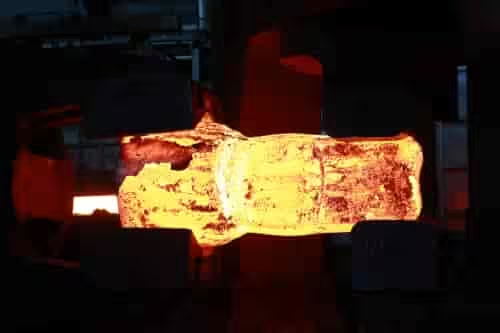
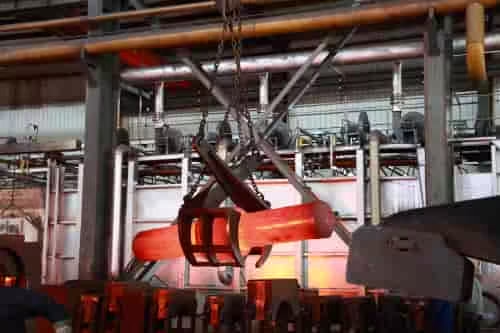
The forging technique has been at the heart of industrial production for centuries, shaping materials through a carefully controlled combination of heat and pressure. This method enables manufacturers to create parts with exceptional strength, durability, and reliability. By altering the structure of metals and other materials, forging enhances their mechanical properties, making them well-suited for demanding applications. In this blog, we will take a closer look at how this process works, its transformative impact on various industries, and why it remains a cornerstone of modern manufacturing. From automotive components to aerospace structures, the influence of forging is profound, and its ability to produce high-performance products continues to revolutionize production across multiple sectors.
What is the Forge Process?
Forging is a specialized manufacturing technique that shapes metals through localized compressive forces. The process involves heating the material until it becomes malleable, followed by the application of pressure to form it into the desired shape. This method is renowned for producing parts that possess superior strength and durability. In this section, we will delve into the key steps involved in this process, including various heating methods and types of presses commonly used in the industry.
Types of Forging Methods
There are different techniques used to create forged parts, depending on the design requirements. These methods include:
- Open-die forging: The metal is placed between two flat dies and shaped by repeated hammering or pressing.
- Closed-die forging: The metal is placed in a mold and compressed between two dies to produce more intricate shapes with high precision.
- Ring rolling: This technique is used for forming large rings, often used in industries such as aerospace and energy production.
Heating Techniques
The heat treatment plays a crucial role in ensuring that the metal reaches an optimal malleable state. Common heating methods include:
- Induction heating: Uses electromagnetic induction to heat the metal quickly and efficiently.
- Resistance heating: Relies on electrical resistance to heat the material uniformly.
- Combustion heating: Involves using direct flame or combustion gases to heat the material.
How the Forge Process Enhances Material Properties
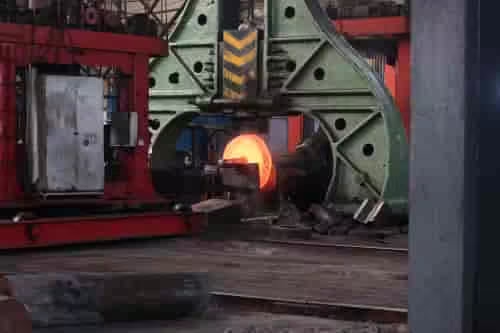
One of the main advantages of this manufacturing method is its ability to enhance the inherent properties of materials. Through the shaping process, the structure of the metal is altered, resulting in improved strength and performance.
- Strength and Durability: Components created through forging tend to have higher tensile strength than those produced through casting or machining. The process creates a denser and more uniform grain structure that improves the material’s load-bearing capabilities.
- Uniform Grain Flow: Unlike casting, where the grain structure may be irregular, forging aligns the grains in the direction of the applied force. This alignment contributes to increased toughness and resistance to fatigue, ensuring that the final product is much more durable.
- Impact Resistance: The compacting effect of forging helps increase the impact resistance of the material. The pressure applied during the process forces the molecules closer together, reducing internal voids and making the component more resistant to wear and tear under heavy loads or extreme conditions.
Applications of the Forge Process in Different Industries
The forge process is used in various industries, from automotive manufacturing to aerospace and heavy machinery production. Here’s how it benefits these sectors:
- Automotive Industry: The forge process is essential for producing engine components, drive shafts, and suspension parts that can withstand high levels of stress and heat.
- Aerospace Industry: In aerospace, forged parts such as turbine blades and landing gear are crucial for ensuring the safety and longevity of aircraft.
- Heavy Machinery: The forge process helps in manufacturing durable components for construction equipment, ensuring performance in demanding environments.
Key Advantages of the Forge Process in Industrial Production
The forge process offers multiple advantages over other manufacturing techniques. This section will focus on the efficiency and cost-effectiveness of forging as a production method.
| Advantage | Description |
|---|---|
| Improved Strength | Forging enhances material strength by refining grain structure. |
| Reduced Material Waste | Less material is wasted during forging compared to casting. |
| Faster Production | Forging is more efficient in mass production scenarios. |
| Lower Energy Consumption | Modern forging methods consume less energy than traditional methods. |
The Future of the Forge Process in Industrial Production
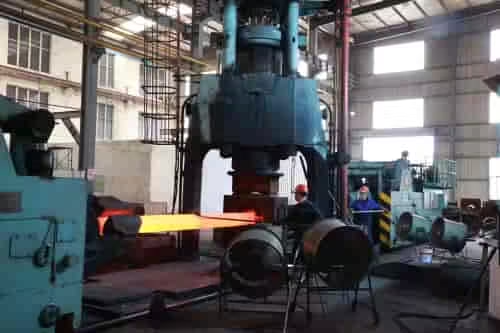
The forge process continues to evolve with advancements in technology, such as automated forging machines, 3D printing integration, and smart manufacturing techniques. The future of forging will focus on improving precision, reducing costs, and increasing sustainability. This section will explore potential innovations that could shape the future of the forge process.
- Automation and Robotics: How robots and automated systems are increasing forging efficiency and precision.
- Sustainability: The shift toward eco-friendly forging practices and the role of renewable energy in forging operations.
Conclusion
The forge process is undeniably a cornerstone of modern industrial production. Its ability to produce strong, durable, and reliable components has revolutionized the manufacturing of high-performance parts in various industries. As technology advances, the forge process will only become more efficient and crucial in the years to come.
FAQ
Q1: What metals are commonly used in the forge process?
A1: The forge process can be applied to a wide range of metals, including steel, aluminum, titanium, and copper alloys. Each material requires specific heating and forging techniques to achieve the desired properties.
Q2: What is the difference between open-die and closed-die forging?
A2: Open-die forging involves shaping a metal between two flat dies, while closed-die forging uses a die that encloses the metal, allowing for more intricate shapes and higher precision.
Q3: How does the forge process compare to casting?
A3: The forge process generally produces stronger, more reliable parts than casting due to the grain flow alignment and reduction of internal defects. However, casting is often more cost-effective for mass production of complex shapes.