Shandong Qilu lndustrial Co.,Ltd.

Gear Forging: Experience the Benefits of Quality Parts
Welcome to My Blog!
Before we dive into the content, I’d love for you to join me on my social media platforms where I share more insights, engage with the community, and post updates. Here’s how you can connect with me:
Facebook:https://www.facebook.com/profile.php?id=100090903441806
Now, let’s get started on our journey together. I hope you find the content here insightful, engaging, and valuable.
Table of Contents
Introduction
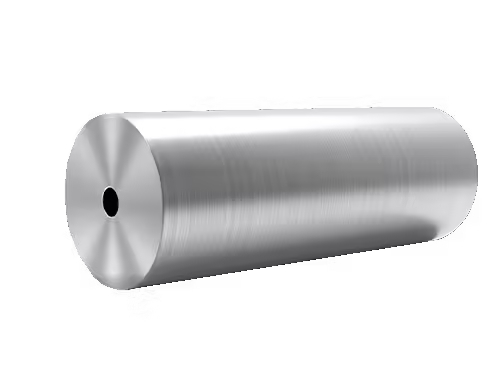
Gear forging is a critical manufacturing process that significantly enhances the performance, reliability, and lifespan of gears used in various industries. From automotive to aerospace, forging gear is synonymous with strength, precision, and quality. Unlike traditional casting or machining, forging gear compresses metal under extreme pressure, refining its grain structure and eliminating weaknesses.
In this article, we will explore everything there is to know about forging gear — its benefits, applications, types, and technical aspects — to help you understand why it remains the gold standard in gear production.
What is Gear Forging?
Gear forging is a metal forming process that uses compressive forces to shape raw metal into high-strength gear components. During this process, heated metal is placed in a die and then hammered or pressed until it conforms to the die’s shape. The result is a gear with excellent structural integrity and resistance to wear and fatigue.
Forged gears typically outperform cast or machined gears in high-load, high-stress environments, making forging gear the preferred method for mission-critical applications.
Advantages of Gear Forging Over Other Methods
Superior Strength and Durability
The most notable benefit of gear forging is the increased mechanical strength. Because the forging process aligns the metal’s grain flow to follow the shape of the gear, it reduces the risk of failure under stress.
Enhanced Fatigue Resistance
Forged gears can endure repeated loading and unloading without developing cracks or deformation. This property is essential in high-speed and high-torque applications.
Dimensional Accuracy
Modern forging techniques allow for tight tolerances, reducing the amount of secondary machining required. Precision forging is especially valuable in automotive transmissions and aerospace mechanisms.
Cost Efficiency in Mass Production
Although gear forging may seem expensive at first glance, it becomes more economical in large-scale production due to reduced waste, shorter machining times, and longer component life.
Improved Surface Finish
The forging process, especially when followed by controlled cooling and finishing techniques, yields a smoother surface finish that improves performance and wear resistance.
Types of Gear Forging Techniques
Open Die Forging for Gears
Used primarily for large gears, this method involves shaping metal between flat dies without enclosing the material. It’s ideal for heavy-duty industrial applications.
Closed Die (Impression Die) Forging
This method offers more precision and is suitable for high-volume production. It uses custom dies that fully enclose the workpiece, ensuring consistent part quality.
Cold Forging
While most gear forging is done hot, cold forging is used for smaller parts and results in excellent surface finishes and material properties without the need for heating.
Hot Forging
Most common for forging gear, hot forging is performed above the recrystallization temperature of the metal, allowing for easy deformation and superior grain structure.
Common Applications of Gear Forging
Gear forging is essential across industries where reliability is non-negotiable. Here are some common applications:
- Automotive: Transmission gears, differential gears, and camshaft gears
- Aerospace: Turbine gears, landing gear mechanisms
- Heavy Equipment: Construction, mining, and agricultural machinery gears
- Industrial Machinery: Gearboxes, cranes, wind turbines
- Marine: Propulsion systems and gear-driven control mechanisms
Material Selection in Gear Forging
Choosing the right material is crucial in forging gear. The selected metal must match the mechanical demands of the gear’s application. Common materials include:
- Carbon Steel: High strength and good wear resistance
- Alloy Steel: Enhanced hardness and fatigue resistance
- Stainless Steel: Corrosion-resistant for harsh environments
- Aluminum: Lightweight applications where load is lower
- Titanium: Aerospace-grade strength-to-weight ratio
Table: Common Gear Forging Materials and Their Applications
| Material | Strength Level | Corrosion Resistance | Common Applications |
|---|---|---|---|
| Carbon Steel | High | Low | Automotive, construction equipment |
| Alloy Steel | Very | Moderate | Aerospace, heavy-duty machinery |
| Stainless Steel | Moderate | High | Marine, food-grade machinery |
| Aluminum | Low | Moderate | Light vehicles, robotics |
| Titanium | Very High | High | Aerospace, high-performance engines |
Key Considerations When Designing Forged Gears
Load Requirements
Design must reflect the gear’s expected operational load. Forged gears are best suited for heavy-load scenarios.
Gear Geometry
The forging die must precisely reflect gear tooth profiles, pitch, and face width to minimize post-processing.
Heat Treatment Needs
Post-forging treatments such as quenching, tempering, or carburizing are often required to reach the desired hardness and tensile strength.
Surface Finish Tolerances
Determine if further machining or surface finishing is necessary for your application. Forged surfaces are typically superior but may need refinement.
Quality Control in Gear Forging
To ensure reliable performance, forged gears go through rigorous quality control processes:
- Non-destructive testing (NDT): Includes ultrasonic, magnetic particle, and dye penetrant inspection
- Hardness testing: Ensures heat treatment effectiveness
- Dimensional inspection: Confirms adherence to design tolerances
- Microstructure analysis: Checks for grain flow and internal flaws
High-end forging gear facilities implement Six Sigma or ISO quality systems to guarantee consistency and traceability in every batch.
Environmental and Economic Impact of Gear Forging
Sustainability Benefits
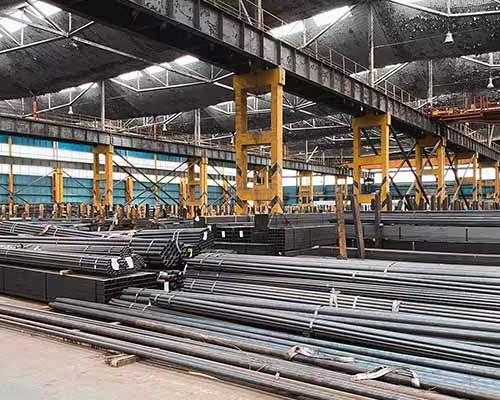
Forging generates less material waste compared to machining, and forged components often require fewer replacements over time. This results in lower lifecycle emissions.
Energy Efficiency
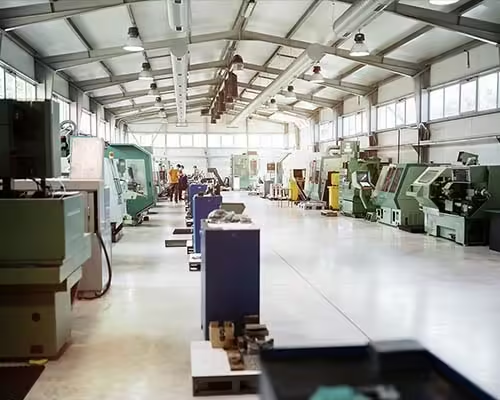
While hot forging uses heat, energy-efficient furnaces and closed-loop cooling systems minimize energy usage per part, making forging gear more environmentally friendly than it appears.
Long-Term Cost Reduction
Though initial tooling can be expensive, gear forging’s longevity, minimal post-processing, and low failure rate make it a smart long-term investment.
Conclusion
Gear forging is the cornerstone of high-performance mechanical systems. From unmatched strength and fatigue resistance to cost-efficiency in large-scale production, gear forging delivers proven benefits that other methods can’t match.
If you’re looking to enhance the reliability and performance of your equipment, gear forging is the way to go. Contact us today to explore custom gear forging solutions tailored to your specific needs.
FAQ
What is the difference between forged and cast gears?
Forged gears are stronger and more fatigue-resistant because their internal grain structure is aligned through the forging process. Cast gears, while easier to shape, are more prone to defects and wear.
What industries benefit most from gear forging?
Automotive, aerospace, heavy equipment, marine, and industrial machinery industries all rely on gear forging for critical applications.
What materials are best for forged gears?
Carbon and alloy steels are most commonly used. Stainless steel, aluminum, and titanium are chosen based on corrosion resistance, weight, or performance requirements.
How long do forged gears last?
With proper use and maintenance, forged gears can last significantly longer than cast or machined alternatives—often several times their expected lifespan.