Shandong Qilu lndustrial Co.,Ltd.

Forged Titanium: Elevate Your Products with Top Quality
Welcome to My Blog!
Before we dive into the content, I’d love for you to join me on my social media platforms where I share more insights, engage with the community, and post updates. Here’s how you can connect with me:
Facebook:https://www.facebook.com/profile.php?id=100090903441806
Now, let’s get started on our journey together. I hope you find the content here insightful, engaging, and valuable.
Table of Contents
Introduction
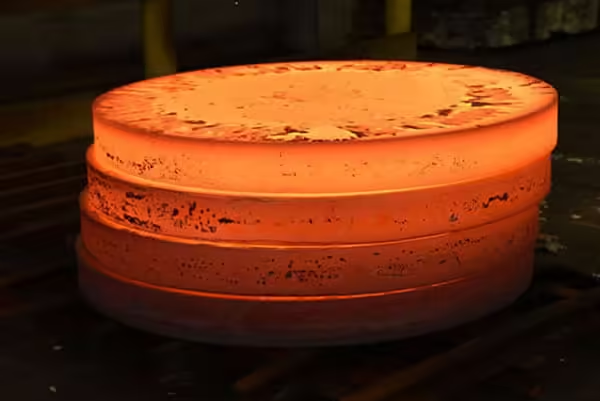
In today’s competitive industrial landscape, selecting the right material is crucial to the performance, durability, and success of any product. Among high-performance materials, forged titanium has emerged as a top-tier choice due to its superior strength, lightweight characteristics, and excellent corrosion resistance. Whether you’re in aerospace, automotive, medical devices, or consumer electronics, understanding the benefits and applications of forged titanium can give you a significant edge.
This blog will dive deep into what titanium forged is, its advantages, uses across industries, how it compares to other materials, and why it is a reliable solution for top-quality manufacturing. By the end, you’ll be well-informed and ready to explore the next step in sourcing forged titanium for your business.
What is Forged Titanium?
Forged titanium is titanium metal that has undergone the forging process, which involves shaping the metal using compressive forces. Unlike casting or machining from billet, forging refines the grain structure of titanium, resulting in superior mechanical properties. The process aligns the grain flow of the metal in the direction of the stresses, enhancing its fatigue strength and toughness.
Why Forging Titanium Matters
Forging titanium, compared to casting or additive manufacturing, leads to:
- Greater structural integrity
- Better fatigue resistance
- Fewer voids or inclusions
- Uniform mechanical properties across the part
Key Properties of Forged Titanium
Mechanical and Chemical Benefits
- High Strength-to-Weight Ratio: titanium Forged is as strong as steel but significantly lighter.
- Excellent Corrosion Resistance: It resists corrosion in harsh environments, including saltwater and bodily fluids.
- Biocompatibility: Ideal for medical applications like implants and surgical tools.
- Thermal Stability: Performs well under extreme temperatures.
- Non-Magnetic: Useful in electronics and specific aerospace applications.
Common Grades of Forged Titanium
| Titanium Grade | Description | Applications | Key Features |
|---|---|---|---|
| Grade 1 | Commercially pure titanium | Heat exchangers, marine hardware | High ductility, low strength |
| Grade 2 | Commercially pure, most used | Pressure vessels, aircraft | Good balance of strength and ductility |
| Grade 5 (Ti-6Al-4V) | Alloyed titanium with aluminum and vanadium | Aerospace, medical implants | High strength, good weldability |
| Grade 23 (ELI) | Extra Low Interstitial | Surgical implants, biomedical use | High purity, enhanced toughness |
Applications of Forged Titanium Across Industries
Aerospace and Aviation
Forged titanium is extensively used in aircraft engines, airframes, and landing gear components due to its ability to withstand extreme temperatures and pressures while reducing overall weight.
Medical and Dental Equipment
Implants, joint replacements, and surgical instruments made from forged titanium offer excellent compatibility with the human body, reducing the risk of rejection and allergic reactions.
Automotive Industry
High-performance and luxury car manufacturers use titanium forged for suspension systems, exhausts, and internal engine parts to boost speed and fuel efficiency while maintaining durability.
Marine and Offshore
Because of its outstanding resistance to corrosion, titanium forged components are ideal for marine propulsion systems, offshore drilling equipment, and seawater piping.
Industrial and Chemical Processing
Heat exchangers, reactors, and valves benefit from the corrosion resistance and strength of forged titanium in chemically aggressive environments.
Consumer Electronics and Wearables
Smartwatches, smartphones, and high-end audio equipment incorporate titanium forged for its lightweight yet strong profile, enhancing product lifespan and aesthetics.
Benefits of Choosing Titanium Forged
Longevity and Durability
titanium forged parts last significantly longer under mechanical stress and harsh conditions than parts made from other metals.
Design Flexibility
Forging allows manufacturers to produce complex shapes and tailored mechanical properties without sacrificing integrity.
Cost-Efficiency Over Time
While the initial investment in titanium forged may be higher, its durability and performance result in fewer replacements, maintenance, and operational downtime—making it cost-effective long term.
The Forging Process of Titanium
Hot Forging vs. Cold Forging
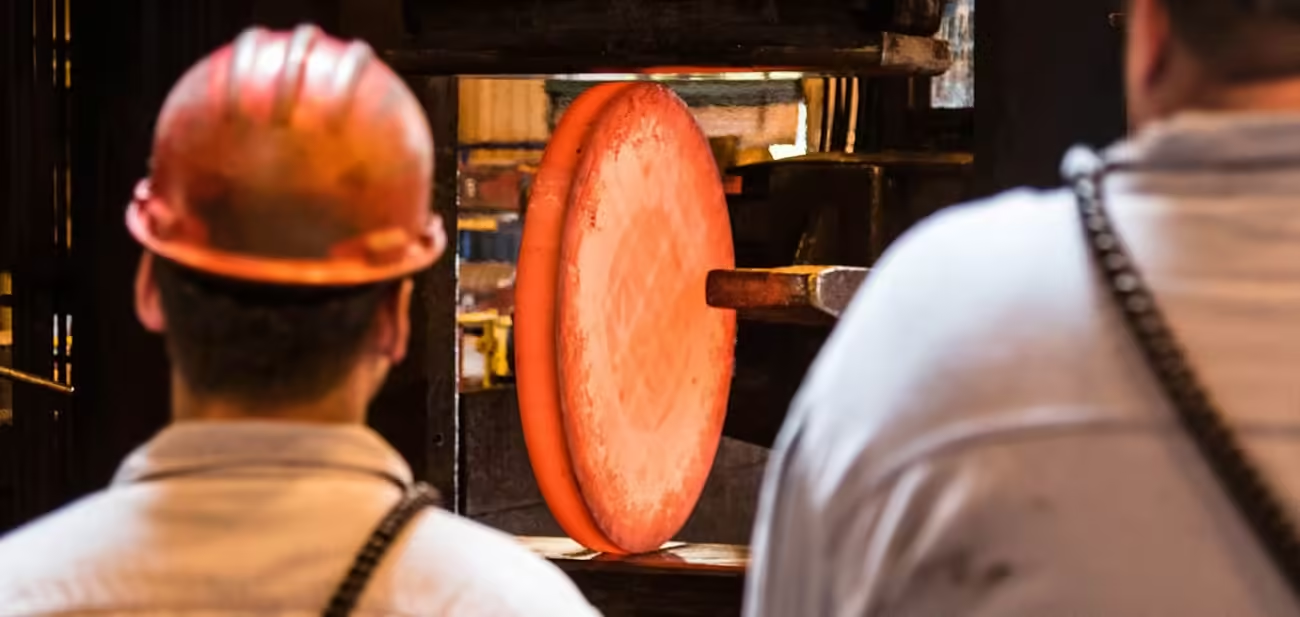
- Hot Forging: Titanium is heated to its recrystallization temperature to allow easier deformation and higher ductility.
- Cold Forging: Used for smaller, simpler parts where surface finish and tight tolerances are a priority.
Open Die vs. Closed Die Forging
- Open Die Forging: Ideal for larger, less complex shapes.
- Closed Die Forging: Offers precise geometries and repeatability for high-volume production.
Comparing Forged Titanium with Other Materials
| Material | Strength | Weight | Corrosion Resistance | Cost | Biocompatibility |
|---|---|---|---|---|---|
| Forged Titanium | High | Low | Excellent | High | Excellent |
| Stainless Steel | Medium | Medium | Good | Medium | Moderate |
| Aluminum Alloys | Low | Very Low | Fair | Low | Moderate |
| Carbon Steel | Very High | High | Poor | Low | Low |
| Magnesium Alloys | Low | Very Low | Poor | Medium | Low |
This comparison helps demonstrate how forged titanium stands out as a top-tier material for critical applications.
How to Source Quality Forged Titanium
Key Considerations When Buying
- Grade and Certification: Ensure materials are certified and match industry standards.
- Supplier Experience: Choose suppliers with expertise in forging titanium.
- Quality Assurance: Look for thorough inspection and testing protocols (e.g., ultrasonic, x-ray).
Customization Options
Leading manufacturers can provide:
- Custom alloys
- Specialized dimensions
- Surface treatments
- Post-forging machining
Conclusion
Forged titanium is an exceptional material that can significantly elevate the performance, quality, and longevity of your products. Whether you’re innovating in aerospace, medical, industrial, or consumer goods, it offers unmatched benefits in strength, weight, and corrosion resistance.
If you’re ready to experience the unmatched advantages of forged titanium in your manufacturing process, contact us today to discuss your requirements and explore custom solutions tailored to your industry.
FAQ
Why is forged titanium more expensive than other metals?
The cost reflects its complex processing, superior performance, and long lifespan, which typically yields a better return on investment.
Is forged titanium suitable for food processing equipment?
Yes, especially because of its corrosion resistance and biocompatibility.
Can titanium forged be welded?
Yes, with the proper technique and preparation, titanium forged welds well.
How is titanium forged tested for quality?
Techniques include ultrasonic inspection, dye penetrant testing, and mechanical property testing to confirm structural integrity and performance.