Shandong Qilu lndustrial Co.,Ltd.

Defence Forgings: Your Strategic Sourcing Guide
Welcome to My Blog!
Before we dive into the content, I’d love for you to join me on my social media platforms where I share more insights, engage with the community, and post updates. Here’s how you can connect with me:
Facebook:https://www.facebook.com/profile.php?id=100090903441806
Now, let’s get started on our journey together. I hope you find the content here insightful, engaging, and valuable.
Table of Contents
Introduction
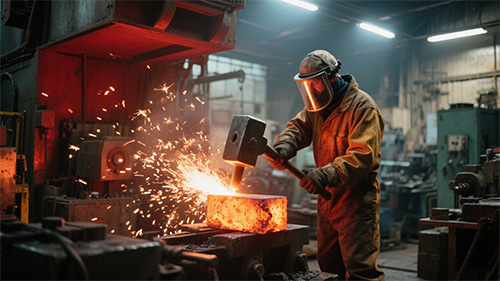
In today’s critical defense and security sectors, every component is vital. Whether you’re sourcing shaft forgings for heavy propulsion systems, ring forgings for aerospace structures, or disc forgings for armored vehicles, defense forgings play a crucial role in operational efficiency and mission success.
We understand the pressure you face when selecting a supplier; you need reliability, consistency, and quality assurance. That’s why we’ve heavily invested in state-of-the-art forging and testing equipment, ranging from 200 to 4,000 tons. This enables us to produce everything from single prototypes to orders exceeding 100,000 pieces, covering a wide array of high-precision forged components used in global defense applications.
This guide is your go-to resource for procuring defense forgings. We’ll detail forging types, applications, quality assurance processes, and key factors for choosing a long-term forging partner. This article is written specifically for procurement specialists, engineers, and project managers in the defense sector, aiming to support your objectives.
Why Defence Forgings Matter More Than Ever
The Critical Role of Forgings in Defence Systems
Forgings form the backbone of numerous critical systems in the defence sector. From naval propulsion shafts to missile system brackets, they are trusted for their mechanical strength, fatigue resistance, and dimensional integrity.
Unlike casting or machining from bar stock, forging aligns the grain flow with the shape of the component, increasing structural integrity—something essential when lives depend on the performance of your machinery.
Commonly forged defence components include:
- Shafts for propulsion and drive systems
- Gear blanks and spline components
- Rings for aerospace turbines
- Flanges and couplings
- Discs for artillery systems and braking units
Each application demands tight tolerances, rigorous testing, and long-term reliability—requirements that only experienced forging specialists can consistently meet.
Choosing the Right Defence Forging Partner
What to Look For in a Forging Supplier for Defence Applications
When sourcing defence forgings, you’re not just purchasing a metal component—you’re buying trust, precision, and reliability. Here’s what you should evaluate in a forging manufacturer:
Equipment Range and Production Flexibility
Look for suppliers with a wide tonnage capacity. A range from 200 to 4000 tons offers the flexibility to produce anything from small pins to large-diameter forged rings or shafts. This also shows a capability to handle both low- and high-volume production.
In-House Testing and Quality Control
Defence applications require strict compliance with international standards. A supplier should have comprehensive in-house inspection capabilities, including:
- Ultrasonic testing (UT)
- Magnetic particle inspection (MPI)
- Chemical composition analysis
- Tensile and impact testing
Material Traceability
All defence forging materials must be traceable from raw input to final inspection. Ask your supplier how they ensure traceability through batch control and material certification.
Global Logistics Capabilities
An often-overlooked point: can your forging supplier deliver quickly, globally, and reliably? Whether you need urgent prototypes or large-scale delivery, a strong logistics chain ensures you’re not caught off guard by delays.
Forging Processes Explained
Common Methods Used in Defence Forgings
There are several forging processes used depending on the part design and mechanical requirements:
| Forging Method | Best For | Typical Applications | Advantages |
|---|---|---|---|
| Open-Die Forging | Large, simple parts | Shafts, bars, billets | Grain refinement, directional strength |
| Closed-Die (Impression) | Complex geometries, repeatability | Gears, brackets, missile parts | High precision, reduced machining |
| Ring Rolling | Symmetrical, ring-shaped components | Bearings, flanges, aerospace and tank rings | Excellent material utilization, concentricity |
| Upset Forging | Parts with increased diameter in a segment | Bolts, fasteners, artillery end caps | Strong head-to-shaft integrity |
Each method involves unique material flow characteristics, tooling, and dimensional control, all of which affect the performance of the final product in a defence system.
Material Selection in Defence Forging
Strategic Materials for Strategic Performance
Choosing the right alloy is just as important as the forging method itself. Defence components often require high-performance metals that resist corrosion, temperature extremes, and mechanical stress. Common materials include:
- Alloy steels – High tensile strength and fatigue resistance
- Carbon steels – Cost-effective with good machinability
- Stainless steels – Excellent corrosion resistance
- Titanium alloys – Lightweight and strong, ideal for aerospace
- Aluminum alloys – Lightweight and corrosion-resistant for structural parts
Working with a forging partner who understands these material characteristics and has access to certified raw stock ensures every part meets spec—from chemical composition to microstructure.
Quality Assurance: Not Optional, But Essential
Defence Forging Standards and Certifications to Demand
You should expect your supplier to comply with internationally recognized certifications and standards, such as:
- ISO 9001: Quality management systems
- ISO/TS 16949 or AS9100: Automotive and aerospace sectors
- MIL-SPEC standards (where applicable)
- NADCAP for specific non-destructive testing processes
In addition, suppliers should have internal quality protocols that go above and beyond what’s required—because in defence, “close enough” isn’t good enough.
Lead Time, Inventory, and Supply Chain Risk
Mitigating Delays in Defence Forging Procurement
Unreliable supply chains can cost millions in project delays. Here’s how a well-prepared forging manufacturer can help:
- Stocking critical materials in advance
- Offering finished product inventory options
- Flexible production scheduling
- Pre-tested components ready for rapid deployment
If your project has tight turnaround times, consider working with a supplier that holds inventory on your behalf or can scale production quickly without sacrificing quality.
Common Challenges in Defence Forging—and How to Avoid Them

Top Procurement Pitfalls and Solutions
- Poor Dimensional Tolerance: Ensure your supplier uses closed-die forging or ring rolling for tighter specs.
- Inconsistent Mechanical Properties: Require full documentation on heat treatment and testing.
- Delayed Deliveries: Partner with companies that offer global delivery and robust supply chain models.
- Lack of Customization: Work with manufacturers open to co-design and engineering consultations.
Your supplier should act as an extension of your engineering team—not just a vendor.
Conclusion
Choosing the right forging partner for your defence applications means selecting someone who shares your commitment to precision, reliability, and global readiness. With advanced equipment from 200 to 4000 tons, in-house testing labs, and global logistics capabilities, our forging capabilities are engineered for performance-critical industries like defence.
Whether you need a single prototype or production runs of 100,000+ parts, we’re prepared to deliver with speed, precision, and integrity. Let us help you build a stronger, more secure tomorrow—one forging at a time.
Get in touch today and see how our forging expertise can power your mission success.
FAQ
What makes defence forging different from other industrial forgings?
Defence forging typically requires stricter tolerances, certified materials, and compliance with national and international military standards. These forgings are often used in critical applications where failure is not an option.
How do I verify the quality of a defence forging supplier?
Look for certifications like ISO 9001, AS9100, and NADCAP. Ask for sample inspection reports, test data, and third-party audit results. In-person visits or virtual tours of their facilities also help.
Can forged components be customized for my specific project?
Absolutely. Forging manufacturers often offer custom dies and design engineering services. Customization is common in defence projects that have unique dimensions or performance needs.
What is the typical lead time for a defence forging order?
Lead times vary based on complexity and volume but typically range from 4–12 weeks. Fast-track options may be available for urgent requirements if inventory or raw material stock exists.