Shandong Qilu lndustrial Co.,Ltd.

Best Drop Forging: Crafting Superior Components!
Welcome to My Blog!
Before we dive into the content, I’d love for you to join me on my social media platforms where I share more insights, engage with the community, and post updates. Here’s how you can connect with me:
Facebook:https://www.facebook.com/profile.php?id=100090903441806
Now, let’s get started on our journey together. I hope you find the content here insightful, engaging, and valuable.
Table of Contents
Introduction
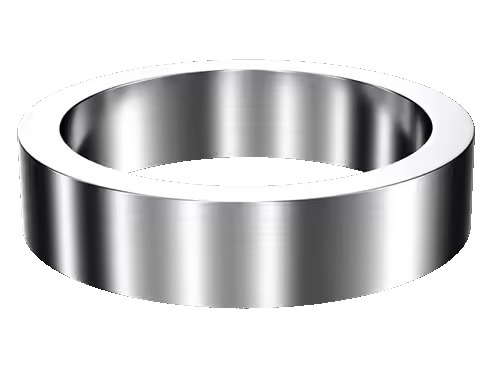
Drop forging is a metal shaping process in which a hammer is dropped onto a piece of metal to mold it into a desired shape within a die cavity. This ancient yet continually evolving technique plays a crucial role in producing high-strength components that are widely used across industries such as automotive, agriculture, construction, oil and gas, railways, and heavy machinery.
As industries demand increasingly durable, precise, and efficient components, forging drop continues to stand out for its reliability and cost-effectiveness. In this blog, we delve deep into the forging drop process, its applications, benefits, and what makes it the preferred choice for manufacturing premium-grade parts.
The Drop Forging Process Explained
What Is Drop Forging?
Drop forging is a forging technique where force is applied through a falling hammer or press to shape metal inside a die. The metal, usually heated, is deformed into the die’s cavity with high accuracy and repeatability. The result is a component that exhibits superior strength, toughness, and fatigue resistance compared to those made from casting or machining.
Types of Drop Forging
There are mainly two types of forging drop methods:
- Open-Die Drop Forging: The workpiece is compressed between flat or simple-shaped dies, allowing for more flexibility in size but requiring more machining.
- Closed-Die Forging Drop: The metal is fully enclosed in dies, creating precise shapes with minimal finishing.
Key Steps in the Drop Forging Process
- Die design and preparation
- Heating the metal to the forging temperature
- Forging using drop hammers or presses
- Trimming and finishing
- Heat treatment for additional strength
Each of these stages must be precisely controlled to maintain the integrity and mechanical properties of the final product.
Advantages of Forging Drop for Industrial Applications
Strength and Durability of Drop Forged Components
Drop forging aligns the internal grain structure of metal to follow the contours of the part. This alignment provides significant strength and resistance to impact, making forged components ideal for high-stress applications.
Cost Efficiency in High-Volume Manufacturing
While the initial cost of die creation can be high, forging drop becomes extremely economical at large production volumes. Once set up, the process allows for rapid, repeatable production with minimal waste.
Precision and Consistency in Forging Drop
Closed-die forging in particular offers exceptional dimensional accuracy. This results in components that often require little to no additional machining, reducing lead times and labor costs.
Applications of Drop Forging Across Industries
Automotive
Drop forging is used for manufacturing engine parts, gear blanks, crankshafts, steering knuckles, and suspension components due to their need for fatigue strength.
Construction and Mining
Heavy-duty tools, connectors, and structural parts that endure extreme loads are commonly made through forging drop.
Oil and Gas
Drop forged parts like valve bodies, couplings, and flanges are standard in high-pressure environments such as oil rigs and pipelines.
Agricultural Equipment
Parts such as plowshares, shafts, and yokes are drop forged to withstand abrasive and dynamic environments.
Drop Forging vs Other Metal Forming Processes
| Feature | Drop Forging | Casting | Machining | Stamping |
|---|---|---|---|---|
| Strength | Very High | Moderate | High | Low to Moderate |
| Material Utilization | Good | Poor | Poor | Excellent |
| Precision | High | Moderate | Very High | High |
| Surface Finish | Good | Very Good | Excellent | Good |
| Production Cost (per unit) | Low (high volume) | Moderate | High | Low |
| Setup Cost | High | Moderate | Low | Moderate |
| Best Use Case | Structural parts | Complex geometries | Prototypes | Thin components |
This comparison illustrates why forging drop remains the go-to solution for high-performance, high-strength applications.
Choosing a Reliable Drop Forging Manufacturer
Why Qilu Stands Out in the Drop Forging Industry
Qilu is a trusted name in the global forging market, known for its professional manufacturing of high-quality forged components. With over 1000 tons of forging inventory, Qilu ensures quick delivery to meet client deadlines without compromising on quality.
Customized Drop Forging Solutions
Qilu offers efficient and flexible custom forging services. Whether you require complex geometries or tailored mechanical properties, our engineering team collaborates closely with you to deliver precision-forged solutions.
Quality Control and Certifications
Our forging drop processes adhere to international quality standards, with full traceability, rigorous material inspection, and mechanical property testing conducted at every stage.
Industry Coverage
Qilu serves a wide range of sectors including agriculture, automotive, oil and gas, construction, marine, and mining—supporting global customers with both standard and bespoke forged parts.
Innovations and Trends in Drop Forging
Digital Manufacturing and Simulation in Forging
Modern forging drop facilities leverage computer-aided die design and simulation tools to ensure accurate material flow, reduce trial-and-error, and accelerate product development timelines.
Eco-Friendly Forging Practices
Qilu is committed to sustainability. We use efficient induction heating, recycle forging scrap, and continuously optimize energy use across production lines.
Material Innovations
As demand grows for high-strength and lightweight parts, forging drop is now applied to new alloy systems like titanium and advanced aluminum, expanding its application in aerospace and high-speed transport systems.
How to Specify a Drop Forged Part
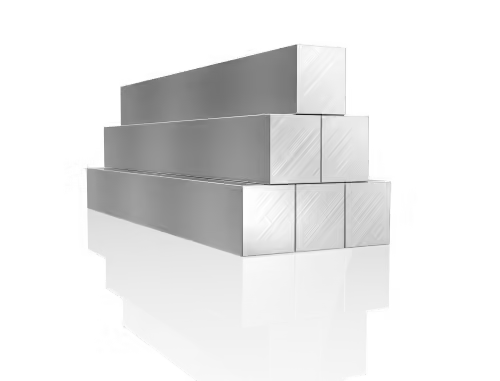
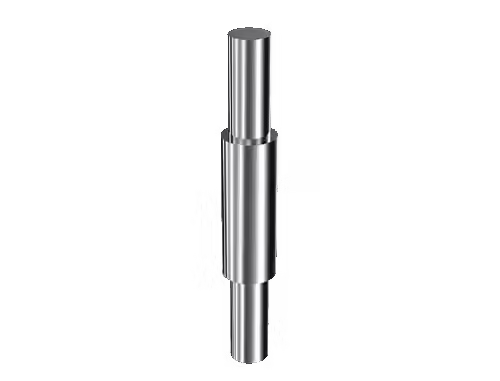
Essential Information for Drop Forging Projects
When ordering drop forged parts, be ready to provide:
- Technical drawings or CAD files
- Material specifications
- Mechanical property requirements
- Surface treatment needs
- Annual production volume
Collaborating early with your forging partner ensures the final component meets both technical and cost objectives.
Conclusion
Drop forging remains an essential process in modern manufacturing, delivering unmatched strength, reliability, and efficiency. With applications across diverse industries and ongoing innovation in materials and processes, drop forging is here to stay as the preferred solution for high-performance components.
Qilu is proud to be your expert forging partner, offering efficient custom drop forging services and maintaining over 1000 tons of forging inventory to ensure fast, reliable delivery. Ready to start your next forging project? Contact us today to discuss your needs and receive a tailored solution that meets the highest quality standards.
FAQ
Is drop forging better than casting?
Yes, for applications where strength, fatigue resistance, and structural integrity are critical, forging drop outperforms casting due to its superior grain structure.
What materials are typically used in forging drop?
Common materials include carbon steel, alloy steel, stainless steel, aluminum, brass, and titanium, depending on the application requirements.
How long does it take to produce a custom drop forged part?
The lead time varies by complexity but generally includes tooling development (2–4 weeks) followed by production (1–3 weeks). Qilu’s vast inventory helps accelerate fulfillment where possible.
Can I order low volumes?
While forging drop is best suited to high-volume production, Qilu supports low-to-medium volumes through optimized tooling and flexible processes.