Shandong Qilu lndustrial Co.,Ltd.

7 Tips to Ensure Quality in The Forgings Industry
Welcome to My Blog!
Before we dive into the content, I’d love for you to join me on my social media platforms where I share more insights, engage with the community, and post updates. Here’s how you can connect with me:
Facebook:https://www.facebook.com/profile.php?id=100090903441806
Now, let’s get started on our journey together. I hope you find the content here insightful, engaging, and valuable.
Table of Contents
Introduction
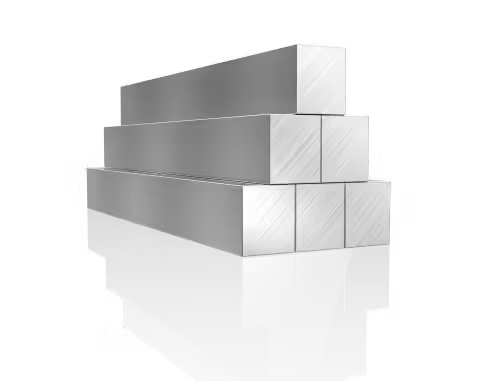
The forgings industry is an essential part of modern manufacturing, producing high-strength components for everything from aerospace to heavy machinery. Quality is everything in this field—without it, products fail, safety is compromised, and businesses suffer. But ensuring quality isn’t just about meeting basic industry standards; it requires a deep understanding of materials, processes, and quality control measures.
Manufacturers who want to stay ahead must focus on refining their techniques, optimizing their supply chain, and investing in proper testing. Let’s dive into expert strategies that can help maintain top-tier quality in forged products.
Understanding Quality Standards in the Forgings Industry
Quality in the forgings industry isn’t just about durability; it’s about meeting the stringent requirements set by regulatory bodies. Standards like ASTM, ISO 9001, and AS9100 exist for a reason—to ensure that forged components meet strict specifications for strength, precision, and performance. For industries like aerospace and oil & gas, even the smallest deviation can lead to costly failures.
Compliance is just the starting point. A manufacturer must continuously assess whether they are just ticking boxes or genuinely producing superior-quality forgings. This means not only following guidelines but also consistently improving processes to stay competitive.
The Foundation of Quality: Selecting the Right Materials
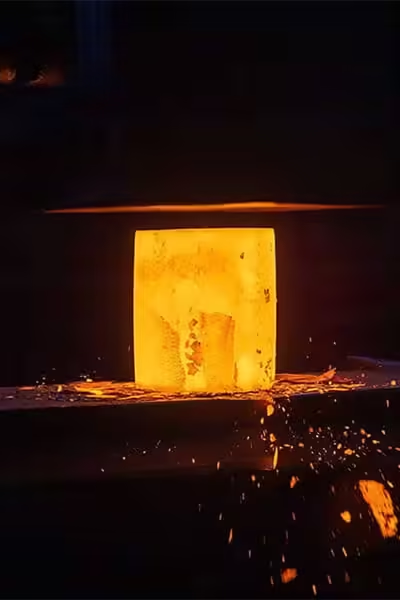
The quality of any forged component starts with the raw materials used. A well-selected metal can determine whether a component lasts years under extreme conditions or fails prematurely. Factors like mechanical strength, heat resistance, and corrosion resistance all play a role.
For example, aerospace components require high-performance alloys that can withstand extreme temperatures, while industrial machinery may prioritize impact-resistant steel. Cost-effectiveness also comes into play—opting for cheaper materials may save money upfront, but long-term durability and performance must be considered.
Advanced Forging Techniques That Enhance Quality
Traditional forging methods still hold value, but modern advancements have transformed the industry. Closed-die forging, for example, allows for greater precision and improved structural integrity. Open-die forging, on the other hand, remains essential for large-scale industrial components. Press forging enhances uniformity, making it a go-to choice for high-performance applications.
Beyond the forging process itself, automation and CNC-controlled processes have redefined quality standards. The introduction of robotic arms and AI-driven precision systems ensures repeatability and minimizes human error, which is one of the leading causes of inconsistencies in traditional forging.
Quality Control: Ensuring Defect-Free Forgings
Quality control isn’t just an afterthought—it’s embedded into every stage of the forging process. Without proper inspection, defects can slip through, leading to failures down the line. A combination of non-destructive testing, ultrasonic inspection, and hardness testing helps manufacturers maintain high standards.
| Quality Control Method | Purpose | Key Advantage |
|---|---|---|
| Non-Destructive Testing (NDT) | Detects internal defects without damaging the product | Ensures product integrity without material loss |
| Ultrasonic Testing (UT) | Uses sound waves to identify hidden flaws | Effective for thick and dense materials |
| Magnetic Particle Inspection (MPI) | Identifies surface and near-surface discontinuities | Fast and reliable for ferromagnetic materials |
| Hardness Testing | Measures material resistance to deformation | Ensures proper strength and durability |
| Dimensional Inspection | Confirms exact specifications | Prevents assembly issues and improves fit |
Ensuring each component passes these tests isn’t just about meeting requirements—it’s about delivering forgings that perform flawlessly under extreme conditions.
The Role of Heat Treatment in Strengthening Forged Components
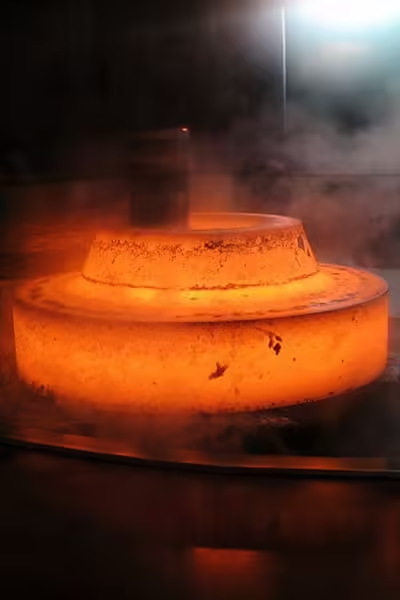
Heat treatment is a game-changer in the forgings industry. Without it, even the best materials may not perform as expected. Processes like annealing, normalizing, and quenching improve metal properties, ensuring optimal hardness, toughness, and durability.
Annealing helps soften metal, reducing stress and making machining easier, while normalizing refines grain structure, improving mechanical properties. Quenching and tempering take it a step further by increasing hardness while maintaining flexibility. Proper heat treatment can mean the difference between a component that cracks under pressure and one that withstands decades of wear and tear.
Managing Suppliers and the Forging Supply Chain
No matter how advanced a manufacturer’s equipment is, poor-quality raw materials can ruin the final product. This is why supplier selection is crucial. A reliable supply chain ensures consistent quality, while a poorly managed one introduces variability that leads to defects.
The best manufacturers vet their suppliers rigorously, checking for proper certifications and proven track records. Establishing long-term partnerships also helps stabilize material costs and guarantees consistency. In contrast, constantly switching vendors to save money can result in fluctuating quality and unpredictable issues.
Conclusion
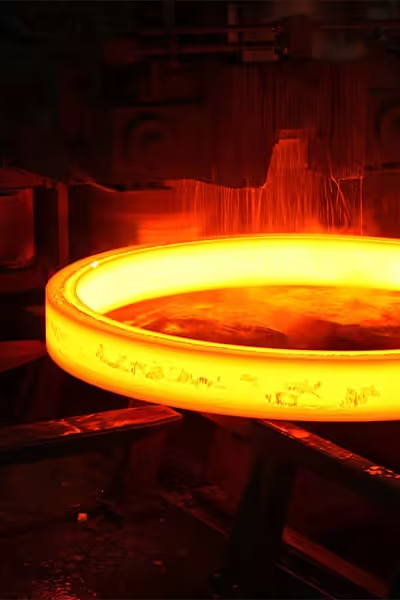
Ensuring quality in the forgings industry requires a comprehensive approach—choosing the right materials, leveraging modern forging techniques, implementing strict quality control, and managing suppliers effectively. Manufacturers who prioritize these factors not only improve product reliability but also gain a competitive edge in the market.
Looking for top-quality forged components? Get in touch with our experts today and find the perfect solution for your needs.
FAQ
What is the biggest challenge in ensuring high-quality forgings?
One of the biggest challenges is maintaining consistency, especially when working with different materials and complex specifications. Without proper quality control, even minor variations can lead to defects.
How does heat treatment improve forged components?
Heat treatment enhances strength, hardness, and durability by refining the metal’s internal structure. Processes like quenching and tempering ensure forged products can handle extreme stress.
Why is automation important in the forgings industry
Automation minimizes human error, improves precision, and ensures repeatability, leading to higher-quality products. It also increases efficiency, reducing production time and costs.
What type of testing is most effective for detecting internal defects?
Ultrasonic testing is highly effective for identifying internal flaws, as it uses sound waves to detect inconsistencies without damaging the component.
How can manufacturers maintain a high-quality supply chain?
By partnering with reputable suppliers, verifying material quality, and establishing long-term relationships, manufacturers can ensure consistent, high-quality raw materials for their forgings.