Shandong Qilu lndustrial Co.,Ltd.

Why Experts Recommend Forged Aluminum for Extreme Durability
Welcome to My Blog!
Before we dive into the content, I’d love for you to join me on my social media platforms where I share more insights, engage with the community, and post updates. Here’s how you can connect with me:
Facebook:https://www.facebook.com/profile.php?id=100090903441806
Now, let’s get started on our journey together. I hope you find the content here insightful, engaging, and valuable.
Table of Contents
Introduction

Forged aluminum has gained significant recognition in various industries due to its outstanding durability, lightweight properties, and superior strength. Compared to other materials, it provides enhanced performance, making it a preferred choice for applications that demand high resilience and longevity. This article explores why experts advocate for this material in critical applications, its benefits, and how it compares to other options.
The Strength and Durability of Forged Aluminum
One of the primary reasons industry professionals advocate for this material is its outstanding strength-to-weight ratio. This characteristic makes it an essential material in industries that prioritize both durability and lightweight efficiency. Unlike cast alternatives, which often suffer from porosity, uneven grain distribution, and structural inconsistencies, the forging process refines the internal grain structure, resulting in a more uniform, robust, and high-performance component.
Through the forging process, the metal undergoes intense pressure, effectively eliminating internal voids and improving overall toughness and reliability. This enhanced structure allows it to endure extreme conditions, whether it be high impact, continuous stress cycles, or exposure to corrosive environments. Consequently, this material is widely utilized in sectors such as aerospace, automotive, marine, and industrial machinery, where safety, longevity, and resilience are critical.
Advantages of Forging Over Casting
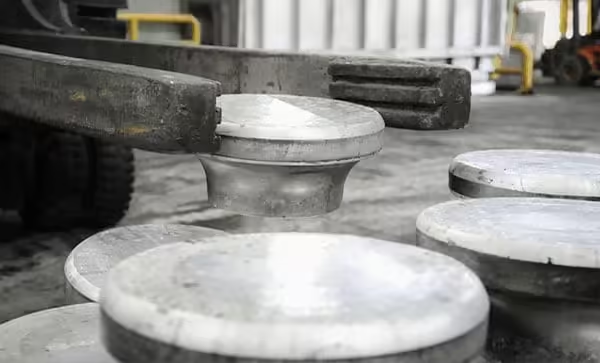
While both forging and casting are widely used in metal fabrication, they yield vastly different results. The forging process offers several key advantages over casting, particularly in applications where strength and reliability are paramount.
- Improved mechanical properties – The forging process enhances grain flow within the metal, leading to superior tensile strength, impact resistance, and toughness. This structural refinement results in parts that can handle heavy loads and extreme conditions far better than cast components.
- Greater structural integrity – Cast components often suffer from porosity, shrinkage, and inconsistent density, making them vulnerable to cracks, fractures, and internal defects. In contrast, forged components benefit from a densely packed molecular structure, ensuring higher load-bearing capacity and longevity.
- High fatigue resistance – Given its superior toughness, this material can withstand continuous stress cycles without deforming or failing prematurely. This makes it particularly beneficial for applications exposed to constant mechanical pressure, vibration, and impact forces.
Additionally, forging enhances material reliability, reducing the need for frequent replacements and lowering overall maintenance costs. Whether used in high-performance vehicles, aerospace engineering, or heavy industrial applications, forged components provide a longer service life, offering substantial economic and operational benefits.
Applications in High-Stress Environments
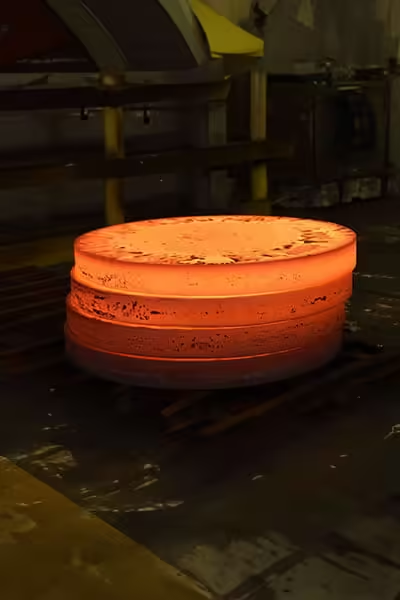
Due to its exceptional durability, corrosion resistance, and lightweight properties, forged aluminum is indispensable in industries that require components capable of withstanding intense operational demands. Below are some of the primary sectors that benefit from the unique properties of forged aluminum:
- Aerospace – Aircraft structures, landing gear, engine components, and fuselage parts rely on lightweight yet high-strength materials to enhance fuel efficiency and structural integrity. Forged aluminum is a preferred choice in aviation engineering, as it meets stringent safety and performance standards while reducing overall aircraft weight. The use of forged aluminum in these applications contributes significantly to improved fuel efficiency and overall performance.
- Automotive – The demand for performance, fuel efficiency, and safety in modern vehicles has driven the widespread use of forged aluminum components. This material is commonly found in high-performance wheels, suspension parts, engine blocks, and transmission components, where durability and weight reduction play a critical role. The high strength and reliability of forged aluminum ensure that these automotive parts perform under demanding conditions, improving vehicle safety and longevity.
- Marine – Exposure to saltwater and harsh marine environments necessitates materials with superior corrosion resistance. Forged aluminum is widely used in shipbuilding, offshore structures, and marine propulsion systems, offering exceptional longevity and performance in demanding aquatic conditions. Its resistance to corrosion makes forged aluminum the ideal material for components exposed to harsh marine environments, ensuring longevity and reducing maintenance costs.
- Industrial machinery – Forged aluminum is an ideal choice for high-strength gears, crankshafts, hydraulic components, and structural reinforcements in heavy-duty machinery. It enhances machine efficiency, withstands continuous operational stress, and reduces the risk of premature component failure. By incorporating forged aluminum into critical machinery components, industries can ensure enhanced performance, reduced downtime, and improved operational efficiency.
The use of forged aluminum in these industries highlights its versatility, reliability, and long-term performance, making it a key material for applications where strength, precision, and endurance are critical. Whether it’s used in aerospace, automotive, marine, or industrial machinery, forged aluminum continues to prove its value by delivering superior performance in the most demanding conditions.
Comparing Forged Aluminum to Other Materials
To further understand why this material stands out, let’s compare it with other commonly used materials.
| Property | Forged Aluminum | Cast Aluminum | Steel | Titanium |
|---|---|---|---|---|
| Strength-to-Weight | High | Moderate | Moderate-High | High |
| Durability | Excellent | Moderate | High | High |
| Corrosion Resistance | High | High | Low-Moderate | Excellent |
| Machinability | High | High | Moderate | Moderate |
| Cost | Moderate | Low | Moderate | High |
This comparison highlights how this material provides a balanced solution for industries that demand both performance and cost efficiency.
Conclusion
Experts consistently recommend this material for its durability, reliability, and performance across multiple applications. The forging process enhances its mechanical properties, making it a preferred choice over cast alternatives and even certain steel or titanium components. Whether in aerospace, automotive, or industrial machinery, its strength, lightweight nature, and resistance to wear make it an optimal material for extreme environments.
FAQ
Q: What makes forged aluminum stronger than cast aluminum?
A: The forging process refines the grain structure, eliminating voids and improving overall mechanical properties, making it stronger and more durable than cast versions.
Q: Is it more expensive than other materials?
A: While it may be more costly than cast options, its long lifespan and superior performance make it a cost-effective choice in the long run.
Q: Can it be used in high-temperature environments?
A: Yes, it exhibits good heat resistance and is commonly used in aerospace and automotive applications where high temperatures are a concern.
Q: How does it compare to titanium?
A: While titanium is stronger, it is also significantly heavier and more expensive. This material provides an excellent balance between strength, weight, and cost.
Q: What industries benefit most from using this material?
A: Aerospace, automotive, marine, and industrial sectors utilize it for its strength, durability, and corrosion resistance.