Shandong Qilu lndustrial Co.,Ltd.

Forged Steel Blocks: Applications in Various Industries
Welcome to My Blog!
Before we dive into the content, I’d love for you to join me on my social media platforms where I share more insights, engage with the community, and post updates. Here’s how you can connect with me:
Facebook:https://www.facebook.com/profile.php?id=100090903441806
Now, let’s get started on our journey together. I hope you find the content here insightful, engaging, and valuable.
Table of Contents
Introduction
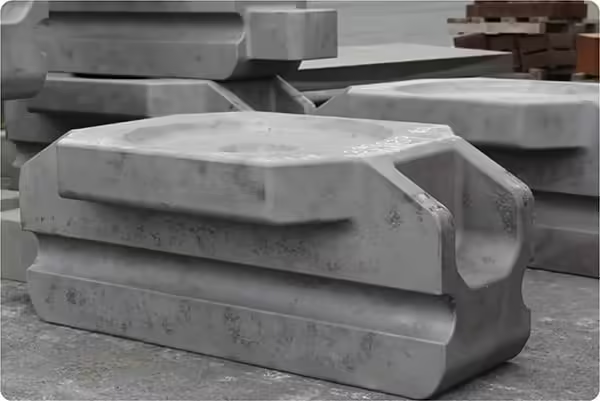
Forged steel blocks are indispensable components in a vast range of industries, highly valued for their exceptional strength, remarkable durability, and inherent versatility. Unlike cast steel, which is simply poured into a mold and allowed to solidify, forged steel undergoes a rigorous mechanical deformation process. This process involves applying compressive forces, typically using a powerful hammer or press, to shape the steel. This forceful manipulation refines the steel’s internal grain structure, effectively eliminating any voids, weaknesses, or inconsistencies that might be present in cast steel. The result is a superior product, a forged steel block, capable of withstanding extreme conditions, heavy loads, and challenging environments, making it a critical material in demanding applications. From the smallest component in a precision instrument to the massive structural element in a towering skyscraper, forged steel blocks provide the backbone for countless essential products and infrastructure.
Manufacturing Process of Steel Blocks
The manufacturing process of forged steel blocks is a meticulous and carefully controlled sequence of steps, ensuring the final product adheres to stringent quality standards and meets the exacting requirements of its intended application. The process begins with the careful selection of high-quality steel billets, the raw material for the forging process. These billets are chosen based on their specific chemical composition and mechanical properties, tailored to the needs of the final forged block steel. The selected billets are then heated to precise forging temperatures in specialized furnaces. This heating process is critical, as it renders the steel malleable enough to be shaped without compromising its internal structure. The heated billet is then transferred to a forging hammer or press, where it is subjected to a series of controlled blows or precisely applied pressure. Skilled operators guide the forging process, manipulating the steel under the hammer or press to gradually shape it into the desired block form. Throughout this process, the steel is continually worked and refined, further enhancing its mechanical properties and ensuring a uniform and robust structure. The forging process might involve multiple stages, with intermediate reheating and shaping to achieve the final dimensions and form of the steel block. After forging, the steel block undergoes a series of finishing operations, such as cooling, heat treatment, and machining, to achieve its final dimensions, surface finish, and desired mechanical properties.
Advantages of Using Steel Blocks
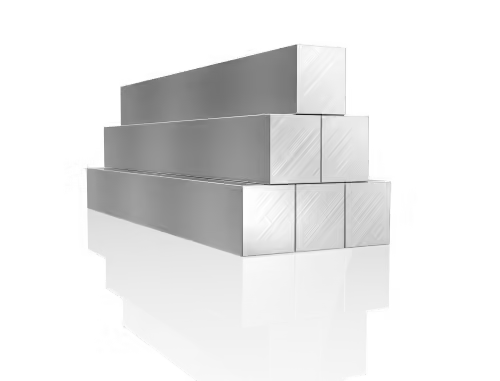
Forged block steel offer a compelling array of advantages that make them a preferre choice in demanding applications across numerous industries. These advantages stem from the unique refinement of the steel’s grain structure during the forging process:
- Superior Strength: The forging process effectively eliminates internal voids and weaknesses that might be present in cast steel. Simultaneously, it refines the grain structure, creating a dense and uniform matrix. This refined microstructure translates to exceptional strength, significantly enhancing the steel block’s ability to withstand high loads, impact forces, and extreme stresses without fracturing or deforming.
- Enhanced Durability: Forged steel blocks exhibit exceptional durability, enabling them to endure harsh environments, extreme temperatures, and heavy loads without compromising their structural integrity. The dense and uniform structure achieved through forging makes the steel less susceptible to corrosion, fatigue, and wear, ensuring a long service life even in challenging conditions.
- Improved Fatigue Resistance: The refined grain structure achieved through forging significantly enhances the fatigue resistance of steel blocks. Fatigue occurs when a material is subjected to repeated cyclic stresses, eventually leading to failure even below the material’s ultimate tensile strength. Forged steel blocks, with their uniform and defect-free microstructure, are far less susceptible to fatigue crack initiation and propagation, making them ideal for applications involving cyclic loading, such as crankshafts and connecting rods in engines.
- Design Flexibility: Forged steel blocks can be manufactured in a wide variety of shapes and sizes, accommodating diverse design requirements and complex geometries. The forging process allows for the creation of near-net-shape forgings, minimizing the amount of machining required and reducing material waste. This design flexibility makes forged steel blocks suitable for a broad spectrum of applications, from simple shapes to highly intricate components.
- Cost-Effectiveness: While the initial cost of forged block steel might be slightly higher than that of cast steel components, the long-term benefits, such as extended service life, reduced maintenance requirements, and improved reliability, make them a cost-effective choice in the long run. The superior properties of forged steel blocks minimize the risk of premature failure, reducing downtime and replacement costs, ultimately leading to significant cost savings over the lifespan of the component.
Applications of Steel Blocks in Industries
Forged steel blocks find extensive use across a wide range of industries, serving as critical components in numerous applications where strength, durability, and reliability are paramount:
- Aerospace: In the demanding aerospace sector, forged steel blocks are indispensable in manufacturing critical components such as landing gear, engine mounts, structural parts, and turbine discs. These components experience extreme stresses, high temperatures, and cyclic loading, requiring the exceptional properties that only forged steel can provide.
- Automotive: The automotive industry relies heavily on forged steel blocks for producing crucial powertrain components such as crankshafts, connecting rods, gears, axles, and steering knuckles. These components are subjected to high stresses, fatigue, and impact loads, demanding the superior strength and durability of forged steel.
- Construction: Forged steel blocks serve as essential structural elements in bridges, buildings, heavy machinery, and infrastructure projects. They provide robust support, load-bearing capacity, and resistance to environmental factors, ensuring the safety and longevity of these structures. They are used in crane hooks, structural supports, and foundation components.
- Energy: The energy sector relies on forged block steel for manufacturing components in power generation equipment, oil and gas exploration, and renewable energy systems. These components, such as turbine rotors, generator shafts, and drill bits, operate under extreme conditions, including high temperatures, pressures, and corrosive environments, requiring the exceptional properties of forged steel.
- Industrial Equipment: Forged steel blocks are integral to various industrial machines, including presses, hammers, gears, shafts, bearings, and dies. They ensure reliable operation under demanding conditions, providing the strength, durability, and wear resistance required for heavy-duty industrial applications.
- Marine: In shipbuilding and marine engineering, forged block steel are used in constructing hulls, propellers, shafts, rudders, anchors, and other critical components that must withstand corrosive saltwater environments, heavy loads, and dynamic forces.
- Rail: Forged steel blocks play a vital role in railway infrastructure, including tracks, wheels, axles, couplings, and other components that require high strength, wear resistance, fatigue endurance, and impact toughness to ensure the safe and reliable operation of trains.
Steel Block Properties and Specifications
The specific properties of forged steel blocks can vary depending on the steel grade and the forging process used. However, some general properties and specifications are commonly associated with these components:
| Property | Value/Unit |
|---|---|
| Density | 7,850 kg/m³ |
| Tensile Strength | 400-1,000 MPa |
| Yield Strength | 250-800 MPa |
| Elongation | 10-25% |
| Hardness | 150-300 HB |
| Melting Point | 1,370-1,510 °C |
| Thermal Conductivity | 45-60 W/m·K |
Steel Block: Quality Assurance and Testing
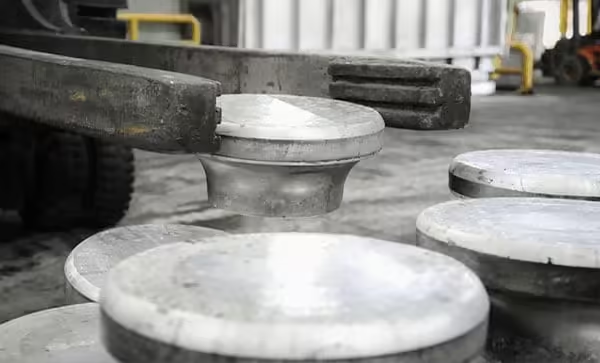
Ensuring the quality of forged steel blocks is paramount, especially in critical applications where failure could have significant consequences. Manufacturers employ various quality assurance measures throughout the manufacturing process to guarantee the integrity and performance of the forged steel blocks:
- Material Certification: Before forging, the steel billets are thoroughly tested and certified to verify their chemical composition and mechanical properties. This ensures that the raw material meets the required specifications and is suitable for the intended application.
- Dimensional Inspection: Throughout the forging process and after completion, precise dimensional inspections are conducted to check the dimensions and tolerances of the forged blocks. This ensures that the blocks meet the specified size and shape requirements and are compatible with their intended use.
- Non-Destructive Testing (NDT): Non-destructive testing methods are employed to detect surface and subsurface defects in the forged block steel without damaging them. Techniques such as ultrasonic testing, magnetic particle inspection, and dye penetrant inspection are used to identify any flaws that could compromise the structural integrity of the blocks.
- Mechanical Testing: Mechanical testing is performed on samples taken from the forged steel blocks to evaluate their mechanical properties. Tests like tensile testing, impact testing, hardness testing, and fatigue testing are conducted to determine the strength, ductility, toughness, and fatigue resistance of the forged steel.
Conclusion
Forged steel blocks stand as a testament to the power of material science and engineering, offering a unique and invaluable combination of strength, durability, and versatility. Their widespread applications across diverse industries, from aerospace and automotive to construction and energy, underscore their critical importance in modern manufacturing and construction. As technology continues to advance and demands for higher performance materials increase, forged steel blocks will undoubtedly continue to play a vital role in shaping the world around us, providing the foundation for countless essential products and infrastructure. Their reliability and performance make them an indispensable material for building a stronger and more technologically advanced future.
FAQ
Q: What is the difference between forged steel and cast steel?
A: Forged steel undergoes mechanical deformation, refining its grain structure and enhancing its properties, while cast steel is simply poured into a mold and allowed to solidify.
Q: How are forged steel blocks made?
A: Forged steel blocks are made by heating steel billets and then subjecting them to controlled blows or pressure from a hammer or press, shaping them into the desired form.
Q: What are the advantages of using forged steel blocks?
A: Forged steel blocks offer superior strength, enhanced durability, improved fatigue resistance, design flexibility, and cost-effectiveness.
Q: In which industries are forged steel blocks used?
A: Forged steel blocks are used in aerospace, automotive, construction, energy, industrial equipment, marine, and rail industries, among others.
Q: How is the quality of forged steel blocks ensured?
A: Manufacturers employ various quality assurance measures, including material certification, dimensional inspection, non-destructive testing, and mechanical testing.