Shandong Qilu lndustrial Co.,Ltd.

Flange Sizes for Different Applications
Welcome to My Blog!
Before we dive into the content, I’d love for you to join me on my social media platforms where I share more insights, engage with the community, and post updates. Here’s how you can connect with me:
Facebook:https://www.facebook.com/profile.php?id=100090903441806
Now, let’s get started on our journey together. I hope you find the content here insightful, engaging, and valuable.
Introduction
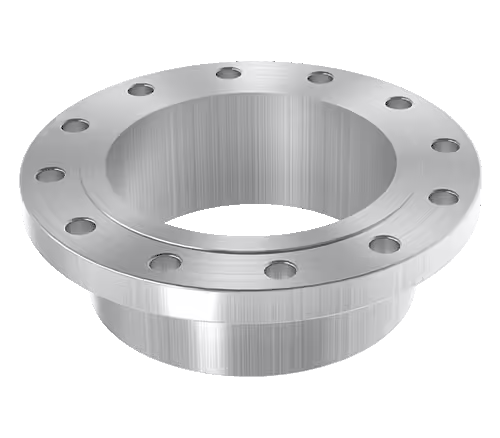
Flanges are essential components in piping systems, connecting pipes, valves, pumps, and other equipment to form a cohesive and leak-free network. They are typically circular, with bolt holes around the perimeter, allowing for secure fastening. Understanding flange sizes is crucial for ensuring proper fit, functionality, and safety in various applications. This comprehensive guide delves into the intricacies of flange sizes, exploring different types, standards, and their respective applications. We will also discuss the factors influencing flange selection and provide a detailed overview of common flange dimensions.
Flange sizes are not arbitrary; they adhere to specific standards and are determined by several factors, including the pipe’s nominal size, pressure rating, and the intended application. Incorrect flange selection can lead to leaks, system failures, and even hazardous situations. Therefore, a thorough understanding of flange sizes is paramount for engineers, technicians, and anyone involved in piping system design and maintenance.
Understanding Nominal Pipe Size (NPS) and Flange Sizes
Nominal Pipe Size (NPS) is a North American set of standard sizes for pipes used for high or low pressures and temperatures. 1 The NPS is a dimensionless number that roughly corresponds to the pipe’s inside diameter. However, it’s important to note that for larger pipes, the NPS and the actual inside diameter diverge. For example, a 12-inch NPS pipe does not have an inside diameter of 12 inches.
Flange sizes are closely related to NPS. A flange designed for a specific NPS pipe will have corresponding dimensions to ensure a proper fit. It’s crucial to match the flange size to the NPS of the pipe to prevent leaks and ensure system integrity.
Exploring Different Types of Flanges and Their Sizes

There are various types of flanges, each designed for specific applications and pressure ratings. Some common types include:
- Weld Neck Flanges: These flanges are welded to the pipe with a butt weld, providing excellent strength and fatigue resistance. They are commonly used in high-pressure and high-temperature applications. Weld neck flange sizes are available for a wide range of NPS and pressure classes.
- Slip-On Flanges: These flanges slip over the pipe and are welded both inside and outside. They are easier to install than weld neck flanges but offer slightly less strength. Slip-on flange sizes are also available for various NPS and pressure classes.
- Blind Flanges: These flanges are used to close off the end of a pipe or vessel. They do not have a bore and are bolted to a matching flange. Blind flange sizes are available for all NPS and pressure classes.
- Socket Weld Flanges: These flanges are similar to slip-on flanges but have a socket in which the pipe is inserted and welded. They are commonly used in smaller diameter piping systems. Socket weld flange sizes are typically available for smaller NPS.
- Threaded Flanges: These flanges have internal threads that allow them to be screwed onto the pipe. They are used in low-pressure applications and where welding is not feasible. Threaded flange sizes are generally available for smaller NPS.
- Lap Joint Flanges: Used with a “stub end” fitting, these are used in applications requiring frequent disassembly. Lap joint flange sizes are available for various NPS and pressure classes.
Each of these flange types has specific size ranges corresponding to different NPS and pressure ratings.
Factors Influencing Flange Sizes Selection
Several factors influence the selection of appropriate flange sizes:
- Pressure Rating: The pressure rating of the system dictates the required flange thickness and bolt size. Higher pressure systems require thicker flanges and larger bolts.
- Temperature: Operating temperature also affects flange selection. High-temperature applications may require special materials and designs.
- Pipe Material: The material of the pipe should be compatible with the flange material to prevent corrosion and ensure a strong connection.
- Application: The specific application of the piping system will influence the choice of flange type and size. For example, high-pressure applications may require weld neck flanges, while low-pressure applications may use threaded flanges.
- Fluid Type: The type of fluid being transported can affect flange material selection due to corrosion or chemical compatibility concerns.
Detailed Overview of Common Flange Sizes and Dimensions
Flange dimensions are standardized by organizations such as ASME (American Society of Mechanical Engineers) and DIN (Deutsches Institut für Normung). These standards define critical dimensions such as:
- Outside Diameter (OD): The overall diameter of the flange.
- Bolt Circle Diameter (BCD): The diameter of the circle on which the bolt holes are located.
- Bolt Hole Diameter: The diameter of the holes for the bolts.
- Flange Thickness: The thickness of the flange.
The following table provides a general overview of common flange sizes for different NPS and pressure classes. It is important to consult the relevant standards for precise dimensions.
| NPS (inches) | Pressure Class (lbs) | Outside Diameter (inches) | Bolt Circle Diameter (inches) | Number of Bolt Holes | Bolt Hole Diameter (inches) |
|---|---|---|---|---|---|
| 1/2 | 150 | 3.50 | 2.75 | 4 | 0.62 |
| 1 | 150 | 4.25 | 3.50 | 4 | 0.62 |
| 2 | 150 | 6.00 | 4.75 | 4 | 0.75 |
| 4 | 150 | 9.00 | 7.50 | 8 | 0.75 |
| 6 | 150 | 11.00 | 9.50 | 8 | 0.88 |
| 1/2 | 300 | 3.75 | 3.00 | 4 | 0.62 |
| 1 | 300 | 4.62 | 3.88 | 4 | 0.75 |
| 2 | 300 | 6.50 | 5.25 | 8 | 0.75 |
| 4 | 300 | 10.00 | 8.50 | 8 | 0.88 |
| 6 | 300 | 12.50 | 10.75 | 12 | 0.88 |
This table provides a simplified overview. Actual dimensions can vary based on specific standards and flange types. Always refer to the appropriate standard for precise measurements.
Importance of Accurate Flange Sizes
Using incorrect flange sizes can lead to serious consequences, including:
- Leaks: Mismatched flanges can create gaps, resulting in leaks of the transported fluid.
- System Failure: Improperly sized flanges can weaken the piping system, increasing the risk of failure under pressure or stress.
- Safety Hazards: Leaks of hazardous fluids or system failures can pose significant safety risks to personnel and the environment.
- Costly Repairs: Replacing incorrectly installed flanges can be expensive and time-consuming.
Therefore, ensuring accurate flange sizes is paramount for safe and efficient operation of piping systems.
Flange Sizes in Specific Industries
Flange sizes play a vital role in various industries, including:
- Oil and Gas: In the oil and gas industry, flanges are used extensively in pipelines, refineries, and offshore platforms. High-pressure and high-temperature applications are common, requiring robust flange designs and precise sizing.
- Chemical Processing: Chemical plants utilize flanges to connect various process equipment. Chemical compatibility of the flange material with the transported fluid is a critical consideration.
- Water and Wastewater Treatment: Flanges are used in water and wastewater treatment plants for connecting pipes, pumps, and valves. Corrosion resistance is an important factor in these applications.
- Power Generation: Power plants use flanges in various systems, including cooling water systems, steam lines, and fuel lines. High-temperature and high-pressure applications are common.
Each industry has specific requirements for flange sizes based on its unique operating conditions.
Flange Size Standards and Specifications
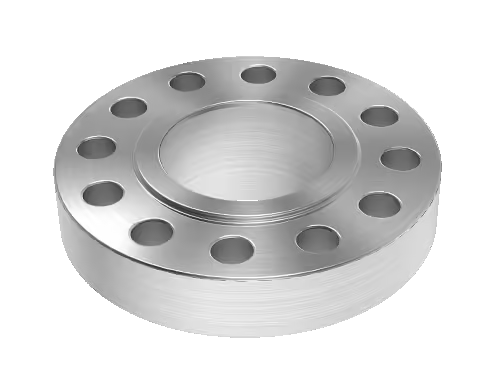
Several standards organizations publish specifications for flange sizes and dimensions, including:
- ASME/ANSI: The American Society of Mechanical Engineers (ASME) and the American National Standards Institute (ANSI) publish widely used standards for flanges in North America.
- DIN: The Deutsches Institut für Normung (DIN) publishes standards for flanges in Germany and Europe.
- JIS: The Japanese Industrial Standards (JIS) publish standards for flanges in Japan.
These standards provide detailed information on flange dimensions, materials, and testing requirements.
Conclusion
Understanding flange sizes is crucial for ensuring the proper functioning and safety of piping systems. Selecting the correct flange size involves considering various factors, including NPS, pressure rating, temperature, and application. Consulting relevant standards and specifications is essential for accurate flange selection. By adhering to these guidelines, engineers and technicians can ensure reliable and leak-free connections in various industrial applications. Accurate flange sizes are crucial to prevent leaks, system failures, safety hazards, and costly repairs.
FAQ
Q: What is the difference between NPS and DN?
A: NPS (Nominal Pipe Size) is a North American standard for pipe sizes, while DN (Diameter Nominal) is the European equivalent. Although they are not directly interchangeable, they are related. For smaller sizes, there is a rough correlation, but for larger sizes, the relationship becomes less direct. It’s crucial to consult conversion tables or standards when working with both NPS and DN.
Q: What are pressure classes for flanges?
A: Pressure classes indicate the maximum allowable pressure that a flange can withstand at a given temperature. Common pressure classes include 150, 300, 400, 600, 900, 1500, and 2500 lbs (pounds per square inch). Higher pressure classes correspond to thicker flanges and larger bolt sizes.
Q: What is the purpose of gaskets in flanged connections?
A: Gaskets are used between two mating flanges to create a leak-tight seal. They fill any imperfections on the flange faces and prevent fluid from escaping. Gaskets are made from various materials, including rubber, compressed fiber, and metal.
Q: Where can I find detailed information on flange standards?
A: Detailed information on flange standards can be found on the websites of standards organizations such as ASME, ANSI, DIN, and JIS. These organizations publish comprehensive standards documents that provide detailed dimensions, material specifications, and testing requirements for various flange types and sizes.