Shandong Qilu lndustrial Co.,Ltd.

Wind turbine forging materials: selection, processing and fatigue-resistant design
Table of Contents
Key components made from Wind turbine forging materials
Large forgings in wind turbines include main shafts, hubs, slewing rings, gearbox blanks and flange discs. For parts that carry bending and torsional loads, designers prefer forged alloy steels because forging aligns grain flow and reduces internal porosity, improving fatigue resistance.
Which alloys are commonly specified as Wind turbine forging materials
Alloy steels in the 41xx family (for example AISI 4140 / 42CrMo4) and low-alloy steels such as 34CrNiMo variants are widely used for high-stress forgings. These steels offer a balance of tensile strength, toughness and hardenability after quenching and tempering—properties critical for rotating shafts and high-load ring forgings. Heat-treatable martensitic/tempered microstructures provide the toughness required in service.
In many designs, materials for wind turbine components are selected with particular focus on fatigue strength and impact toughness at the anticipated operating temperatures. Suppliers typically provide post-treatment properties (such as tensile strength and Charpy V-notch results) and ensure traceability to heat numbers.
Why forging improves performance for Wind turbine forging materials
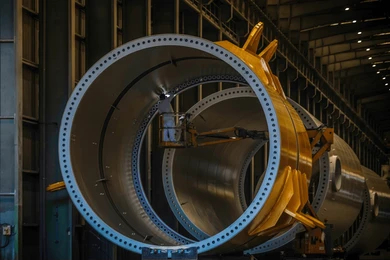
Forging produces a directional grain flow that follows part geometry, eliminating internal casting defects and improving mechanical continuity across high-stress regions. For critical turbine components this translates to higher endurance limits and fewer initiation sites for cracks—key benefits when machinery must run millions of load cycles. See general forging principles for background.
Typical heat treatment and processing routes for Wind turbine forging materials
Typical manufacturing sequences start from a forged blank followed by controlled normalizing, quenching and tempering to achieve the required strength and toughness window. For larger cross-sections, controlled cooling (in sand or with computed quench regimes) prevents quench cracks and excessive residual stress. NDE and hardness mapping validate the heat-treatment outcome across the forging.
Mechanical properties engineers expect from Wind turbine forging materials
Design specifications often call out minimum yield strength, tensile strength and Charpy energy at a reference temperature. For example, a quench-and-tempered 42CrMo4 forging might be specified for high tensile strength with a guaranteed minimum impact toughness to resist crack propagation under cyclic loading. Test reports accompany deliveries to demonstrate compliance.
Corrosion, surface treatment and environmental considerations for Wind turbine forging materials
Offshore service introduces risks such as chloride corrosion and hydrogen embrittlement. To mitigate these, surface treatments—like shot peening, specialized coatings, or cathodic protection—are commonly incorporated into the material system. Therefore, selecting appropriate materials for wind turbine components also involves assessing coating compatibility and cathodic/anodic behavior in marine environments. Industry articles often cover surface engineering techniques for wind power components.
Testing, inspection and standards for Wind turbine forging materials
Quality control uses a mix of non-destructive testing (NDT), chemical analysis (OES) and mechanical testing (tensile, hardness, impact). Forging suppliers and fabricators follow recognized standards (general forging requirements and material-specific specs) to ensure reproducibility and traceability. Referenced standards and procurement specs are central to acceptance testing.
Welding, machining and joining implications for Wind turbine forging materials
Post-forging operations (machining, keyway broaching, weld attachments) must respect the microstructure and residual stress state. For some parts, local tempering after machining or stress-relief cycles reduce the risk of cracking. Designers plan allowances and finishing routes to preserve the fatigue benefits conferred by forging.
Supply chain and procurement notes for Wind turbine forging materials
Because forgings are large and heavy, lead times and logistics factor into material selection. Buyers typically require mill certificates and NDT reports, and often specify additional testing (e.g., ultrasonic scans, metallography) for critical lots. Offshore projects additionally demand corrosion-resistant options or post-processing treatments. Industry suppliers list common alloy offerings and services for wind components.
Lifecycle and fatigue management using Wind turbine forging materials
A lifecycle view accounts for inspection intervals, repairability, and end-of-life recyclability. Because wind turbines operate for decades under variable loads, materials are selected not only for initial strength but for long-term fatigue performance and inspectability—factors that reduce downtime and maintenance cost over a project’s life.
Practical specification checklist for engineers specifying Wind turbine forging materials
- Define load cases and fatigue spectra rather than only peak loads.
- Choose an alloy with documented post-treatment toughness and high fatigue strength.
- Require mill traceability, NDT, and mechanical test certificates.
- Specify surface protection and post-machining stress relief as needed.
- Plan for logistics, heat-treatment distortion allowances, and inspection access.
This checklist helps convert performance requirements into a clear procurement specification.
Closing thoughts
Selecting the right materials for wind turbine components is a multidisciplinary decision: metallurgy, forging capability, heat treatment control, and surface engineering all play a crucial role. By basing choices on documented mechanical properties, verified processing routes, and relevant standards, engineers can reduce fatigue risks and extend the operational life of wind-power components. For background reading on wind turbines and forging methods, refer to the Wikipedia entries on wind turbines and forging.
If you want to know more about the relevant content, please click here.