Shandong Qilu lndustrial Co.,Ltd.

Stainless Steel vs. Carbon Steel: The Ultimate Forging Material Selection Guide (2026 Edition)
In the rapidly evolving industrial sector of 2026, the success of a manufacturing project often hinges on a single decision: material selection. For procurement officers and engineers involved in metal fabrication, the debate of Stainless Steel vs. Carbon Steel remains the most critical crossroad. Both materials offer distinct advantages in the forging process, but as global supply chains shift toward specialized high-performance alloys and sustainable practices, understanding the nuanced differences is paramount.
This guide provides a comprehensive technical analysis of Stainless Steel vs. Carbon Steel within the context of modern forging, helping you balance performance, budget, and long-term durability.
Table of Contents
The Fundamental Metallurgy: Chromium vs. Carbon
At the core of the Stainless Steel vs. Carbon Steel comparison lies chemical composition. Carbon steel is primarily defined by its carbon content (ranging from $0.05\%$ to $2.1\%$), which dictates its hardness and strength after heat treatment. In contrast, stainless steel must contain a minimum of $10.5\%$ chromium.
As noted by ASM International in their materials properties database, this chromium content creates a “passive layer” of chromium oxide that protects the underlying metal from oxidation. For buyers, the choice in Stainless Steel vs. Carbon Steel often boils down to whether the operating environment demands inherent corrosion resistance or if a cost-effective material with a protective coating will suffice.
Forging Performance and Process Complexity
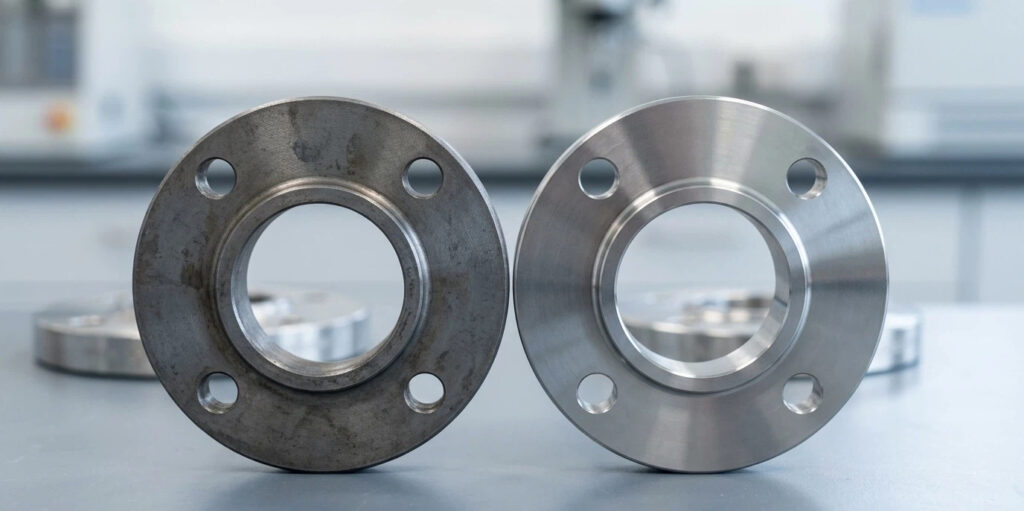
Forging is not just about the final product; it is about the “forgeability” of the metal. When evaluating Stainless Steel vs. Carbon Steel, manufacturers must account for deformation resistance.
1.Carbon Steel Forging: Generally, carbon steel is easier to forge. It has a broader forging temperature range and lower flow stress, which results in less wear on expensive forging dies.
2.Stainless Steel Forging: Due to its high alloy content, stainless steel requires significantly higher forging pressures. Precise temperature control is mandatory to avoid grain growth or sensitization, which can compromise the alloy’s corrosion resistance.
The Forging Industry Association (FIA) highlights that the energy consumption for forging stainless steel can be $20\%$-$30\%$ higher than that of carbon steel, a factor that directly impacts the final quote for B2B projects. (Source: FIA Technical Papers)
Technical Comparison: Stainless Steel vs. Carbon Steel at a Glance
To assist in your decision-making, we have summarized the key performance metrics of Stainless Steel vs. Carbon Steel for 2026 industrial standards:
| Property | Carbon Steel (e.g., 1045/4140) | Stainless Steel (e.g., 304/316L) |
| Corrosion Resistance | Low (Requires coating/painting) | Excellent (Inherent passive layer) |
| Tensile Strength | High to Very High (Heat treatable) | Moderate to High |
| Machinability | Excellent | Moderate (Work-hardening tendencies) |
| Thermal Conductivity | High | Low |
| 2026 Price Index | Economic / Stable | Premium / Volatile |
The 2026 Cost Factor: Beyond the Raw Material
When analyzing the price of Stainless Steel vs. Carbon Steel, B2B buyers must look past the “price per kilogram.” While carbon steel is significantly cheaper upfront, the Total Cost of Ownership (TCO) may tell a different story.
In 2026, the implementation of the Carbon Border Adjustment Mechanism (CBAM) by the European Union has added a “green premium” to steel products. According to the European Commission, carbon steel often carries a higher carbon footprint per ton during the initial smelting phase compared to high-recycled-content stainless steel. (Source: EU CBAM Regulations
). Therefore, the Stainless Steel vs. Carbon Steel price gap is narrowing when environmental taxes and maintenance costs (painting/re-coating carbon steel) are factored into long-term infrastructure projects.
Industrial Applications: Finding the Right Fit
Determining the winner in the Stainless Steel vs. Carbon Steel battle depends entirely on the application:
- Choose Carbon Steel for: High-strength structural components, automotive axles, heavy machinery gears, and projects where the budget is the primary constraint and the environment is dry/protected.
- Choose Stainless Steel for: Food processing equipment, marine hardware, chemical valves, and medical instruments where hygiene and rust prevention are non-negotiable.
Strategic Procurement in 2026
The decision between Stainless Steel vs. Carbon Steel should be based on a rigorous audit of your project’s mechanical requirements and the environmental conditions of the final installation. As global markets fluctuate, maintaining a flexible sourcing strategy for both materials allows manufacturers to pivot based on price availability and shifting sustainability mandates.
In conclusion, while the Stainless Steel vs. Carbon Steel debate is decades old, the data-driven approach of 2026 ensures that engineering precision always trumps historical habit. By selecting the right material, you guarantee not just the quality of the part, but the longevity of your brand’s reputation.
FAQ
Is stainless steel always stronger than carbon steel?
Not necessarily. While stainless steel is tougher, high-carbon steels and alloy steels can achieve higher ultimate tensile strength through specific quenching and tempering processes compared to many austenitic stainless grades.
Why is the “Stainless Steel vs. Carbon Steel” price difference so large?
The price of stainless steel is heavily influenced by the cost of alloying elements like Nickel and Chromium, which are traded on global exchanges and are more volatile than the iron ore used for carbon steel.
Can forged carbon steel be used in marine environments?
Only if it is treated with heavy-duty marine-grade coatings or galvanization. However, for critical submerged components, the Stainless Steel vs. Carbon Steel choice almost always favors stainless steel (specifically 316L or Duplex) due to its resistance to chloride-induced pitting.