Shandong Qilu lndustrial Co.,Ltd.

Forging Fundamentals: Automotive Component Forgings with Steel Flanges Explained
Table of Contents
Automotive Component Forgings are indispensable in the modern automotive industry, providing strength, reliability, and safety across countless parts and assemblies. Among these forged components, forged steel flanges occupy a unique niche by offering robust connection points, improved load-bearing capabilities, and superior fatigue resistance. In this guide, we’ll explore the forging process, why flanges matter, how they are used in automotive contexts, and what makes them ideal for demanding engineering applications.
What Are Automotive Component Forgings?
In the most general sense, Automotive Component Forgings are parts made by shaping metal under high pressure — usually with heat — to improve strength and structural integrity compared with cast or machined parts. Unlike cast parts, forged items have a refined grain structure and fewer internal defects, giving them higher reliability under stress. The forging process aligns metal grains in the direction of load, enhancing mechanical properties such as tensile strength and fatigue resistance.
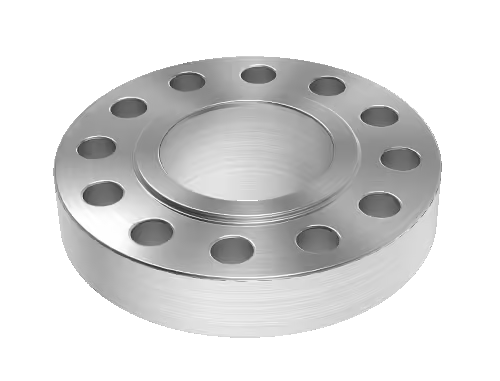
Forged steel flanges are a subtype of Automotive Component Forgings that connect components in structural assemblies or fluid systems. A flange — in mechanical terms — is a projecting rim or collar used for strengthening or attachment purposes.
The Forging Process in Brief
Forging, as a metalworking technique, applies compressive forces to shape steel while eliminating internal voids and aligning grain flow — all of which improve performance compared to cast or welded alternatives.
Key steps include:
1.Material Heating: Steel is heated to above its recrystallization temperature to make it malleable.
2.Shaping: Mechanical hammers or presses deform the heated material into dies shaped for specific parts.
3.Cooling and Heat Treatment: Controlled cooling and heat treatments like quenching and tempering optimize mechanical properties.
4.Machining & Quality Control: Precision milling and testing ensure final dimensions and material performance.
In forged steel flanges used for automotive applications, this robust manufacturing process ensures that the flange can handle torque, pressure, and cyclic loads without failure.
Why Forged Steel Flanges Matter in Automotive Component Forgings
Forged steel flanges are essential because they serve as critical connection points in assemblies that must withstand dynamic loads, pressure fluctuations, and thermal cycling. The forging process gives these flanges enhancements in key performance areas:
- Mechanical Strength: Forged components have superior tensile strength and are less prone to internal defects.
- Fatigue Resistance: Refined grain patterns improve resistance to repeated stress cycles — ideal for automotive systems under vibration.
- Tight Tolerance and Fit: Precision forging allows flanges to fit more accurately with adjoining components like shafts, pipes, and housings.
- Weld Integrity: Forged steel offers a stable base for joining processes such as welding, reducing the risk of fissures or weak joints.
These advantages make forged steel flanges a go-to choice in high-stress automotive assemblies such as engine mounts, transmission linkages, and exhaust junctions.
Where Forged Steel Flanges Are Used in Automotive Contexts
The breadth of Automotive Component Forgings is vast, and flanges are found in a surprising number of automotive systems:
1.Engine and Powertrain Assemblies
- Exhaust manifolds and turbocharger connections require flanges that can withstand high thermal stress.
- Oil and coolant passages often use flanged joints to maintain leak-free performance under pressure.
2.Suspension and Steering Systems
- Control arm linkages and shock mounts utilize flanges to distribute loads evenly and resist corrosion and fatigue.
3.Drive and Transmission Systems
- Drive shaft flanges and coupling interfaces rely on robust forging to handle torque transfer with minimal deformation.
4.Fluid and HVAC Systems
- Automotive air conditioning, brake fluid lines, and fuel systems often use forged flanges for pressure retention and ease of assembly.
Outside automotive use, forged flanges are also common in industries like oil and gas, power generation, and heavy industrial piping due to their reliability in high-pressure environments.


Material Selection and Testing Considerations
Selecting the right material and verifying its performance are central to ensuring flange reliability:
Materials Used:
- Carbon and alloy steels provide a balance of strength and cost-effectiveness.
- Stainless and heat-resistant alloys can be used where corrosive environments or elevated temperatures are a concern.
Testing and Inspection:
Automotive Component Forgings like steel flanges undergo rigorous testing:
- Tensile and fatigue testing to confirm strength and endurance.
- Dimensional precision checks to ensure correct mating with adjacent parts.
- Non-destructive inspections (such as ultrasonic testing) to detect internal flaws before assembly.
Advantages of Forged Versus Other Manufacturing Methods
| Feature | Forged Steel Flanges | Cast/Stamped Alternatives |
|---|---|---|
| Grain Structure | Continuous and aligned | Random and inconsistent |
| Strength | High tensile & fatigue resistance | Lower, stress concentrations may appear |
| Reliability | Highly predictable performance | Potential for porosity or weld failures |
| Suitability for High Load | Excellent | Limited |
The inherent advantages of forging ensure that steel flanges perform under demanding automotive thresholds, making them suitable even for safety-critical parts.
Emerging Trends in Automotive Forging
The forging industry is evolving rapidly, integrating automation and advanced simulation to optimize die design, material flow, and process efficiency. Sensors and robotics improve repeatability, while material science advances allow the use of novel alloy combinations for flanges that are lighter yet stronger. Such innovations continue to expand the scope of Automotive Component Forgings.
Conclusion
For engineers, procurement teams, or automotive enthusiasts looking to understand how metal parts achieve reliability and durability, Automotive Component Forgings — especially forged steel flanges — are a cornerstone technology. The forging process enhances strength and performance in ways that casting and machining cannot match, making these components indispensable in modern vehicle systems.
With appropriate material selection, meticulous testing, and microstructural integrity ensured through forging, steel flanges provide tomorrow’s automotive systems with the resilience they demand — from powertrain connections to structural mounts.
If you want to know more details, please click here.