Shandong Qilu lndustrial Co.,Ltd.

Why Forged Propeller Shaft Is Preferred for Extreme Sea Conditions
Modern ships face extreme operational conditions: high torque, cyclic fatigue, and corrosive seawater. A forged propeller shaft delivers superior mechanical performance because the forging process ensures continuous grain flow, dense microstructure, and optimal dimensional integrity, which are critical for durability and safety at sea. Unlike cast or welded shafts, forged shafts are specifically designed to withstand prolonged operational stresses without crack initiation or early fatigue failure.
Table of Contents
Extreme Operational Demands on Propeller Shafts
Marine propulsion shafts endure sustained torque, bending moments, and cyclic loads. Corrosion fatigue from seawater exposure increases failure risk. Designing a shaft that meets these challenges requires understanding load cycles, torque peaks, and stress distribution — areas where forged propeller shafts outperform other manufacturing methods.
Why Forged Shafts Perform Under Extreme Marine Conditions
The ability of a forged propeller shaft to endure extreme sea conditions comes primarily from its manufacturing process:
1.Grain Flow Alignment: During hot forging, metal is plastically deformed so that grains and inclusions align along the axial load path. This orientation reduces stress concentrators and internal voids, which are the primary origins of fatigue cracks. Studies confirm that shafts with optimal grain flow exhibit significantly extended fatigue life, explaining the preference for forging in marine applications.
2.Dense Microstructure & Fine Grains: Forging compresses the metal, creating a dense, refined microstructure that enhances crack resistance and impact toughness. Controlled heat treatments (normalizing, quenching, tempering) balance strength and ductility, allowing the shaft to withstand sudden torque peaks or shock loads such as propeller snagging or collision impacts.(NRC)
3.Process Control & Large-Scale Forging: Heavy-section open-die and closed-die forging for large-diameter shafts maintain macroscopic consistency and traceable quality. Finite element analysis and temperature gradient control ensure grain continuity, while macro-etch and non-destructive testing (UT/MPI/RT) verify structural integrity before shipment.(ScienceDirect)
This combination of forging, heat treatment, and inspection forms a “process defense line” that allows forged shafts to survive high torque, corrosion-fatigue, and impact in marine environments.
Advantages of Forged Shafts in Marine Applications
Forging compresses and aligns the metal microstructure along the principal load paths. This grain flow orientation reduces defects, improves fatigue resistance, and increases toughness. Large marine shafts (up to 45-inch diameter) benefit from precision forging, ensuring uniform properties and higher reliability under extreme conditions.
Key benefits:
- Improved fatigue life
- Enhanced torsion resistance
- Better corrosion performance
- Reduced internal defects
Heat Treatment and Performance Optimization
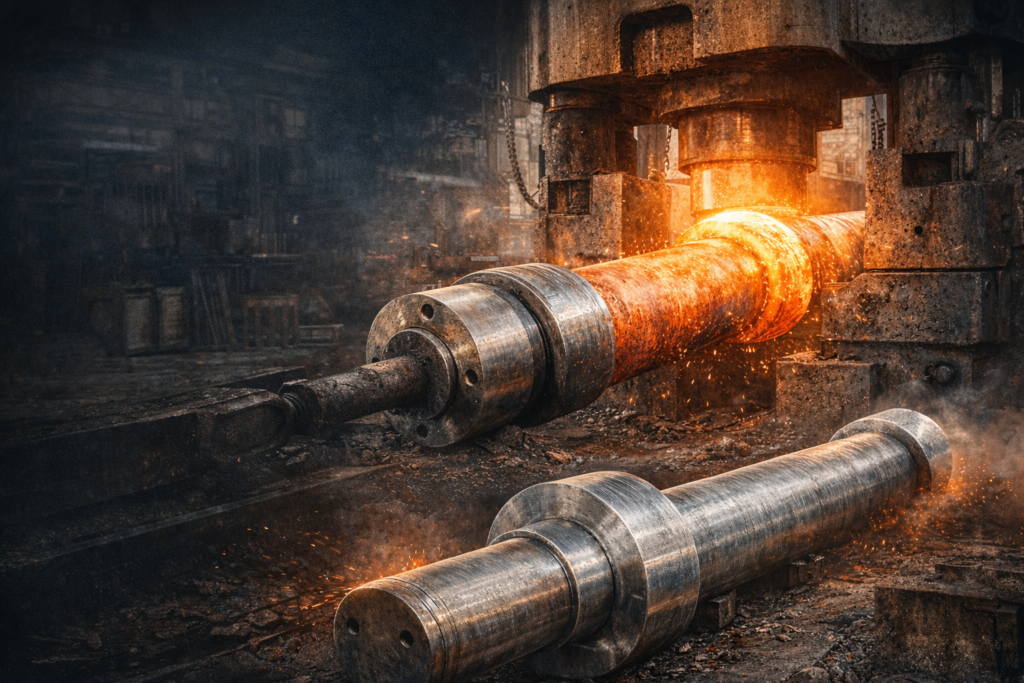
Post-forging heat treatments, such as quenching and tempering, balance hardness and ductility. Optimized thermal cycles improve fatigue strength, toughness, and corrosion resistance. This ensures the shaft withstands high torque, bending, and seawater exposure over its service life.
NDT Inspection for Forged Shafts
Non-destructive testing verifies integrity without damaging the component:
- Ultrasonic Testing (UT) for internal flaws
- Magnetic Particle Inspection (MPI) for surface cracks
- Radiography (RT) for volumetric defects
- Macro-etch for grain flow confirmation
These inspections ensure forged propeller shafts meet stringent marine performance requirements. (ABS guide)
Large-Diameter Forging Capabilities
Ships often require shafts exceeding 40 inches in diameter. Heavy-section forging ensures uniform properties, continuous grain flow, and mechanical strength. Suppliers like Qilu Forging demonstrate production capabilities up to 45 inches, supporting large vessel applications.
Forged Shaft Key Performance Indicators
| Feature | Importance | Verification Method |
|---|---|---|
| Grain Flow | Resists fatigue & cracks | Macro-etch, simulation review (MDPI) |
| Heat Treatment | Balances strength & ductility | Hardness test, microstructure inspection |
| NDT | Detects defects | UT, MPI, RT |
| Diameter | Meets ship requirements | Dimensional check, supplier capability |
Conclusion
The forged propeller shaft is essential for extreme marine conditions, providing superior fatigue resistance, torsion performance, and corrosion durability. Combining precise forging, heat treatment, and NDT ensures long service life. Contact our experts to learn how large-diameter forged propeller shafts can be specified for your fleet.
FAQ
Why choose a forged shaft over cast or welded?
Forging aligns grains and reduces defects, improving fatigue life and torsion strength.
How is grain flow verified?
Macro-etch sections or forging simulations show proper orientation.
Which NDT methods are standard?
UT, MPI, RT; chemical analysis confirms material.(ABS guide)
When should third-party testing be required?
For first-time suppliers, new alloys, or mission-critical shafts (e.g., ice-class or DP vessels).