Shandong Qilu lndustrial Co.,Ltd.

Forged vs Cast Steel: 5 Shocking Myths Debunked
Welcome to My Blog!
Before we dive into the content, I’d love for you to join me on my social media platforms where I share more insights, engage with the community, and post updates. Here’s how you can connect with me:
Facebook:https://www.facebook.com/profile.php?id=100090903441806
Now, let’s get started on our journey together. I hope you find the content here insightful, engaging, and valuable.
Table of Contents
Introduction
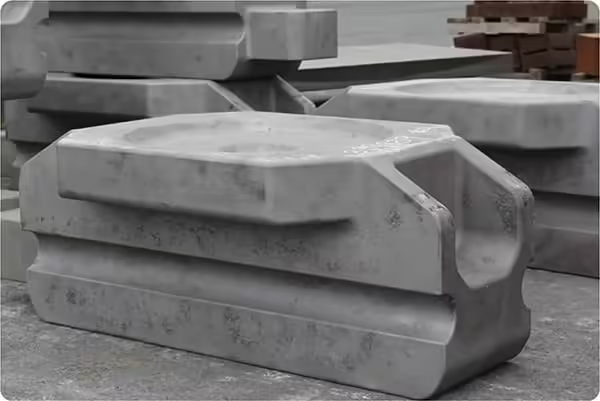
When it comes to choosing between forged vs cast steel, many industries and manufacturers face a dilemma. These two metalworking processes each have distinct properties, yet myths and misconceptions often cloud the decision-making process. Some believe that cast steel is always weaker, while others think forged steel is unnecessarily expensive. But how much of this is true?
This article will debunk five of the most common myths about forged vs cast steel, providing a clearer picture of their differences and advantages. Whether you’re in construction, automotive, or heavy machinery, understanding these materials will help you make an informed decision.
Myth #1: Forged Steel Is Always Stronger Than Cast Steel
Understanding Strength in Forged vs Cast Steel
One of the biggest myths is that forged steel is always superior in strength compared to cast steel. While forging does refine the grain structure, giving it better mechanical properties in some applications, this is not a universal rule.
What Influences Strength?
Several factors affect the strength of forged vs cast steel, including:
- Material Composition: Alloying elements like carbon, chromium, and nickel impact both forged and cast steel.
- Heat Treatment: Proper heat treatment can enhance the strength of both types of steel.
- Load Type: Static loads favor cast steel, while dynamic loads benefit from forged steel.
While forged steel generally has better toughness and fatigue resistance, properly designed cast steel components can achieve equal or even superior strength under specific conditions.
Myth #2: Cast Steel Is Brittle and Prone to Breaking
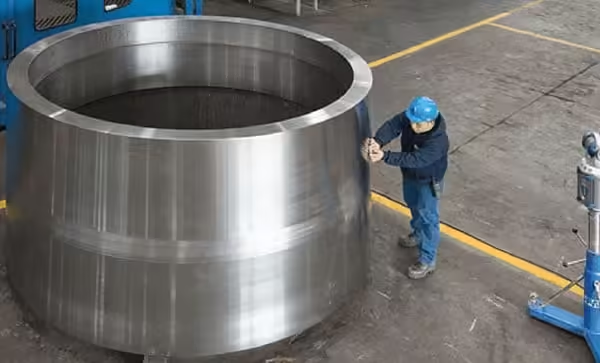
The Truth About Cast Steel Durability
Many assume that cast steel is brittle and easily breaks under pressure. However, this myth comes from a misunderstanding of the casting process and improper comparisons with low-quality castings.
Why Cast Steel Can Be Highly Durable
- Customizable Microstructure: Modern casting techniques allow precise control over grain structure.
- Advanced Heat Treatment: Proper tempering and quenching can enhance impact resistance.
- Optimized Designs: Cast components can be engineered to withstand heavy loads and harsh environments.
For applications like heavy machinery, mining equipment, and rail components, cast steel can provide excellent performance when manufactured correctly.
Myth #3: Forged Steel Is Too Expensive for Large-Scale Production
Cost Considerations in Forged vs Cast Steel
Another misconception is that forged steel is prohibitively expensive, making it unsuitable for large-scale production. While forging does require specialized equipment and processes, its cost-effectiveness depends on several factors.
Comparing Costs: Forging vs Casting
| Factor | Forged Steel | Cast Steel |
|---|---|---|
| Initial Tooling Cost | Higher due to mold and press setup | Lower as casting molds are easier to produce |
| Material Waste | Lower since forging minimizes excess material | Higher due to gating systems and risers |
| Machining Requirements | Less machining required as fibers align with shape | More machining needed for dimensional accuracy |
| Production Speed | Slower for complex shapes | Faster for intricate geometries |
| Overall Cost Efficiency | More cost-effective for high-stress parts | Better for intricate designs and large-scale production |
While forging has a higher upfront cost, it often results in a lower lifecycle cost due to improved durability and reduced failure rates.
Myth #4: Cast Steel Cannot Achieve High Precision
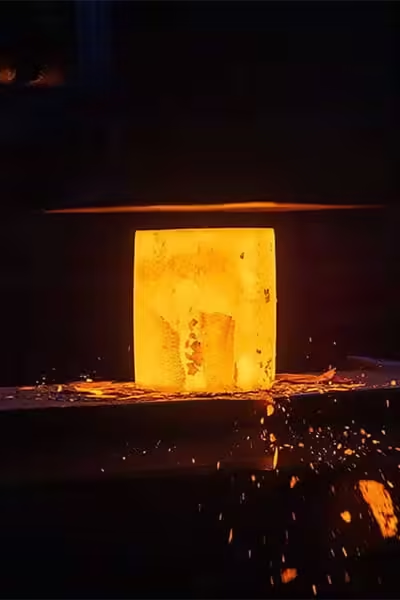
Precision in Forged vs Cast Steel
Some believe that cast steel lacks precision and always requires extensive machining. However, modern casting methods have significantly improved accuracy and consistency.
Key Factors Affecting Precision
- Investment Casting: Allows for near-net-shape production with minimal machining.
- Computer-Aided Design (CAD): Ensures high accuracy in mold creation.
- High-Quality Molding Materials: Help achieve tighter tolerances.
While forging may offer better dimensional stability in some cases, cast steel components can achieve exceptional precision when manufactured correctly.
Myth #5: Forged and Cast Steel Cannot Be Used Together
Complementary Uses in Forged vs Cast Steel
A common misunderstanding is that industries must choose exclusively between forged and cast steel. In reality, many applications use both materials to maximize performance and efficiency.
Where They Work Together
- Automotive Industry: Cast steel is used for engine blocks, while forged steel is preferred for crankshafts.
- Construction Equipment: Cast steel components support complex structures, while forged parts handle high-stress connections.
- Aerospace Engineering: Forged turbine disks offer strength, while cast components provide intricate cooling channels.
Using forged vs cast steel strategically can lead to better cost savings and improved performance in many industries.
Conclusion
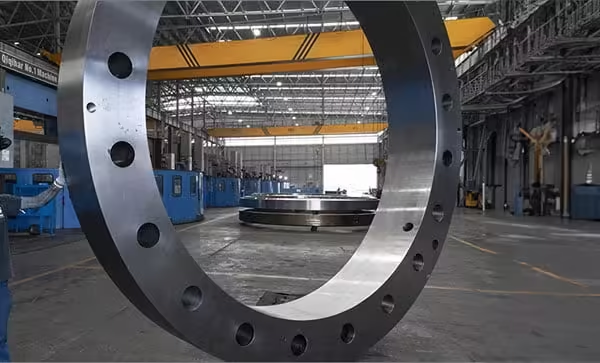
Understanding the real differences between forged vs cast steel can help businesses make better material choices. While forged steel excels in toughness and fatigue resistance, cast steel offers greater design flexibility and cost benefits. Each has its place in modern manufacturing, and the best choice depends on the specific application.
Looking for high-quality steel components? Choose the best steel solution for your needs today!
What is the main difference between forged and cast steel?
Forged steel is shaped under high pressure, improving its grain structure, while cast steel is melted and poured into molds, allowing for complex shapes.
Is forged steel always stronger than cast steel?
Not necessarily. Strength depends on factors like heat treatment, alloy composition, and the type of load the material will endure.
Which is more cost-effective: forged or cast steel?
It depends on the application. Forged steel has a higher initial cost but lower maintenance needs, while cast steel is cheaper upfront but may require more machining.
Can cast steel be as precise as forged steel?
Yes, with modern casting techniques like investment casting, cast steel can achieve high precision comparable to forging.
Are there applications that use both forged and cast steel?
Absolutely! Many industries combine the two to balance strength, cost, and manufacturing complexity.