Shandong Qilu lndustrial Co.,Ltd.

Forged Steel Parts vs Cast Steel Parts and the Hidden Risk Inside Critical Components
When buyers compare forged steel parts vs cast steel parts, the real issue is failure risk. Will the part crack under repeated load? Will hidden porosity shorten service life? Will the component deform when impact, torque, or pressure increases?
For procurement teams, forged steel parts vs cast steel parts should be evaluated before drawings become purchase orders. This guide helps you choose between forged steel and cast steel for critical components. It explains internal density, grain flow, fatigue life, impact strength, and when forged parts for high load applications are the safer long-term choice.
Table of Contents
Why the Forged vs Cast Steel Parts Decision Matters
The search for forged steel parts vs cast steel parts often starts when a buyer wants to avoid downtime, replacement cost, or safety failure. In critical components, the manufacturing route affects more than shape. It changes internal soundness, grain structure, fatigue behavior, and inspection risk.
According to the Forging Industry Association article on how forgings compare to other processes, grain flow in forgings helps provide strength at critical stress points. This is why forged steel is widely used for shafts, rings, gear blanks, hooks, pins, and heavy machinery blocks.
Cast steel also has a clear role. The Wikipedia article on metal casting explains that casting is useful for complex shapes that may be difficult or uneconomical to make by other methods. So forged steel parts vs cast steel parts is not a simple “strong vs weak” debate. It is a decision about risk, geometry, load, and inspection.
What Forging Changes Inside the Steel
The Wikipedia article on forging defines forging as shaping metal using localized compressive forces. For critical components, that pressure can be the key difference.
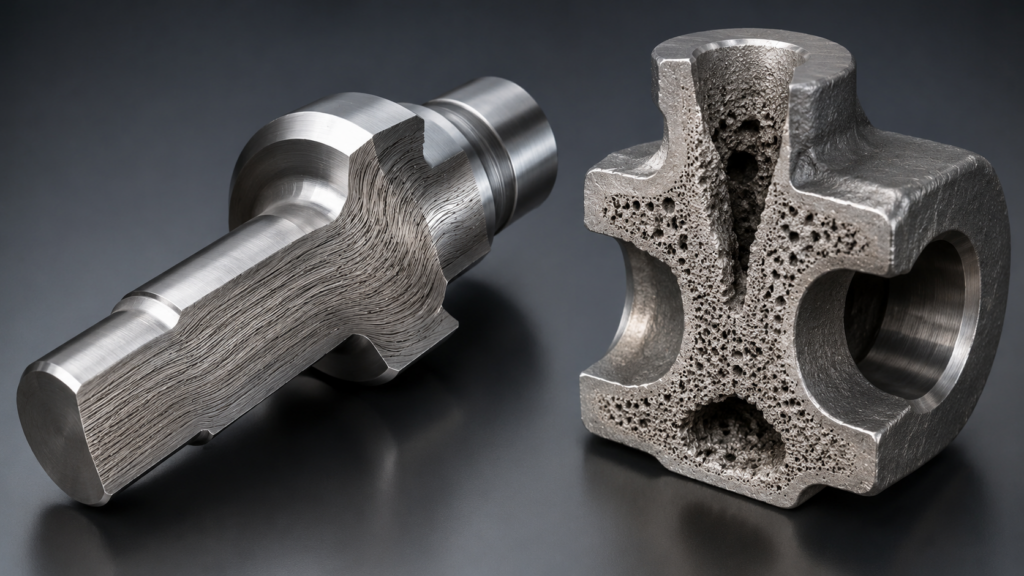
In properly designed forged steel parts, the internal grain flow can follow the shape of the part. For a shaft, ring, hook, or gear blank, that direction can support how load travels through the component.
This matters for forged parts for high load applications because cracks often start at stress concentration points. Good forging design cannot fix a poor drawing, but it can improve the internal structure that carries load.
What Casting Does Well and Where Risk Begins
Casting uses molten steel poured into a mold. For cast steel parts, this is valuable when the geometry is complex, the walls are irregular, or machining from forged stock would waste too much material.
The trade-off is solidification. As molten steel cools, the process must control shrinkage, gas, inclusions, and feeding. The ASM International article on casting defects lists common defect categories such as cavities, discontinuities, inclusions, and structural anomalies.
These defects are not present in every casting. High-quality foundries can manage them. But when the part is a rotating shaft, lifting component, pressure part, or mining equipment part, forged steel parts vs cast steel parts becomes a reliability question, not only a price question.
Internal Density Is the Hidden Difference Buyers Miss
The biggest difference in forged steel parts vs cast steel parts is often invisible. Forging plastically deforms steel under pressure, which can improve internal density when the forging ratio, temperature, and heat treatment are controlled.
Cast steel parts may perform well, but the final result depends heavily on mold design, pouring control, feeding, cooling, and inspection. A clean surface does not always prove internal soundness.
A 2022 MDPI paper, Casting Defects in Sand-Mold Cast Irons—An Illustrated Review, explains porosity as voids or pores caused by trapped air or shrinkage. Although the paper focuses on cast irons, the failure logic is useful for buyers: voids and discontinuities can become stress raisers.
This is why forged steel parts vs cast steel parts should be judged by load, defect tolerance, and failure consequence.
Fatigue Life Under Repeated Load
Many critical components do not fail from one overload. They fail after repeated cycles. A small crack starts, grows slowly, and finally breaks the part without much warning.
The ASM International handbook article on fatigue failures describes fatigue as progressive localized damage under fluctuating loading, including crack initiation, cyclic crack growth, and final fracture.
This matters when forged steel parts vs cast steel parts are compared for rotating or vibrating equipment. Forged steel often performs better in fatigue-sensitive applications because the structure can be more continuous and defect risk can be lower. For gear blanks, excavator pins, heavy shafts, drive parts, and rings, fatigue resistance is often worth more than a lower initial price.
Impact Strength in Real Working Loads
When discussing forged steel parts vs cast steel parts, impact loading needs attention. Mining equipment, construction machinery, lifting systems, oilfield tools, and power transmission parts rarely work under smooth loads.
They face shock, vibration, torsion, bending, misalignment, and occasional overload. That is why forged parts for high load applications are often used where one failure may stop production or create safety risk.
Typical examples include forged shafts, forged rings, forged hooks, forged blocks, forged gear blanks, couplings, and excavator pins. For these critical components, forged steel is often selected to resist deformation, crack initiation, and sudden fracture under real working conditions.
Forged Steel Parts vs Cast Steel Parts in a Practical Comparison
| Factor | Forged Steel Parts | Cast Steel Parts |
|---|---|---|
| Internal density | Usually higher when properly forged | Depends on casting quality and feeding |
| Grain structure | Directional grain flow is possible | Less directional structure |
| Fatigue resistance | Strong for cyclic loading | Sensitive to defects and geometry |
| Impact strength | Better for severe shock loads | Suitable for moderate-load parts |
| Shape complexity | Less flexible for very complex shapes | Strong advantage |
| Defect risk | Lower with correct forging and testing | Porosity, shrinkage, and inclusions must be controlled |
| Best use | Critical components and high-load parts | Complex shapes and lower-risk parts |
When Cast Steel Parts Are Still the Better Choice
Cast steel should not be treated as a poor option. It can be the right choice when geometry matters more than maximum internal strength.
Choose cast steel when the part has a very complex shape, the load is low to moderate, near-net shape reduces machining cost, the component is not safety-critical, and the foundry can provide inspection records.
For housings, brackets, covers, frames, and complex bodies, cast steel may offer better value. This makes forged steel parts vs cast steel parts a practical engineering decision rather than a marketing claim.
When Forged Steel Is the Safer Investment
Forged steel becomes the stronger route when the part carries high load, works under repeated stress, or failure would cause downtime.
In short, forged steel parts vs cast steel parts comes down to working risk. Choose forged steel when fatigue life is important, impact strength is required, internal soundness is critical, the part faces bending or torsion, or the application involves lifting, mining, transmission, or heavy machinery.
For more production details, see Qilu’s page on forged steel parts. For oversized shafts, rings, blocks, and non-standard heavy components, open die forgings for large components are often used when size flexibility and internal quality both matter.
Final Decision
The best way to compare forged steel parts vs cast steel parts is to ask what the part must survive. If the main challenge is complex geometry and moderate load, cast steel parts may be practical. If the challenge is repeated stress, impact, torsion, safety risk, or long service life, forged steel parts are usually the better route.
For critical components, purchase price is only one part of the decision. Internal quality, fatigue life, inspection confidence, and downtime risk matter more. That is why forged steel parts vs cast steel parts should be evaluated through real working conditions, not just drawings and quotes.
FAQ
Are forged steel parts always stronger than cast steel parts?
Not always. But forged steel parts usually perform better in high-load, fatigue-sensitive, and impact-loaded applications when properly designed, forged, heat treated, and tested.
Are cast steel parts bad for critical components?
No. Cast steel can work well if the load level, geometry, casting process, and inspection plan are suitable.
Which is better for forged parts for high load applications?
Forging is usually preferred because it can provide better internal density, grain flow, toughness, and fatigue resistance.
What is the biggest risk with cast steel?
The main risks are porosity, shrinkage, inclusions, segregation, and internal discontinuities. These can become crack initiation points.
What should buyers check before choosing forged vs cast steel parts?
Check load direction, fatigue risk, impact level, geometry, inspection method, material grade, heat treatment, and failure consequence.