Shandong Qilu lndustrial Co.,Ltd.

Wind Turbine Main Shaft Forgings: Why Forged Shafts Matter in Modern Wind Energy
A wind turbine main shaft is not just a large rotating part. It is the mechanical link that carries rotor loads into the drivetrain, and its quality can influence fatigue life, bearing performance, maintenance cost, and long-term turbine availability. In this guide, you will learn how main shaft forgings are made, why forged steel is widely used, what engineers check during inspection, and how to evaluate large-scale forging capability before placing an order.
Modern turbines are pushing every drivetrain component harder. Bigger rotors create higher torque. Offshore sites add humidity, salt exposure, and difficult maintenance access. Research from NREL notes that failures of main bearings, gearboxes, generators, and blades are among the highest contributors to downtime in both offshore and onshore turbines. That is why this component deserves more attention than a simple line item on a procurement sheet.
Table of Contents
Where the Wind Turbine Main Shaft Carries the Real Load
The wind turbine main shaft sits between the rotor hub and the rest of the drivetrain. In geared turbines, it transfers torque toward the gearbox. In direct-drive designs, the load path is different, but the rotor-side shaft and bearing system still carry complex dynamic forces.
The part is exposed to two kinds of load that matter in design:
1.Ultimate loads, which can damage a turbine during extreme events.
2.Fatigue loads, which accumulate over millions of cycles.
DTU’s explanation of IEC 61400-1 notes that turbine designers typically consider both ultimate and fatigue loads, with operating modes such as normal operation, idling, and yaw error shaping the load conditions. This is important because a wind turbine main shaft rarely fails from a single simple load. More often, damage comes from repeated stress, load reversal, misalignment, surface condition, or internal metallurgical inconsistency.
For buyers, this means the question should not only be: “Can the supplier make the size?”
A better question is:
“Can the supplier control internal quality, heat treatment, machining allowance, and inspection for a fatigue-critical shaft?”
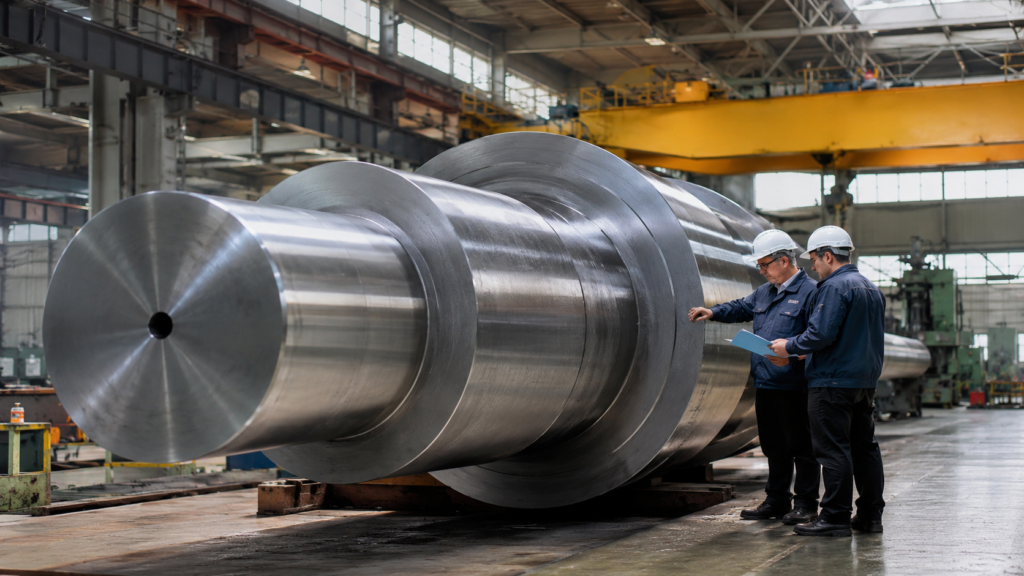
Manufacturing Process of Wind Turbine Main Shaft Forgings
The manufacturing process of wind turbine main shaft components usually begins with high-quality alloy steel ingots or billets. The goal is not only to shape the steel, but to refine its internal structure so it can survive long-term cyclic loading.
A typical route includes:
1.Steelmaking and ingot preparation:The starting material must meet chemical composition requirements. Clean steel is essential because inclusions can become fatigue crack initiation points.
2.Heating before forging:The steel is heated in a controlled furnace. Temperature uniformity matters. Uneven heating may create internal stress or inconsistent deformation during forging.
3.Open-die forging:Large shafts are commonly produced by open-die forging. The steel is compressed and elongated through repeated passes, improving internal consolidation and helping shape the grain structure along the shaft geometry.
4.Normalizing or preliminary heat treatment:This step helps refine the microstructure before final hardening and tempering.
5.Quenching and tempering:Heat treatment is used to achieve the required strength, toughness, and hardness profile. For this shaft type, uniform heat treatment is especially important because thick sections cool more slowly than smaller components.
6.Rough machining:Excess material is removed to reach a near-final geometry and reveal the surface for inspection.
7.NDT and final machining:Ultrasonic testing, magnetic particle testing, dimensional checks, and surface inspection help verify that the forging meets technical requirements before delivery.
This route is why wind power forging components are treated differently from ordinary industrial shafts. The process has to manage size, metallurgy, and fatigue performance at the same time.
Why Forged Shafts Perform Better in Wind Energy
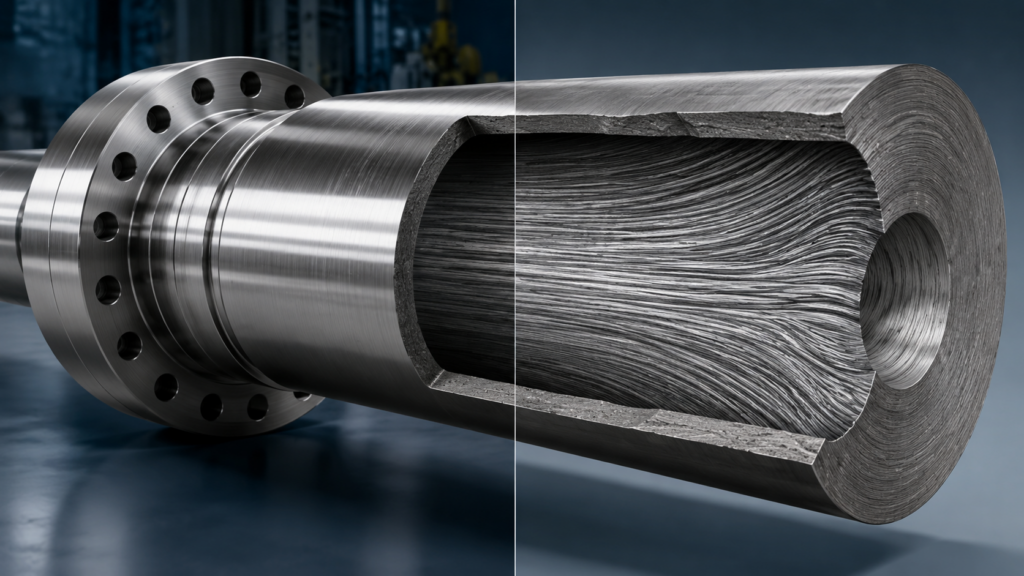
The advantages of forged main shafts for wind energy come from how forging changes the internal structure of steel. Forging compresses the metal, reduces internal voids, and helps orient grain flow in directions that support load-bearing performance. ASM International describes control of grain flow as one of the major advantages of shaping metal by forging, rolling, or extrusion.
For a rotor-side shaft, this matters in practical ways:
- Better fatigue resistance under cyclic torque
- Improved toughness for changing wind loads
- Reduced risk from internal shrinkage or porosity
- More reliable performance in large cross-sections
- Stronger structural continuity than many cast alternatives
Casting can be suitable for some heavy components, but a shaft is a rotating, fatigue-loaded part. When the design depends on long service life, forged shafts are often preferred because the material structure is more favorable for repeated mechanical stress.
Material Selection for Large Scale Steel Forgings
Large scale steel forgings used in wind energy are usually made from alloy steels selected for strength, toughness, hardenability, and fatigue resistance. Common choices may include grades such as 42CrMo4, 34CrNiMo6, or other project-specific alloy steels depending on the design standard and customer requirements.
The best material is not always the strongest material on paper. For this application, the steel must balance several properties:
- Tensile strength for torque transmission
- Yield strength for structural stability
- Impact toughness for load variation
- Hardenability for thick-section heat treatment
- Machinability for bearing seats and connection areas
- Cleanliness for fatigue-sensitive service
A thick forged shaft is different from a small test coupon. The center of the part may cool differently from the surface. This is why heat treatment capability, furnace size, quenching control, and mechanical testing location all matter.
What Causes Main Shaft Problems in the Field?
A main shaft is usually designed for long service life, but field problems can still appear when design assumptions, manufacturing quality, assembly conditions, or operating loads do not align.
Common issues include:
- Fatigue cracking near stress concentration zones
- Surface damage at bearing seats
- Misalignment-related bearing loading
- Internal defects that escape weak inspection
- Improper heat treatment causing low toughness or uneven hardness
- Corrosion and fretting in harsh environments
How Offshore and High-MW Turbines Are Raising the Bar
As turbines move into higher power classes, the wind turbine main shaft becomes larger and more demanding. Offshore wind makes the challenge even sharper because maintenance access is harder, weather windows are limited, and downtime is expensive.
This trend affects forging requirements in several ways:
- Larger ingot weights and forging press capacity
- Deeper hardenability requirements
- More demanding ultrasonic testing
- Tighter dimensional control after machining
- Higher expectations for traceability
- Better documentation for third-party review
For large offshore projects, a supplier’s workshop capacity is only part of the decision. Buyers also need evidence of process control. That includes heat treatment records, material certificates, NDT reports, machining capability, and previous experience with large scale steel forgings.
This forged shaft is not a commodity part in this context. It is part of a long-life energy asset, and small manufacturing shortcuts can become expensive failures years later.
Final Thoughts
The wind turbine main shaft is one of the few components where metallurgy, forging process, heat treatment, machining, and field reliability meet directly. As turbines grow larger and offshore projects expand, buyers are no longer just purchasing a heavy steel part. They are selecting a fatigue-critical component that must perform for years under changing loads.
A high-quality wind turbine main shaft does not happen at the final inspection stage. It is built from the first material decision, shaped through controlled forging, stabilized through heat treatment, verified by testing, and finished with careful machining.
FAQ
What is a wind turbine main shaft?
A wind turbine main shaft is the large rotating shaft that transfers rotor torque and loads into the drivetrain. It is one of the key structural parts inside the nacelle.
Why are forged shafts used in wind turbines?
Forged shafts are used because forging improves internal integrity, grain flow, toughness, and fatigue resistance. These properties are important for long-term rotating service.
What materials are used for main shaft forgings?
Common materials include alloy steels such as 42CrMo4, 34CrNiMo6, or customer-specified grades. The final choice depends on turbine design, load requirements, and standards.
What are the advantages of forged main shafts for wind energy?
The main advantages are higher fatigue strength, better internal soundness, improved toughness, and more reliable performance under variable wind loads.