Shandong Qilu lndustrial Co.,Ltd.

Forging Surface Defects: Root Causes and Prevention Strategies
In the high-stakes world of industrial manufacturing, the structural integrity of a component begins at the surface. For industries such as aerospace, automotive, and heavy energy, the presence of Forging Surface Defects is not merely a cosmetic issue; it is a critical failure point that can lead to catastrophic mechanical breakdown. As components are subjected to extreme cyclic loading and thermal stress, any microscopic irregularity can act as a stress riser, drastically reducing the fatigue life of the metal.
Achieving a zero-defect production line requires a rigorous understanding of the metallurgical and thermodynamic factors that govern metal flow. This guide examines the root causes of surface irregularities and provides a professional framework for ensuring metallurgical integrity through advanced quality control.
Table of Contents
What are Forging Surface Defects?
Technically, Forging Surface Defects refer to any physical discontinuity or morphological irregularity on the exterior of a forged part. These occur during the plastic deformation phase, where the metal is pushed beyond its yield point at elevated temperatures. Unlike internal voids, these defects are often the result of interaction between the raw material, the die surface, and the atmospheric conditions within the furnace.
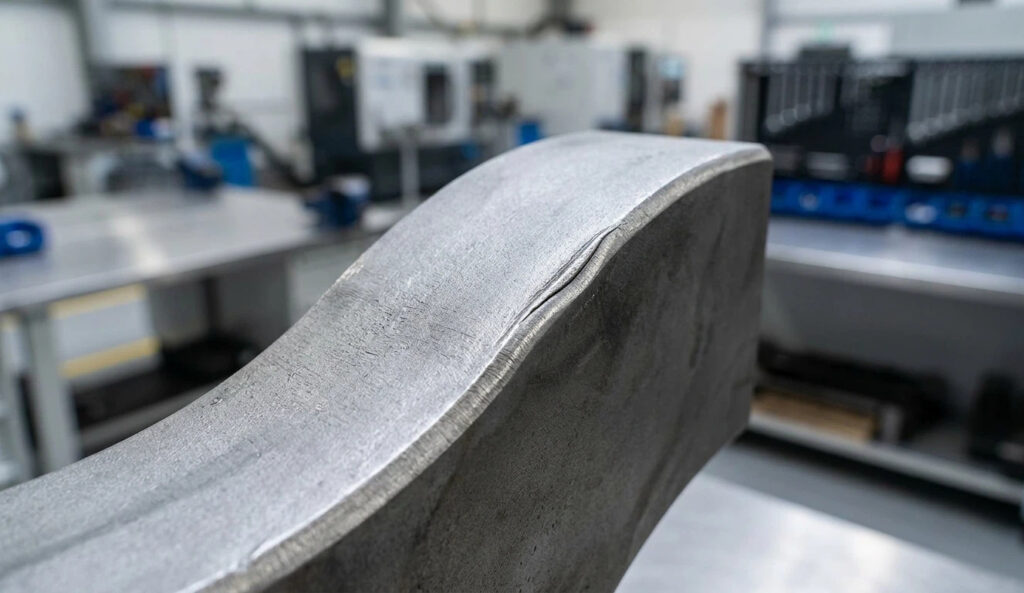
Common manifestations of Forging Surface Defects include seams, laps, and cold shuts. A seam is typically a longitudinal crack that originates from a defect in the starting billet, while laps and folds occur when the metal is folded over itself during the press stroke without fusing. Identifying the specific morphology of Forging Surface Defects is essential for adjusting the forging parameters and die lubrication strategies.
The Metallurgy of Surface Cracks and Metal Flow
The most damaging of all Forging Surface Defects are surface cracks. These fissures often develop when the tensile stresses on the surface of the workpiece exceed the local ductility of the material. In hot forging, this is frequently a result of “overheating,” where the grain boundaries become weakened by oxidation, a condition known as “burning.”
When investigating how to prevent surface cracks in hot forging, engineers must focus on the “forging window”—the precise temperature range where the metal is most plastic. If the metal is forged too cold, the lack of ductility leads to brittle fracture; if too hot, the grain boundaries may melt or oxidize. Furthermore, improper die lubrication can cause localized sticking, leading to “tearing” as the metal flow is interrupted, creating jagged Forging Surface Defects that are difficult to remediate.
The Crucial Role of Cooling Rate
Once the physical shaping of the part is complete, the risk of developing Forging Surface Defects does not end. The cooling rate of the component is perhaps the most overlooked variable in surface integrity. As the metal transitions from the forging temperature to room temperature, a significant thermal gradient is established between the surface and the core.
If the cooling rate is too aggressive, the exterior of the part shrinks faster than the interior, inducing high residual tensile stresses on the surface. This often leads to “delayed cracking,” where surface cracks appear hours after the part has left the press. Furthermore, the effect of cooling rate on forging grain structure is profound; slower, controlled cooling prevents the formation of hard, brittle phases like martensite in alloy steels, which are highly susceptible to cracking during subsequent handling or machining.
Detection of Forging Surface Defects using MPI
In a professional quality control environment, visual inspection is insufficient for high-criticality parts. The detection of forging surface defects using MPI (Magnetic Particle Inspection) is the industry standard for identifying sub-surface and surface-breaking flaws that are invisible to the naked eye.
During MPI, a magnetic field is induced in the forged part. If a surface-breaking crack is present, it creates a leakage field that attracts magnetic particles, clearly highlighting the location and orientation of the Forging Surface Defects. For non-ferrous materials, Liquid Penetrant Inspection (LPI) is used according to ASTM E165 standards. These non-destructive testing (NDT) methods are mandatory for validating that the part meets the safety requirements of modern engineering applications.
Technical Comparison: Common Forging Defects and Remedies
To streamline quality control, it is helpful to categorize common forging defects and their remedies. The following table summarizes the primary issues encountered in a modern forge shop.
Forging Surface Defects Identification Matrix
| Defect Type | Primary Cause | Visual Characteristic | Prevention/Remedy |
| Surface Cracks | Improper cooling rate or overheating | Jagged, linear fissures | Control furnace atmosphere; normalize cooling |
| Laps/Folds | Sharp die radii or poor metal flow | Overlapping metal layers | Redesign die fillets; optimize lubrication |
| Scale Pitting | Excessive oxidation in furnace | Irregular indentations | Use induction heating; descale before forging |
| Cold Shuts | Low forging temperature | Sharp, distinct seams | Increase billet temperature; increase press speed |
Advanced Quality Control and Prevention Strategies
Preventing Forging Surface Defects requires a holistic approach to the manufacturing environment. It begins with the selection of the raw material. If the starting billet has surface inclusions, these will inevitably be elongated into surface cracks during the forging process.
Advanced quality control strategies now include:
- Predictive Simulation: Using Finite Element Analysis (FEA) to predict metal flow and identify potential areas of stress concentration before the dies are even cut.
- Atmosphere Control: Utilizing nitrogen or argon-shrouded furnaces to minimize oxidation, thereby reducing scale pitting.
- Controlled Cooling Pits: Implementing insulated pits or conveyor-based cooling systems to manage the cooling rate and prevent residual stress buildup.
By addressing the root causes of Forging Surface Defects, manufacturers can significantly reduce the “cost of quality”—the combined expense of scrap, rework, and potential field failures. In the aerospace sector, where parts must endure millions of cycles, the elimination of these surface-breaking flaws is a prerequisite for airworthiness.
Conclusion
The pursuit of metallurgical perfection is a balance of heat, pressure, and time. Forging Surface Defects are the physical manifestation of a process that has moved out of equilibrium. Whether caused by a lack of lubrication, an improper cooling rate, or poor die design, these defects represent a liability that no modern manufacturer can afford.
By integrating rigorous NDT methods like the detection of forging surface defects using MPI and adhering to international standards, the industry can ensure that the components of tomorrow are safer and more reliable than those of today. A zero-defect surface is the hallmark of a world-class forge.
FAQ
How can I distinguish between a lap and a surface crack?
A lap is usually a fold where two surfaces have met but not fused, often appearing as a smooth, curved line. Surface cracks are typically jagged and follow grain boundaries, often resulting from thermal or mechanical stress.
Why is the cooling rate so critical for alloy steels?
Alloy steels are prone to “thermal shock.” If the cooling rate is too high, the surface reaches the martensite start temperature too quickly, causing a volume expansion that creates high-tension surface cracks.
What is the most effective way to prevent scale pitting?
Scale pitting is best prevented by reducing the time the billet spends in the furnace and using high-pressure water descalers immediately before the billet enters the die.
Are all Forging Surface Defects rejectable?
Not necessarily. If a defect is shallow and can be removed by machining without falling below the minimum design thickness, the part may be salvaged. However, for critical fatigue-limited parts, any Forging Surface Defects are usually grounds for rejection.