Shandong Qilu lndustrial Co.,Ltd.

Why Grain Flow in Forged Steel Parts Reduces Heavy Machinery Failure
Forged steel parts are often selected for heavy machinery because failure rarely starts with one dramatic overload. It usually begins with repeated stress, impact, vibration, bending, torque, or hidden weak points inside the material.
For construction machinery, mining equipment, lifting systems, agricultural machines, and industrial drive units, forged steel parts can help reduce cracking, fatigue, and deformation risk. This article explains how grain flow forging, fatigue resistance, impact strength, and supplier quality control affect the service life of machinery parts.
Table of Contents
Why Heavy Machinery Parts Fail Under Real Working Loads
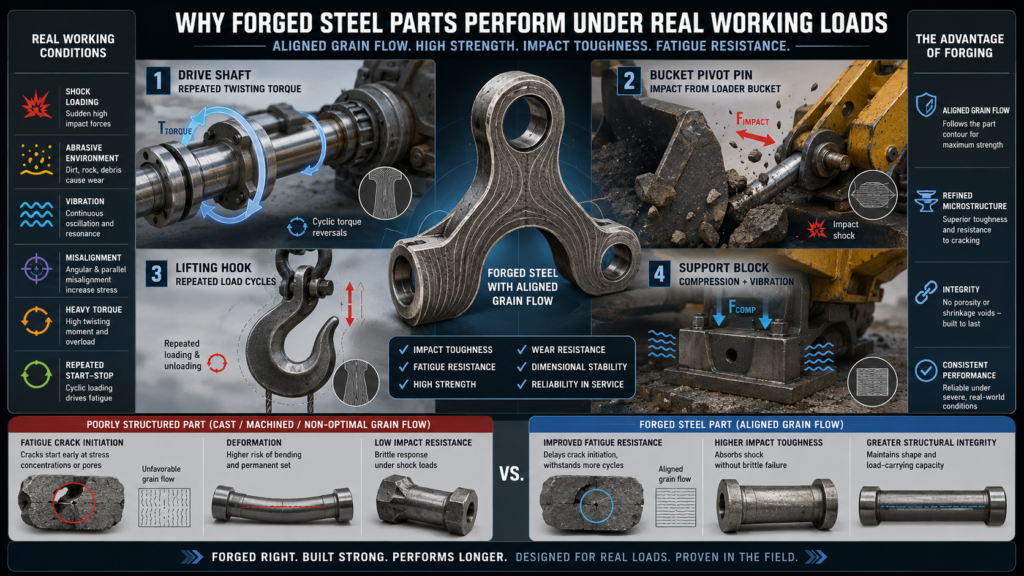
Heavy machinery parts do not work in clean laboratory conditions. They face shock loading, abrasive environments, changing angles, vibration, misalignment, heavy torque, and repeated start-stop cycles.
A shaft may twist thousands of times. A pin may absorb impact every time a bucket hits rock. A lifting hook may experience repeated loading and unloading. A support block may carry both compression and vibration.
This is why forged steel parts are not chosen only for static strength. They are chosen because critical machinery parts often need fatigue resistance, impact toughness, and structural integrity under repeated service conditions.
The Forging Industry Educational and Research Foundation’s Product Design Guide for Forging explains that proper deformation and grain flow, combined with material uniformity, help maximize impact toughness, fracture toughness, and fatigue strength. That makes forging especially relevant when component failure would cause downtime, safety risk, or expensive replacement.
What Makes Forged Steel Parts Different from Cast or Machined Parts?
Forging shapes metal under compressive force. Instead of simply cutting a part from bar stock or pouring molten metal into a mold, forging deforms the material so its internal structure becomes more compact and directionally aligned.
Compared with many cast parts, forged steel parts usually offer better internal soundness and fewer casting-related voids. Compared with purely machined parts, forged steel parts can be designed so the material flow follows the component shape instead of being cut across critical load paths.
ScienceDirect’s overview of the forging process notes that forging can create favorable grain flow patterns that increase fatigue life and fracture toughness in metal alloys. This is the basic reason grain flow forging matters for heavy duty forgings used in demanding machinery.
For buyers, the practical point is simple: the strongest design is not only about material grade. It is also about how the steel was shaped.
Grain Flow in Forged Components: Why Direction Matters
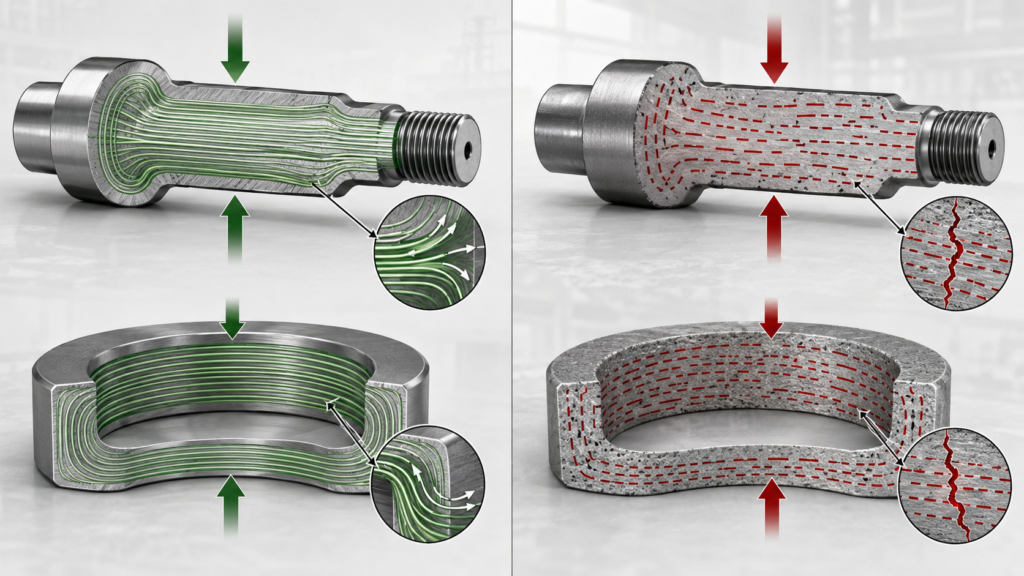
Grain flow is the directional pattern created when metal is plastically deformed during forging. In well-designed forged components, this flow can follow the shape of the part and support the direction of load.
This is important because cracks often grow along weak paths. If grain flow is continuous and aligned with the stress path, the part may resist crack initiation and propagation better than a part with random or interrupted structure.
A 2023 MDPI study on grain-flow orientation after hot forging reported that forged samples with grain-flow orientation in the main deformation direction showed higher fatigue life than other tested configurations. That finding supports what many forging engineers already apply in practice: grain flow in forged components affects real fatigue performance.
For forged steel parts such as shafts, rings, flanges, gear blanks, hooks, pins, and support blocks, grain flow should not be treated as a visual detail. It is part of the structural design.
How Forged Steel Parts Improve Fatigue Resistance
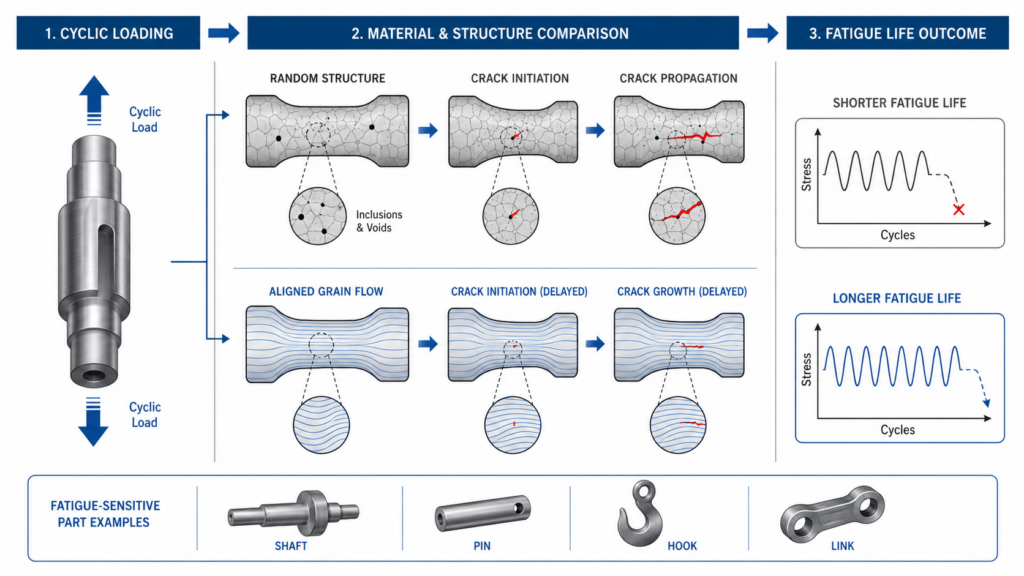
Fatigue failure happens when a part experiences repeated stress below its ultimate strength. It may look strong at first, then develop small cracks after thousands or millions of cycles.
Forged steel parts help reduce fatigue risk in several ways. Proper forging can refine structure, close internal voids, improve material continuity, and align grain flow with the part geometry. These features are valuable for heavy machinery parts that rotate, lift, strike, push, pull, or carry shock loads.
A ScienceDirect study on forging ratio and fatigue behavior found that forged samples at a higher forging ratio showed strong hardness, mechanical properties, and fatigue behavior. For buyers, this reinforces an important point: forging ratio and deformation control should be discussed when ordering heavy duty forgings, not ignored as shop-floor details.
Common fatigue-sensitive forged steel parts include transmission shafts, axle parts, gear blanks, connecting links, crane hooks, crusher components, track-related parts, and load-bearing pins.
Fatigue failure happens when a part experiences repeated stress below its ultimate strength. It may look strong at first, then develop small cracks after thousands or millions of cycles.
Impact Resistance and Deformation Control in Heavy Duty Forgings
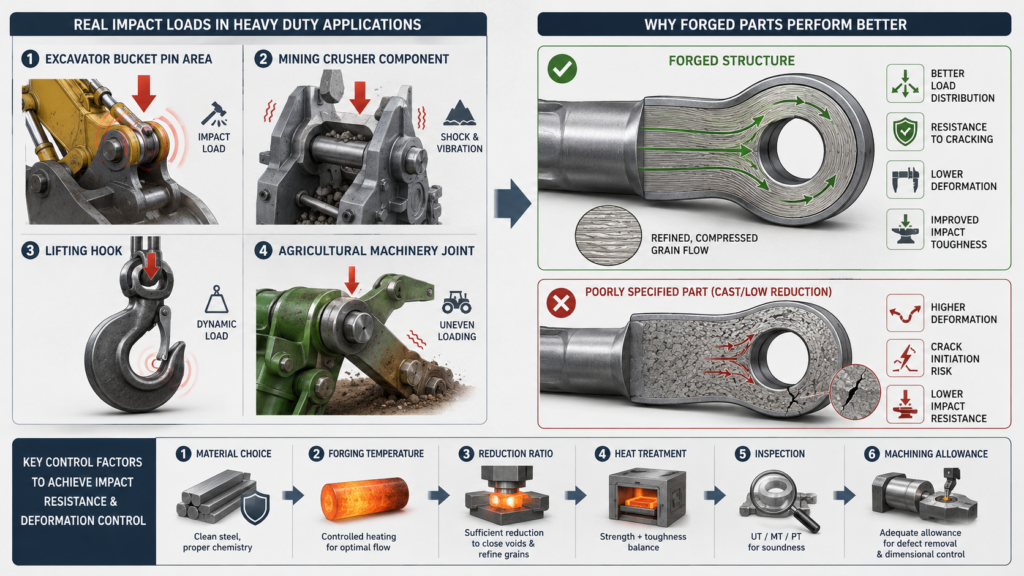
Heavy duty forgings are often used where sudden impact is as important as long-term fatigue. In mining, construction, lifting, and agricultural equipment, machinery parts may face stone impact, bucket loading, soil resistance, shock vibration, and uneven field conditions.
Forging can help because the process compresses and refines the steel structure. However, not every forging is automatically reliable. The result depends on material choice, forging temperature, reduction ratio, heat treatment, inspection, and machining allowance.
Forged steel parts used in severe impact conditions should be specified with the actual working environment in mind. A part for a crusher, excavator, or hoisting system may need different steel grade, heat treatment, and testing requirements than a general industrial bracket.
Where Forged Steel Parts Are Used in Heavy Machinery
Forged steel parts are widely used in heavy equipment because many load-bearing components cannot afford random internal defects or weak directional strength.
Typical applications include:
| Application Area | Common Forged Components | Main Reason for Forging |
|---|---|---|
| Construction machinery | shafts, pins, arms, hubs | impact resistance and load support |
| Mining equipment | crusher shafts, rollers, support parts | fatigue and shock resistance |
| Lifting equipment | hooks, sheaves, load shafts | safety and structural integrity |
| Agricultural machinery | axles, gears, drive parts | wear, torque, and field impact |
| Industrial machinery | rings, flanges, cylinders, couplings | dimensional stability and strength |
For very large shafts, rings, blocks, and cylinders, buyers can also read our guide on open die forgings for large steel parts to understand why open die forging is often used when size, strength, and application-specific requirements matter.
For high-torque shafts, structural bases, flanges, and other load-bearing parts, our article on custom forged components explains how grain flow, forging ratio, machining allowance, and NDT verification affect fatigue resistance.
Common Mistakes When Buying Forged Parts for Heavy Machinery
Many buyers know they need forged steel parts, but still make risky purchasing decisions.
The most common mistakes include:
- choosing only by material grade;
- comparing suppliers only by price;
- ignoring forging ratio;
- not asking about grain flow forging;
- skipping ultrasonic testing;
- accepting unclear heat treatment records;
- forgetting machining allowance;
- not sharing actual load conditions;
- treating all machinery parts as standard parts.
Conclusion
Forged steel parts are valuable because heavy machinery failure is rarely only about one load event. It is usually about fatigue, impact, stress concentration, internal quality, and long-term service conditions.
By using grain flow forging, suitable materials, correct heat treatment, and proper inspection, forged steel parts can help reduce cracking, fatigue, and deformation risk in demanding machinery parts. For buyers, the better question is not simply whether a part is forged. It is whether the forging process, grain flow, testing, and supplier experience match the real working load.
FAQ
What are forged steel parts used for?
Forged steel parts are used in heavy machinery, construction equipment, mining equipment, lifting systems, agricultural machines, and industrial drive systems where strength, fatigue resistance, and impact toughness matter.
Why is grain flow important in forged components?
Grain flow helps align the internal structure with the part shape and load path. Proper grain flow in forged components can improve fatigue resistance, impact resistance, and crack control.
Are forged steel parts stronger than cast parts?
In many high-load applications, yes. Forging often provides better internal soundness, grain flow, and fatigue resistance than casting. Final performance still depends on steel grade, forging process, heat treatment, and inspection.
What causes forged machinery parts to fail?
Common causes include wrong material selection, poor forging design, interrupted grain flow, improper heat treatment, internal defects, overload, stress concentration, and inadequate inspection.
What should buyers check before ordering forged steel parts?
Buyers should check material certificate, forging ratio, grain flow direction, heat treatment, NDT results, mechanical properties, dimensional tolerance, machining allowance, and supplier experience.
Which heavy machinery parts are commonly forged?
Common examples include shafts, rings, gear blanks, pins, hooks, flanges, hubs, cylinders, rollers, support blocks, couplings, and load-bearing structural components.