Shandong Qilu lndustrial Co.,Ltd.

Why Open Die Forgings Matter for Large Steel Parts
Open die forgings are often selected when a component is too large, too customized, or too critical to be treated like a standard steel part. For buyers of large steel forgings, forged steel parts, and heavy forgings, the real question is not only “Can this shape be made?” It is “Will this part carry load reliably after machining, heat treatment, and years of service?”
This guide explains why open die forgings matter for large components, how the process supports strength and reliability, and what buyers should check before ordering shafts, blocks, rings, cylinders, or custom forged components.
Table of Contents
Why Large Components Need More Than Standard Steel
Large load-bearing parts often work under torque, bending, compression, impact, fatigue, and temperature changes. In mining equipment, power generation, shipbuilding, oil and gas, and heavy machinery, one failed component can stop an entire production line.
Open die forgings are valuable because the process plastically works the steel instead of simply cutting a shape from standard stock. The Forging Industry Association describes forging as a bulk forming process where metal is pressed, pounded, or squeezed under great pressure into high-strength parts known as forgings. Forging Industry Association’s Forging 101
For large components, this matters. A forged shaft or ring is not only about size. It is about internal soundness, controlled deformation, and a material structure that can support demanding service.
What Are Open Die Forgings?
Open die forgings are produced by deforming heated metal between flat or shaped dies without completely enclosing the material in a closed cavity. The operator or forging system repeatedly works the piece to reduce, elongate, upset, punch, or shape it toward the required form.
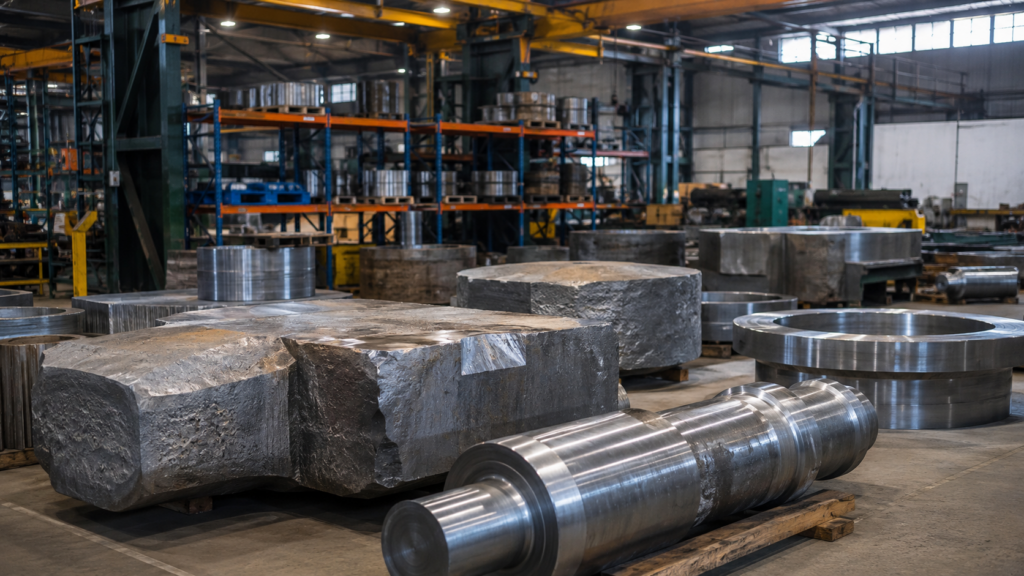
This process is commonly used for large steel forgings because it offers flexibility. Instead of building expensive closed dies for every shape, the manufacturer can produce rough forged forms such as blocks, bars, shafts, discs, rings, hollows, and step shafts.
Open die forgings are especially practical when the part is large, low-volume, custom-designed, or intended for machining after forging.
How Open Die Forging Improves Strength and Grain Flow
The main value of open die forging is not only visible shape. It is what happens inside the steel. During forging, deformation can refine the grain structure, close internal voids, and help align grain flow with the component’s working direction.
The main value of open die forging is not only visible shape. It is what happens inside the steel. During forging, deformation can refine the grain structure, close internal voids, and help align grain flow with the component’s working direction.
The FIA’s Product Design Guide for Forging explains that directional strength forging refines grain structure and develops grain flow, which can improve properties such as tensile strength, ductility, impact toughness, fracture toughness, and fatigue strength.
ASM International also notes that control of grain flow is one of the major advantages of shaping metal parts by rolling, forging, or extrusion. ASM International grain flow reference
That is why open die forgings are often preferred for heavy-duty steel parts where fatigue, load path, and long-term reliability matter more than near-net-shape appearance.
Open Die Forging vs Casting for Large Steel Parts
Casting is useful for complex shapes, but buyers should understand the trade-off. Castings can be efficient when geometry is complicated and machining allowance needs to be reduced. However, large load-bearing castings may require strict control of shrinkage, porosity, inclusions, and heat treatment.
Open die forgings are often chosen when strength and internal integrity are the priority. Properly forged steel parts can offer more consistent internal structure for shafts, blocks, rings, and pressure-related components.
| Factor | Open Die Forging | Casting |
|---|---|---|
| Best fit | Large load-bearing parts | Complex shapes |
| Internal density | Strong when well controlled | Depends heavily on casting quality |
| Grain flow | Can be controlled by deformation | No forged grain flow |
| Machining need | Usually higher | Often lower |
| Common use | Shafts, rings, blocks, cylinders | Housings, complex bodies |
The better choice depends on application. For large components under heavy load, open die forgings usually offer stronger reliability logic.
Open Die Forgings for Shafts, Blocks, Rings, and Cylinders
Open die forgings can support many product forms used in heavy equipment.
Forged blocks are used for mold bases, die blocks, pressure equipment, machine frames, and components that require heavy machining. The value is stable structure and enough machining allowance.
Forged shafts are used in transmission systems, marine equipment, power generation, mining machinery, and rolling equipment. They must resist torque, bending, fatigue, and surface stress.
Forged rings are common in flanges, bearings, pressure vessels, wind power, and rotating equipment. They are selected when circular strength and dimensional stability matter.
Forged cylinders and hollows are used in pressure equipment, hydraulic systems, energy equipment, and petrochemical applications.
For buyers who need non-standard forged blocks, shafts, rings, cylinders, or other custom forged components, open die forgings provide flexibility in steel grade, size, heat treatment, rough machining, and inspection requirements.
Where Open Die Forged Steel Parts Are Used
Open die forged steel parts are widely used where large size and service reliability meet. In mining equipment, large shafts, rolls, liners, and structural parts may face impact and abrasive environments. In power generation, forged shafts and rings must support rotating loads and long service cycles.
In shipbuilding, forged parts may need toughness, strength, and traceability. In oil and gas, heavy forgings can be used in pressure-related or drilling-related components.
These are not commodity parts. They are often made according to drawings, process requirements, material standards, and inspection plans.
Open die forgings help buyers match material grade and forging route to the real working condition rather than forcing the project to fit a standard stock shape.
What Buyers Should Check Before Ordering Large Steel Forgings
Before ordering large steel forgings, buyers should confirm more than size and price.
Key checks include:
1.Steel grade and applicable standard
2.Forging ratio
3.Heat treatment condition
4.Chemical composition
5.Mechanical properties
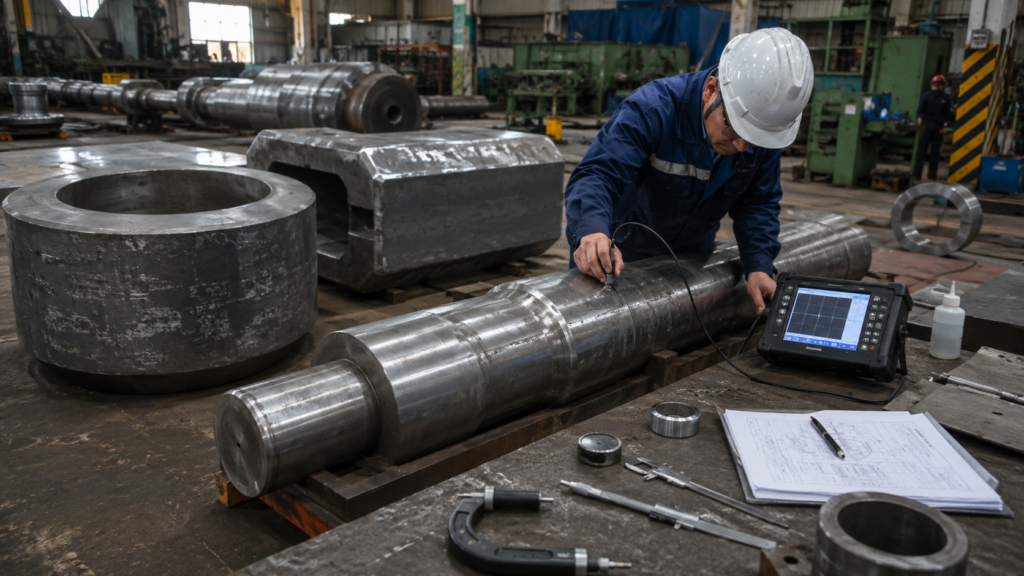
6.Ultrasonic testing requirements
7.Grain size, if required
8.Machining allowance
9.Dimensional tolerance
10.Surface condition
11.Material traceability
12.Delivery and export packaging
ASTM A788/A788M covers general requirements for steel forgings and requires the product specification and general requirement specification to be included in certification when applicable.
Supplier Capability: Forging, Heat Treatment, Testing, and Machining
A supplier of heavy forgings should not only have material access. It should have the process capability to control the part from forging plan to delivery.
Buyers should review:
- Forging press or hammer capacity
- Heating furnace capability
- Heat treatment capacity
- Rough machining support
- UT, hardness, and dimensional inspectionUT
- Documentation and traceability
- Packaging for large components
- Experience with export projects
Open die forgings require process judgment. A good supplier should understand how deformation, heat treatment, inspection, and machining allowance affect the final part.
Future Trend: Larger, More Customized, More Traceable Forgings
The market for large forged components is moving toward higher traceability and more application-specific production. Buyers no longer only ask whether a part can be forged. They ask for material records, heat treatment charts, UT reports, machining allowance plans, and export-ready documentation.
Open die forgings fit this direction because the process is flexible enough for custom steel components while still supporting quality control. For manufacturers of large equipment, the future value is not only forging capacity. It is engineering communication, repeatable process control, and reliable delivery.
Conclusion
Open die forgings are used when large components need more than basic shape and size. For shafts, blocks, rings, cylinders, and heavy-duty forged steel parts, the process can support strength, internal reliability, flexible sizing, and application-specific manufacturing.
FAQ
What are open die forgings used for?
Open die forgings are used for large load-bearing components such as forged blocks, shafts, rings, cylinders, discs, hollows, and heavy-duty industrial parts.
Why is open die forging suitable for large components?
It allows large steel pieces to be plastically deformed and shaped while supporting better internal structure, strength, and custom sizing.
Are forged steel parts stronger than cast parts?
Forged steel parts often provide better internal density and directional strength for load-bearing applications, but final performance depends on material grade, process control, heat treatment, and inspection.
What materials are used for open die forging?
Common materials include carbon steel, alloy steel, stainless steel, tool steel, and other grades selected according to load, temperature, wear, and application requirements.
What should buyers check before ordering heavy forgings?
Buyers should check material grade, forging ratio, heat treatment, mechanical properties, UT inspection, dimensions, machining allowance, and supplier production capacity.
Can open die forged steel parts be customized?
Yes. Open die forging is suitable for custom blocks, shafts, rings, cylinders, hollows, and special components made according to drawings or application requirements.