Shandong Qilu lndustrial Co.,Ltd.

Why Custom Forged Shafts Define Gearbox Longevity
In the high-stakes environment of industrial power transmission, the failure of a single component can lead to catastrophic downtime and six-figure repair bills. Within heavy-duty gearboxes and motor systems, the shaft is often the most vulnerable link. When engineers face recurring issues like shaft snapping at the shoulder or permanent plastic deformation under peak loads, the conversation inevitably shifts from standard bar stock to the superior mechanical integrity of Custom Forged Shafts.
Unlike components machined from generic rolled bar, a forged shaft is engineered to handle the complex interplay of torsional stress and bending moments. This guide explores the technical parameters that make forging a mechanical necessity for high-performance drive systems.
Table of Contents
Torsional Rigidity vs. Plastic Deformation: The Forging Response
In high-torque industrial applications, a shaft must do more than simply rotate; it must resist the urge to twist permanently. When a motor starts under a full load, the shaft experiences a massive spike in torque. If the material’s shear modulus and yield strength are insufficient, the result is plastic deformation—a permanent twist that throws the entire gear mesh out of alignment.
The manufacturing process of Custom Forged Shafts addresses this by refining the grain structure through controlled plastic deformation at recrystallization temperatures. This process increases the dislocation density within the metal’s crystalline lattice, effectively raising the yield point. For an industrial gearbox, this translates to higher torsional rigidity. You aren’t just choosing a material; you are choosing a process that ensures the shaft returns to its original state after every high-torque event.
The Geometry of Failure: Managing Stress in Step Shafts
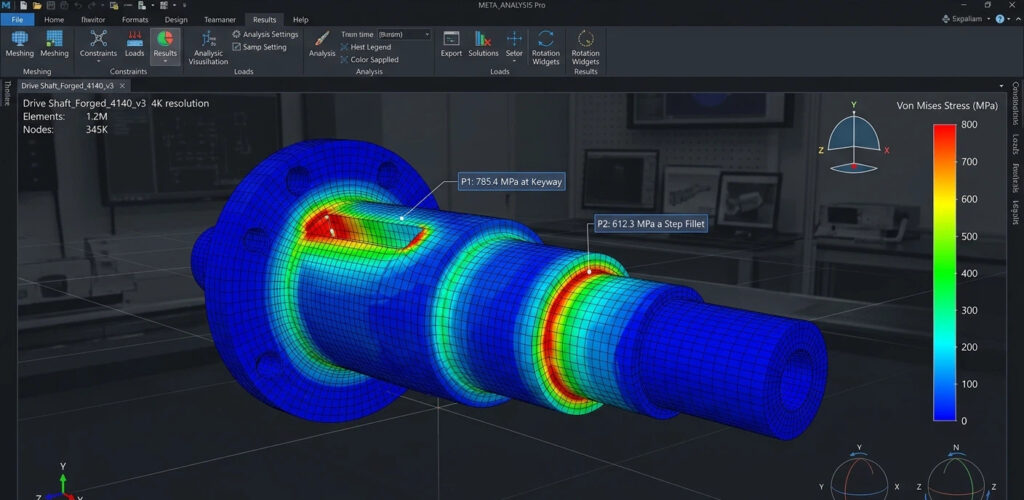
Most industrial shafts are not uniform cylinders; they are Step shafts designed to seat bearings, seals, and gears. Each change in diameter—the “step”—creates a geometric discontinuity known as a stress raiser. In a high-speed motor system, these steps are the primary sites for fatigue crack initiation.
The advantage of using Custom Forged Shafts in a stepped configuration lies in the “near-net-shape” forging process. By forging the steps into the rough shape before final machining, the metal’s internal “flow lines” are forced to follow the contour of the shaft’s geometry. In contrast, machining a step into a standard rolled bar cuts across these flow lines, leaving the grain ends exposed at the most critical stress points.
To maximize the fatigue limit of Step shafts, engineers should specify a generous fillet radius.A common rule of thumb in mechanical design is that increasing the fillet radius from 5% to10% of the shaft diameter can reduce the stress concentration factor (K) by up to 20%.
Enhancing the Fatigue Limit of Drive Shafts
Fatigue is the silent killer of power transmission components. It occurs when microscopic cracks grow under repeated cyclic loading—even when the load is well below the material’s ultimate tensile strength. For high-speed Drive shafts, the fatigue limit is the most critical design parameter.
According to research from the Forging Industry Association (FIA), the forging process yields a grain structure that is oriented in the direction of the primary stresses. When a drive shaft is forged, the longitudinal grain flow remains continuous. This continuity acts as a barrier to crack propagation.
If you are experiencing premature failure in your Drive shafts, the culprit is often “directionalweakness” found in non-forged materials. Because Custom Forged Shafts align their internalmicrostructure with the rotational forces of the gearbox, they offer up to 30% higher fatigueresistance compared to cast or weldment alternatives.
Heavy duty forged shafts for industrial gearbox and motor systems
Selecting the right alloy for Heavy duty forged shafts for industrial gearbox and motor systems is not about finding the “best” steel, but the most suitable one for your specific torque-to-weight requirements.
| Material Grade | Key Characteristics | Best Suitability |
| AISI 4140 (42CrMo4) | Excellent hardenability and toughness. | Standard industrial gearboxes and moderate torque motors. |
| AISI 4340 (34CrNiMo6) | High nickel content for superior deep-hardening and fatigue strength. | Heavy-duty mining equipment and high-impact drive systems. |
| 18CrNiMo7-6 | Exceptional case-hardening properties. | High-speed reduction gears requiring maximum surface wear resistance. |
When ordering Custom Forged Shafts, the choice of material dictates the heat treatment response. For instance, 4340 is a mechanical necessity when the shaft diameter exceeds 200mm, as its alloy content ensures the core reaches the desired hardness, preventing the “soft-center” syndrome that leads to torsional snapping.
Ultrasonic Testing and Microstructure Integrity
A forged label doesn’t guarantee quality unless it is backed by non-destructive testing (NDT). For Custom Forged Shafts used in critical motor systems, internal voids or non-metallic inclusions are unacceptable. These internal flaws act as internal stress raisers that can lead to sudden, brittle failure without warning.
The industry standard for validating the internal soundness of Heavy duty forged shafts for industrial gearbox and motor systems is Ultrasonic Testing (UT) per ASTM A388. A professional forging partner should provide:
- UT Level 1 Certification: Ensuring no internal discontinuities above a specified equivalent flat-bottom hole size.
- Grain Size Verification: Typically aiming for an ASTM grain size of 5 or finer to ensure optimal toughness.
Ensuring the quality of Custom Forged Shafts through these benchmarks is what separates a reliable industrial system from a liability.
conclusion
Investing in Custom Forged Shafts is a commitment to the long-term health of your industrial infrastructure. By aligning the material’s internal grain flow with the operational stresses of your gearboxes, you effectively eliminate the primary causes of shaft fracture and deformation.
Whether you are designing complex Step shafts for a multi-stage reduction unit or sourcing high-strength Drive shafts for a 500KW motor, the forging process provides a level of safety that machining alone cannot match. Stop replacing failed parts and start engineering for reliability.
FAQ
Can I replace a hollow machined shaft with a solid forged shaft?
It depends on your mass-moment of inertia requirements. However, Custom Forged Shafts can often be forged as “hollow” (upset forging) to provide the same torsional rigidity with significantly less weight, optimizing motor efficiency.
Why do my Drive shafts fail at the keyway?
Keyways are notorious stress concentrators. When using Custom Forged Shafts, ensure the keyway radius is optimized and consider induction hardening the keyway area to prevent deformation under high-start torque.
Is 4140 enough for Heavy duty forged shafts for industrial gearbox and motor systems?
For most mid-range gearboxes, yes. But if your application involves frequent “shock loads” or extreme cold, moving to a nickel-chrome-moly alloy like 4340 provides the essential impact energy resistance.